A protective skin designed for working marine surfaces
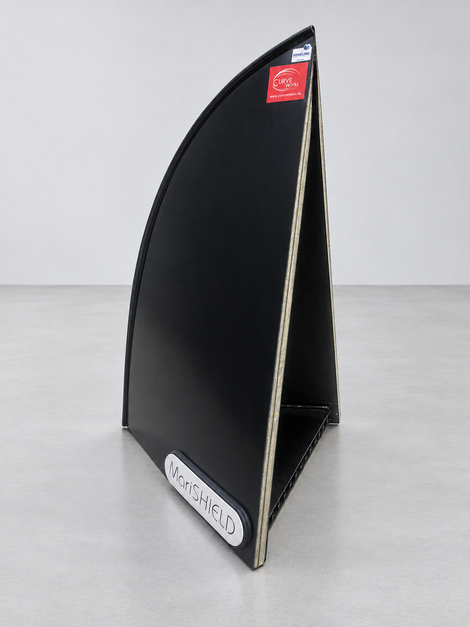
Dutch engineering company Curve Works is exhibiting MariSHIELD in the 2026 METSTRADE product directory, presenting a bonded composite-protection system for structures exposed to abrasion, repeated impacts and beaching contact. The official listing, dated 1 September 2026, describes an outer layer made from high-density polyethylene, high-strength fibre reinforcement and an energy-absorbing foam core. Developed with Kemeling, the system is intended for demanding applications including patrol vessels, landing craft, pontoons and transport barges. Its relevance to recreational craft below twelve metres is worth examining, especially where a builder designs a beachable tender or small workboat-derived hull. That does not mean the manufacturer has certified every small leisure boat for installation or that a protective layer can make an unsuitable hull safe to run ashore. The product's stated construction and intended applications are verifiable; its performance on a specific recreational vessel remains an engineering question.
What the original supplier announcement establishes
The first-party METSTRADE product page describes MariSHIELD as lightweight armour bonded to an existing composite surface, with layers intended to work together as a damage-tolerant structure. The manufacturer identifies an HDPE outer skin, reinforcement and foam. It does not publish the exact thickness or mass of each configuration, independently measured impact energy, installation temperature range or a complete list of compatible resins and substrate materials. No reader should infer those specifications from the generic words lightweight or high strength. A boatbuilder investigating the product needs the current technical data and details of the intended connection to the hull. There may also be differences between using the system on a pontoon and bonding it to a moving vessel. The supplier's listing is useful because it identifies a specific engineering approach, but it does not establish universal suitability.
The difference between a coating and a protective structure
Conventional boat maintenance often involves applying paints, antifouling or surface coatings to protect a hull against particular exposures. MariSHIELD is described instead as a layered structural protection system. That distinction matters because its thickness, attachment and potential to absorb energy can affect the way forces pass into the underlying boat. An outer surface may resist abrasion while the reinforcement and foam contribute a different response to impacts. Yet a layered product can only perform as intended when the bond and supporting structure are appropriate. Adding material over a damaged hull may conceal rather than solve an underlying problem. The builder should inspect the original composite and confirm whether repairs are needed before any protective layer is considered. The system should not be evaluated solely on the apparent toughness of its external skin.
Why beaching damage can occur
A small boat may approach a sandy beach, gravel foreshore or ramp during routine use. Even when conditions appear calm, waves can move the hull against the ground, creating repeated contact and localised loads. Sharp stones and hard objects may cause scratches, gouges or more serious damage. The extent depends on the hull's construction, shape, loading and movement, not just the speed of the approach. A protective layer could potentially reduce damage at selected contact points if it is designed for that duty. However, the presence of MariSHIELD should not encourage a skipper to beach a craft without checking whether the boat and location are suitable. Through-hull fittings, propulsion equipment and structural limitations remain important. The safest beaching strategy includes careful site selection and procedures that limit unnecessary movement against the bottom.
What an HDPE outer layer contributes
High-density polyethylene is often associated with a relatively tough, low-friction surface in industrial applications. Curve Works identifies HDPE as the outer skin of the MariSHIELD system, but the properties of the finished assembly depend on its actual formulation, thickness and construction. A buyer should not assume that the surface can withstand every sharp impact or abrasive material. It may also behave differently when wet, hot or exposed to certain chemicals. The designer should ask about surface wear tests and the conditions under which they were conducted. The presence of polyethylene does not guarantee that the bond to the boat will remain intact indefinitely. A durable surface needs a suitable supporting system, appropriate edge treatment and continuing inspection. The complete assembly matters more than any one named ingredient.
Reinforcement and the foam core
The official description pairs high-strength fibre reinforcement with an energy-absorbing foam layer. In a composite protective system, these components can potentially help distribute and manage local forces. But the exact mechanism and degree of energy absorption depend on material properties and geometry that the public product summary does not specify. A buyer should request representative test results and clarify whether they involve repeated impacts, puncture, compression or another type of loading. A layer designed to absorb a brief impact may respond differently to a prolonged concentrated load. Boats experience both kinds of stress. The structure beneath the protection must be considered because energy transmitted beyond the layer may still damage it. A credible engineering assessment should include the protective system and the existing hull as one complete structure.
Retrofitting an existing composite hull
Curve Works describes MariSHIELD as something that can be bonded to an existing composite structure. This makes the product interesting for possible refits, but installation requires understanding the original laminate, coatings and previous repairs. A builder should assess adhesion, surface preparation, drainage and the effects of adding material to a curved hull. It may be inappropriate to attach it over antifouling or a degraded substrate without suitable preparation. The system's weight and thickness could affect local clearances and, to some degree, vessel performance. All such changes need to be calculated for the actual boat. Owners should request an installation plan rather than buying the material on the assumption that it functions as ordinary protective tape. Retrofitting a hull is an engineering project, even when the finished addition appears relatively simple.
A small tender is not a landing craft
The manufacturer highlights patrol boats and landing craft among the intended applications. Those vessels may be constructed for heavy, repeated contact in ways that a lightweight recreational tender is not. An owner considering MariSHIELD for a beachable leisure craft should be cautious about transferring claims from a commercial application. The designer must verify that the hull shape, underlying structure and propulsion arrangement are suitable. A narrow patch of protection cannot make the entire boat immune to grounding. The propeller, waterjet intake, skeg or rudder may remain vulnerable. If the objective is to make beach visits more practical, the owner should evaluate alternatives such as a purpose-designed beaching hull or a safer method of transferring passengers ashore. Protective material is one possible contributor, not a replacement for boat suitability.
Pontoons and marina infrastructure
The product's stated use on pontoons and working structures creates another possible relevance to small-boat owners. A marina or private berth may experience repeated contact from boats and tenders, and certain surfaces can suffer abrasion or impact damage. A protective system could be considered for appropriate infrastructure if the supplier confirms its compatibility and installation requirements. That does not automatically make it a substitute for properly sized fenders or safe berthing. A pontoon structure has its own load paths, expansion and maintenance concerns. The installer should confirm how the layer is fixed, how damaged sections are repaired and whether water can become trapped behind it. The product's value may be different for a fixed structure than for a moving hull. Owners should make that distinction during procurement.
Weight and vessel performance
The word lightweight is useful as a general design goal but needs numbers to guide a boatbuilding decision. Any additional layer adds mass, and its placement can influence the boat's trim, especially on a small craft with limited carrying capacity. A designer should calculate the installed area, mass per square metre and any other required materials, including adhesives or mechanical edging. The owner should then evaluate whether the added protection offers enough benefit to justify the cost and weight. The same calculation should consider changes in hydrodynamics if the layer is fitted below the waterline. A slightly protruding edge can alter local flow or collect debris. The official product listing does not offer universal resistance or speed estimates. A professional design should assess these issues before installation, not after performance changes become obvious.
Repairing damage to a sacrificial layer
A system intended to withstand abrasion and impact may eventually show wear or damage itself. It is important to know whether a damaged section can be repaired locally or whether a larger part of the installation must be replaced. Curve Works' short listing does not provide a complete repair procedure, so the owner should request it from the supplier. Inspections should look for cracks, separation at the edges or signs that the bond has weakened. Damage beneath an outer protective skin may not always be visible without additional checks. A sensible maintenance programme accounts for the intended operating loads and the history of any hard contact. The objective is to preserve the underlying hull, but that depends on identifying when the protective system is no longer performing as intended.
Weather, temperature and ageing
Marine composite structures face wet conditions, UV exposure and changes in temperature. Different materials within a layered assembly can expand, contract or age differently. The supplier should provide information about acceptable operating temperatures, chemical resistance and how the outer layer behaves during prolonged sunlight exposure. If a boat is stored on a trailer or in a hot climate, the installation may encounter conditions unlike those on a working pontoon in northern Europe. The bond system must remain compatible with those exposures. Owners should also ask whether inspections are required after winter storage or an extended period ashore. A protective product can be durable without being maintenance-free. Understanding its limitations helps avoid treating a catalogue description as a promise of perpetual performance.
Testing claims against actual use
An owner or boatyard evaluating MariSHIELD should define the problem before selecting the product. Is the main concern repeated rubbing at a pontoon, damage from a gravel foreshore or an occasional contact at a launch ramp? These are different load cases. The supplier should provide evidence relevant to the chosen application, ideally using comparable substrates and conditions. A test showing improved abrasion resistance does not necessarily establish improved puncture resistance, and vice versa. If a prototype installation is possible, the boatbuilder can monitor it over time while retaining appropriate inspection of the underlying hull. The test plan should record the area protected, operating conditions and any visible wear. This provides more useful evidence than a broad claim that the surface is exceptionally tough.
Costs, warranty and responsibility
A specialised material may require trained installers, particular surface preparation and detailed quality control. The total project cost should include all those requirements, as well as any change to the existing boat's warranty or survey documents. Owners should clarify who is responsible for assessing the underlying hull and what happens if the protective layer fails to adhere. A manufacturer may supply the material while a separate yard undertakes installation; the division of responsibility should be explicit. Insurance and compliance requirements may apply where the work affects the hull structure. For a small recreational boat, the economics can differ markedly from those of a commercial landing craft. An investment should be justified by a recurring problem or a clearly defined operational need, not simply by the attraction of new composite technology.
A useful product with application-specific limits
MariSHIELD illustrates how marine suppliers are combining different materials to address abrasion and impact rather than relying on a single coating. The September 2026 catalogue entry confirms a layered system developed by Curve Works with Kemeling and identifies working vessels and infrastructure among its intended applications. It does not establish that every leisure boat under twelve metres is suitable for treatment. For readers interested in beachable craft, durable tenders or marina improvements, the value lies in investigating whether a protective structure can be engineered for a particular problem. Technical data, compatibility, weight and repair methods are essential to that decision. Properly selected protection may help reduce damage, but it does not change the skipper's duty to avoid hazardous grounding and mooring conditions.
Original industry sources and image credits
Reporting based on Curve Works first-party MariSHIELD structural laminate product entry developed with Kemeling, released 1 September 2026 in METSTRADE directory.
Lead image: Curve Works MariSHIELD Adds Layered Impact Protection to Composite Boat Structures — original producer product photograph. © Curve Works. Original supplier image.