
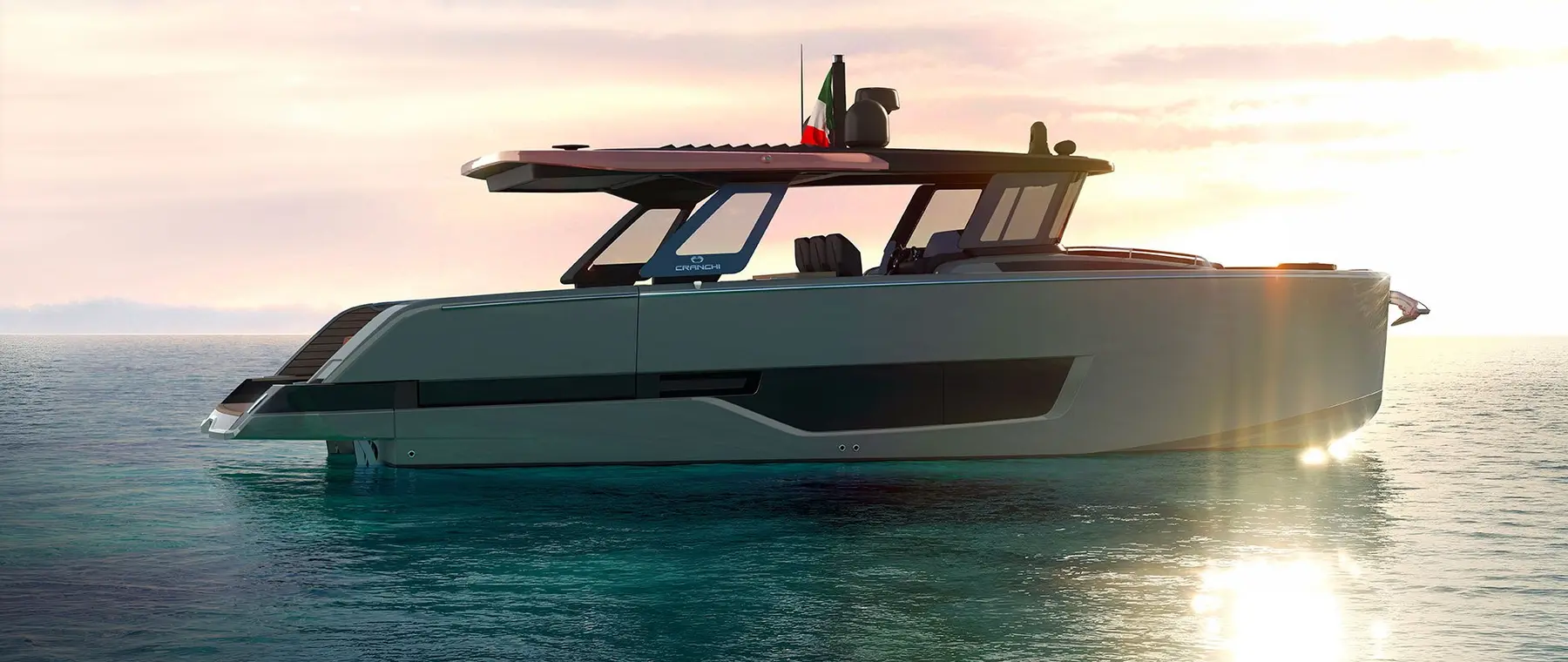
The Cranchi A47 develops an increasingly popular idea in leisure boating: a boat that feels almost completely open while anchored, yet provides enough protection and sleeping accommodation to remain enjoyable when the outing runs into the next day. The Italian builder describes it as an evolution of the A46 concept rather than a wholesale departure.
At around 14.25 metres overall, the A47 sits in the substantial walkaround category where the relationship between deck area and internal cabins becomes a central design decision. Its open layout invites swimming and conversation, while the separate lower-deck sleeping spaces provide a more practical escape when guests need privacy.
Cranchi's current details identify the yacht as a new project with preliminary figures, so it is important to distinguish the design intention from a final production specification. The model is particularly relevant for Mediterranean owners who want to anchor in sheltered bays and then continue comfortably to another harbour.
A layout designed for real days afloat
At the stern, folding bulwarks transform the cockpit into a wider platform close to the water. Cranchi says the resulting space extends beyond five metres across when the terraces are open, with a height-adjustable swim platform creating further possibilities for swimming and stepping on or off a tender.
A garage beneath the aft sunpad is designed to accommodate a tender up to two metres long. That provision is practical for reaching a beach or quay without repeatedly bringing the main boat alongside, although tender weight, launching arrangements and available storage for fuel or safety equipment need to be checked.
Clear side decks continue forward past the central console and galley toward a recessed bow sunpad. The uninterrupted circulation makes a difference when several people are aboard, provided the crew still keeps walkways free of loose gear and uses the appropriate handholds whenever the boat is moving.
Engineering and handling choices
The reverse-raked windscreen is one of the A47's most distinctive changes, intended to shelter the driver without removing the sense of an open boat. A broad T-top with adjustable louvres allows occupants to manage light and shade, and the structure incorporates lighting and audio equipment.
Cranchi lists twin Volvo Penta D6 IPS 650 diesel units, each rated at 480 horsepower, in the preliminary propulsion data. The IPS arrangement places a different emphasis on handling and machinery integration than the outboard-powered A48, showing that the brand is offering genuinely different approaches within a similar length class.
The manufacturer describes a hull beam around 4.29 metres, fuel capacity of approximately 1,500 litres and a fresh-water tank around 300 litres. Although useful as planning figures, they should not be read as evidence of any particular range or fuel consumption until performance data for the final build is available.
Comfort beyond the day trip
The interior arrangement provides a separate owner's cabin and a second cabin with twin berths, served by a shared bathroom. This is the feature that most clearly changes the boat from a purely sociable day platform into a credible option for a family or two couples staying aboard overnight.
The layout will make more sense to a buyer after walking it from end to end. A generous cockpit is valuable, but a family cruiser also needs sufficient headroom, access around beds, spaces for damp towels and practical separation between the sleeping cabins and the living area.
Shade is another decisive part of comfort in strong sun, particularly when children or older guests are aboard. Adjustable louvres above the cockpit give the crew more choice, although the extent of coverage and the ease of operating the roof should be demonstrated in person.
What prospective owners should check
Cranchi lists a provisional 14-person capacity and CE Category B, with a reminder that preliminary specifications can change. A buyer should seek the final declaration, the exact hull configuration and all supplied documentation rather than treat an early web specification as a contractual performance promise.
The A47's central appeal is that it can offer the excitement of open-air travel without requiring everybody to sleep in a shared, convertible saloon. The trade-off is complexity: opening sides, a moving swim platform and an adjustable roof introduce systems that need thoughtful maintenance over time.
For anyone comparing this yacht with the A46 or the newer A48 O/B, the conversation should begin with preferred propulsion, number of cabins and typical use rather than appearance alone. Cranchi has created a distinctive open-deck proposition whose value will depend on how the owner actually spends time at sea.