
Coniston concludes its fifty-fourth record week
The 54th Coniston Power Boat Records Week concluded on 6 November 2026 with eleven national record entries appearing on the event's final provisional sheet. The fastest of those was Peter Little's 100.18mph run in the 2000 Monohull class, a milestone for a competitor with a long history of circuit racing. Records Week is different from an ordinary race: entrants attempt measured speed runs against a defined national or international class record, rather than aiming to overtake another boat in a fleet. Every new mark remains subject to ratification.
The Lake District setting is familiar to leisure boat owners, but the event operates under tightly controlled arrangements and professional supervision. High-speed boats used in record attempts bear little resemblance to the requirements of ordinary recreational cruising. The result is newsworthy because it demonstrates engineering and driver skill in relatively compact powered craft, not because it suggests that high speeds are acceptable on public lakes outside permitted events. Coniston's normal navigation and safety rules remain a separate matter.
Peter Little reaches 100.18mph
Little's successful effort was recorded in the National Clubman Circuit 2000 Monohull category. He entered an Allison hull powered by a 200hp Mercury XR2 outboard, a combination developed for a specialised competition duty rather than the load and comfort requirements of a family boat. On Wednesday 4 November, organisers reported a 97.36mph speed; by Friday he had raised his figure to 100.18mph. That improvement of 2.82mph made him the highest-speed entry on the final provisional list.
The class covers engines in the 1501–2050cc range. A compact hull and a high-output outboard can be extremely responsive, requiring exceptional attention to trim, balance, control setup and safety arrangements. Little told Powerboat News that he had not previously exceeded 100mph on Coniston Water. Although it is a notable achievement, the official ratification process still matters: a provisional record should never be described as fully confirmed before the governing body completes its review.
The result follows several attempted runs
The successful Friday speed came after repeated attempts throughout the scheduled week, showing that a record is not necessarily achieved in one straightforward passage. Conditions on a lake change from hour to hour. Wind, surface disturbance, visibility and mechanical configuration can affect whether a boat can safely and consistently produce its intended performance. Teams must also comply with the event's timing procedures and technical rules, so the final mark depends on more than a momentary speed shown on a dashboard.
For recreational owners, the useful lesson is about preparation and operating within a defined safety envelope. A record team inspects and adjusts a boat specifically for high-speed running. The setup that produces the best result in controlled conditions may be unsuitable for passengers, rough weather or ordinary marina approaches. High-speed figures should be read as achievements within their class and circumstances, not as general performance claims for outboard-powered family craft.
Ben and Sophie Holehouse lead another class
Ben and Sophie Holehouse appear on the provisional sheet with an 81.20mph figure in Pleasure Navigation Endurance Group A Sport, exceeding the earlier 74.44mph mark by 6.76mph. Their result also improved on an 79.90mph figure announced earlier in the week. The class represents a different style of vessel and competition from Little's single-hull 2000 Monohull entry, so the absolute speeds should not be used to rank drivers without considering the rules for each category.
The event records also distinguish established marks from improvements to existing records. In some categories, an entry may set the initial officially recognised benchmark rather than beat a previous number. That makes a record sheet more complicated than a simple table of first, second and third places. Readers should check the exact category before comparing figures, particularly when one class imposes different engine, hull or crew limitations.
Jet-ski and circuit classes also improve
Jason Carr appears with a 79.51mph entry in Offshore Circuit Jet Ski Racing J1, ahead of the previous 76.31mph figure. Jeremy Gibson recorded 78.42mph in OCRDA F1, improving substantially on 70.60mph. Bob McCarthy and Sophie Lewis are listed at 64.23mph in OCRDA F2 against 62.12mph, while Tristan Tomlinson reached 64.20mph in National Clubman Circuit 1500 Monohull compared with 63.45mph previously. All of those marks are provisional pending ratification.
The variety illustrates why Coniston attracts more than one kind of powered craft. A personal watercraft differs from a racing monohull, and neither should be compared directly with a leisure RIB or everyday speedboat. Each category is defined so performance can be judged against an appropriate benchmark. Some classes use a driver and navigator, others a different crew arrangement. Reliable reporting must preserve the names, class definitions and conditional status of each result.
Pro-Cat records advance in several steps
The new Pro-Cat Modified class accounts for four of the eleven national record entries on the final provisional sheet. Speeds progressed through 55.87mph, 56.82mph, 57.01mph and 57.56mph as different pairings among Malachy Browne, Alex Partridge, Sophie Lewis and Harrie Shortman established or improved the mark. The sheet's sequence matters: several entries in the same category do not necessarily represent four independently enduring records after the final attempt.
A developing class can attract repeated improvements during one event as crews refine their boats. A technically accurate summary should identify the latest mark while acknowledging the steps that led to it. The pattern demonstrates how competitive engineering progresses through measurement, comparison and incremental improvement. It is not evidence that a person can reproduce those speeds in an ordinary production catamaran, because the class has its own designs, equipment and safety rules.
Diesel outboard enters the record sheet
Aaron Hilton and Lisa Johnston recorded 44.81mph in the Experimental Pro-Cat Diesel category, improving on the 44.32mph figure reported earlier in the week. Their boat used an Amaroq 40 diesel outboard with Team Endeavour Racing UK. The inclusion of a diesel-powered entry is a reminder that alternative propulsion configurations can appear in specialist racing as well as commercial and leisure applications, although a race result does not establish the overall ownership economics of the engine.
Diesel and petrol outboards differ in mass, torque delivery, fuel requirements and maintenance. The best propulsion choice for a small recreational boat depends on hull compatibility, annual use, service availability and operating conditions. A carefully prepared record attempt is useful evidence that a particular installation can attain a measured speed, but not a standard fuel-consumption test or an assurance of long-term durability in unrelated applications.
Coniston is a distinctive Lake District fixture
The event is based at Coniston Water and organised within a specialised racing framework. Its organisers describe it as a gathering open to multiple types of powerboat, from tiny hydroplanes and inshore circuit machines to larger offshore craft. The 2026 programme ran from Monday 2 November through Friday 6 November, with competitors and officials assembling for carefully controlled record attempts. The final sheet includes eleven entries, although that count is not the number of participants or the number of runs completed.
Local residents and visiting boaters should distinguish the event's permission to use a controlled speed course from ordinary use of the lake. Speed restrictions, navigation rules and access arrangements outside the event remain applicable. The appeal of the record week lies partly in seeing highly specialised machines under supervision, not in encouraging casual high-speed operation around other recreational users. Spectators must follow local directions and keep clear of controlled areas.
The ratification process is still outstanding
The final published sheet records announced new speeds but does not yet amount to an independently certified final record book. Each category's governing body may need to review timing, eligibility and the technical requirements before approving the mark. Reports published immediately after the event have therefore described the figures as provisional. This is especially important for the most prominent number, Little's 100.18mph, because a headline could otherwise imply a completed formal decision.
Readers who track historic records should rely on the relevant record authority for eventual confirmation and amendments. Early organisers' lists are valuable evidence of what was announced during the week, but additional review can change the official position. Accurate reporting need not diminish the competitors' achievements; stating that ratification is pending is part of presenting the result in the form it currently holds.
Why compact powerboat owners should follow the results
Coniston's 2026 record week is a compelling account of specialised small powered boats, with provisional advances across monohulls, jet skis, Pro-Cats and a diesel-outboard entry. Little's 100.18mph run is the leading figure, while the participation of two-person crews in other classes highlights the diversity of record attempts. The story is relevant to enthusiasts of outboard propulsion, lightweight hulls and marine engineering within Leisure Boat Guide's under-12-metre audience.
Owners should resist using racing records as a guide to everyday cruising speeds. A safe small-boat journey is determined by seamanship, weather, operating limits, passenger comfort and applicable local rules. The practical value of the event lies in its disciplined measurement and engineering, not in the pursuit of speed without oversight. Further reporting should follow the official ratification process rather than declare these provisional marks permanently established.
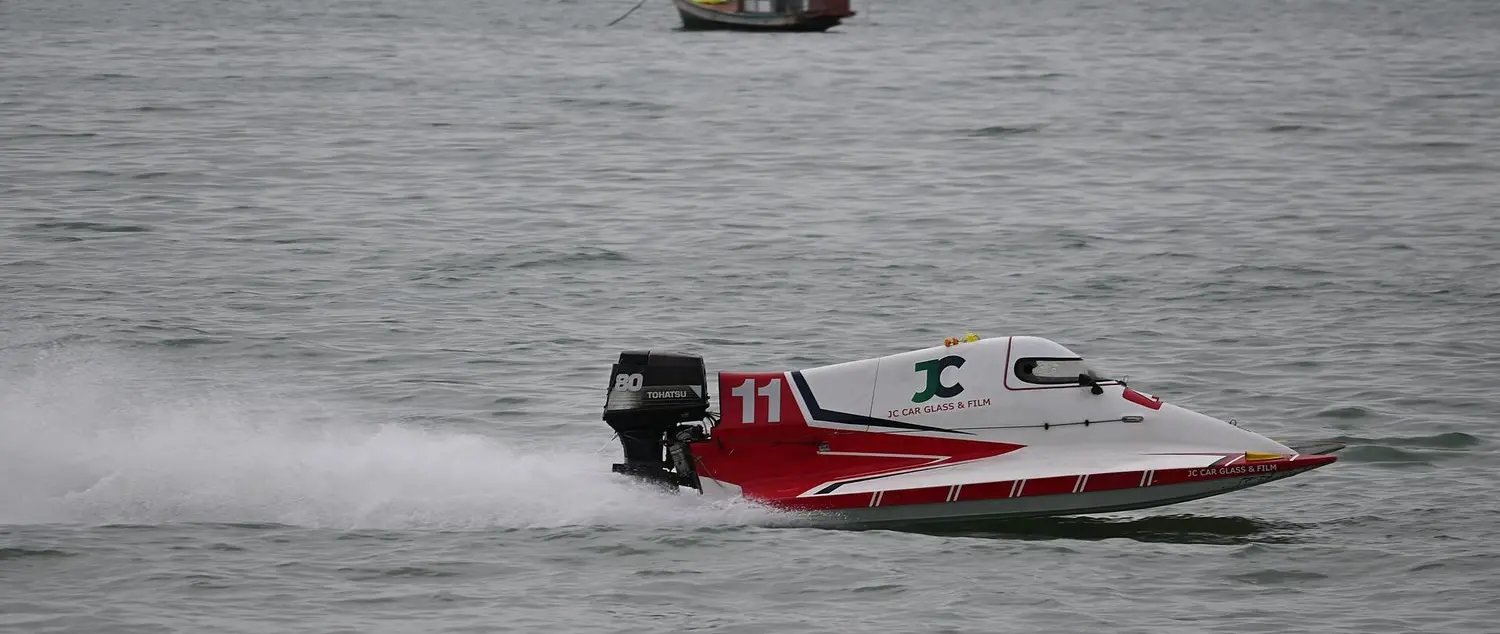
Sources: Powerboat News' published event result sheet, 7 November 2026 and Coniston Power Boat Records Week organisers. Photograph: a powerboat running at speed, by PattayaPatrol, Wikimedia Commons, CC BY-SA 4.0; illustrative image, not a photograph of Peter Little or Coniston 2026.
