
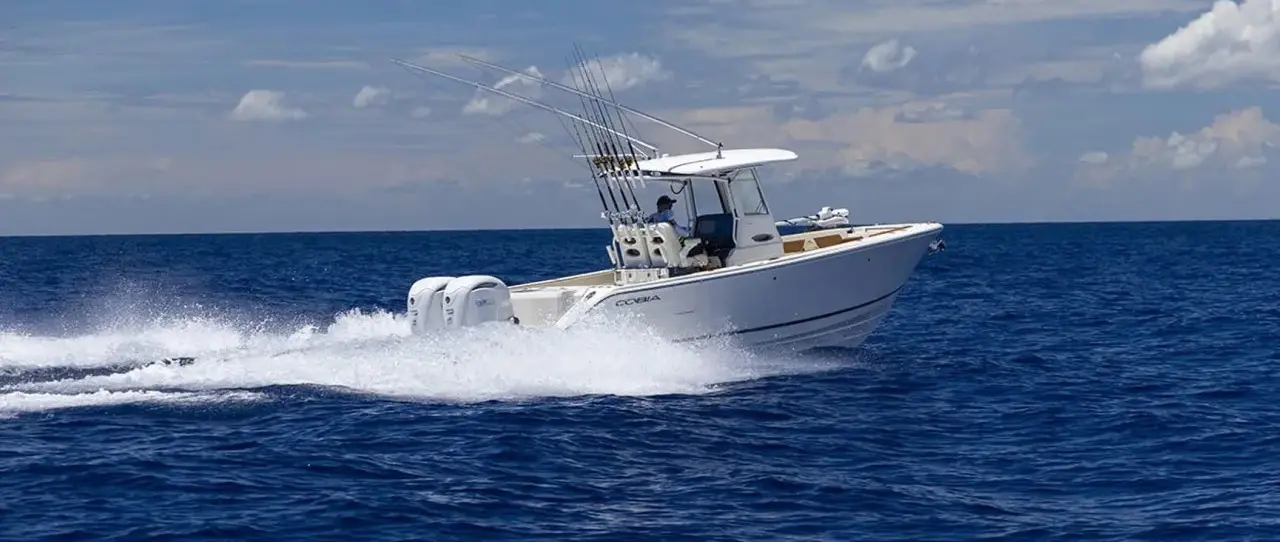
Why Cobia's 285 CC is a noteworthy step in the range
Cobia positions the 285 CC as a centre-console boat able to combine dedicated angling facilities with the space and finish expected from a family dayboat. The builder calls the model all-new and publishes an overall length of 28 feet 5 inches, or about 8.66 metres. It sits in a category where buyers increasingly ask a single boat to manage inshore social trips, longer coastal passages and offshore fishing without a permanent change of layout.
The manufacturer's published beam of 9 feet 11 inches is an important part of that equation. A wide working deck can give crew room to move around the console and aft cockpit, but it also affects berth choice, handling alongside and any plans to transport the boat over land. Owners should check the actual beam against the restrictions at their home marina before treating a model's versatility as a given.
An open centre-console plan places the navigation position near the middle of the boat, preserving walk-around access to the bow and the stern. On the 285 CC this matters because the owner can supervise an active fishing cockpit while guests use more relaxed forward seating. The arrangement also means that protection from spray and weather will depend on the console, windscreen, chosen canvas and operating conditions.
Propulsion and capacity without inflated promises
The builder specifies a maximum combined engine rating of 700 horsepower and a fuel capacity of 231 US gallons. Those figures indicate the power and range-planning envelope but should not be confused with verified cruising speed or economical endurance for every installation. The eventual choice of engines, propellers, electronics, passengers and gear changes the vessel's displacement and the way it behaves at sea.
A sensible buying comparison will examine the engine package actually offered and request a performance sheet showing test load, sea conditions and fuel consumption. The information is especially valuable for a centre-console owner who expects to reach distant fishing grounds early and return with adequate reserve. An optimistic calculation based on a light demonstration boat is a poor basis for scheduling an offshore journey.
Cobia describes a helm that can accommodate dual 16-inch Garmin displays, giving owners the possibility of a broad navigation and sonar workspace. That capacity does not prove the precise electronics supplied with every build. Dealers should document whether the chosen specification includes radar, sonar transducers, digital engine instruments and communications equipment, and whether their positions allow clear sight lines while seated and standing.
Fishing details worth checking in person
Angling equipment is a central part of the 285 CC's design. Cobia cites a 43.5-gallon livewell, two insulated cockpit fish boxes and dedicated tackle stations with storage. This is a useful division of functions: live bait can remain in a managed water system while the separate boxes store chilled catch and equipment. Owners should inspect lids, drains, seals and service access rather than judge a system solely by its quoted volume.
The cockpit is intended to serve active fishing, so deck drainage, nonslip surfaces and safe movement around rod holders are especially important. On a viewing, prospective owners should take the number of anglers who normally crew the boat and walk through an imaginary landing sequence. That practical exercise reveals whether tackle can be reached quickly, whether working space is obstructed by seating and whether coolers need to be moved.
Fishing suitability also depends on the waters and style of fishing. A boat configured for light inshore casting might prioritise unobstructed deck access and comfortable seating, while an offshore trolling owner may want outriggers, multiple rod positions and more robust communications. The 285 CC offers a platform for those decisions; a purchase order needs to identify which options are standard, optional or dealer-fitted.
Passenger comfort and circulation
Space at the bow has a very different role when the day is spent cruising with guests rather than pursuing fish. The centre-console concept lets the forward area function as a social zone without shutting off the passage to the stern. It also allows crew to reach the anchor locker and docking lines without passing through an enclosed cabin. The quality of this circulation becomes obvious when several people board at once.
Cobia's presentation of the model emphasises accommodation for both fishing and family use, an ambition that deserves a practical test during a sea trial. Guests should have secure handholds when the boat accelerates and places to sit that do not interfere with the skipper's view. Owners carrying children or inexperienced passengers should examine the height of rails, the gate arrangement and available shade in their chosen configuration.
For an all-day boat, comfort is partly a matter of where bags, food, safety equipment and wet towels can go. Buyers should ask to see each storage space open, examine ventilation and check whether frequently used gear blocks access to plumbing or batteries. A well-arranged console can make short trips seem effortless, whereas awkward access creates frustration even on a vessel with generous measurements.
Maintenance and operating economics
The 285 CC's larger fuel capacity, fishing pumps and electronics make it capable of ambitious days afloat, but they also broaden the list of items that must be inspected regularly. A livewell is only as dependable as its pump, plumbing and electrical circuit, while an electronic helm requires clean connections and software maintenance. The most persuasive owner features are the ones that remain easy to maintain after several seasons.
Engine access is particularly important on an outboard-powered boat. A buyer should be able to reach batteries, filters, steering components and bilge equipment without dismantling useful seating or cabinetry. Service intervals and winterisation requirements need to be confirmed against the final engine package and the climate in which the boat will be kept. Insurance and mooring expenses deserve the same early attention as the initial price.
There is also a balance between equipment and payload. Extra fishing kit, passengers, freshwater and full fuel tanks all affect trim and performance; an advertised maximum engine rating does not remove that constraint. Owners should request a complete as-built weight estimate with selected options, then establish a realistic load for the longest trips contemplated. Such preparation is essential for responsible offshore operation.
What prospective owners should take from the design
The Cobia 285 CC appears most attractive to buyers seeking a genuine mixed-use centre console rather than a dayboat that merely resembles a fishing vessel. Its official specification combines an almost ten-foot beam, dedicated fish boxes, a large livewell and a helm arrangement designed for substantial displays. Each attribute points to practical use rather than decoration, although execution can only be judged aboard an actual boat.
The main comparison should be with other boats of similar dimensions and intended waters, not with an abstract promise of being perfect for every activity. A family focused on coastal sightseeing may value protected seating and a head arrangement over the last increment of fishing storage. A fishing-oriented owner may make the opposite choice. An honest test of two different day plans will usually settle which compromises matter.
This analysis uses Cobia's published 285 CC specifications and description, with numbers attributable to the builder rather than to an independent sea trial. Buyers should verify the chosen model year, installed equipment and certification with an authorised dealer. The strongest conclusion is that this centre-console design offers a serious base for both angling and leisure, provided its final specification follows the owner's real itinerary.