
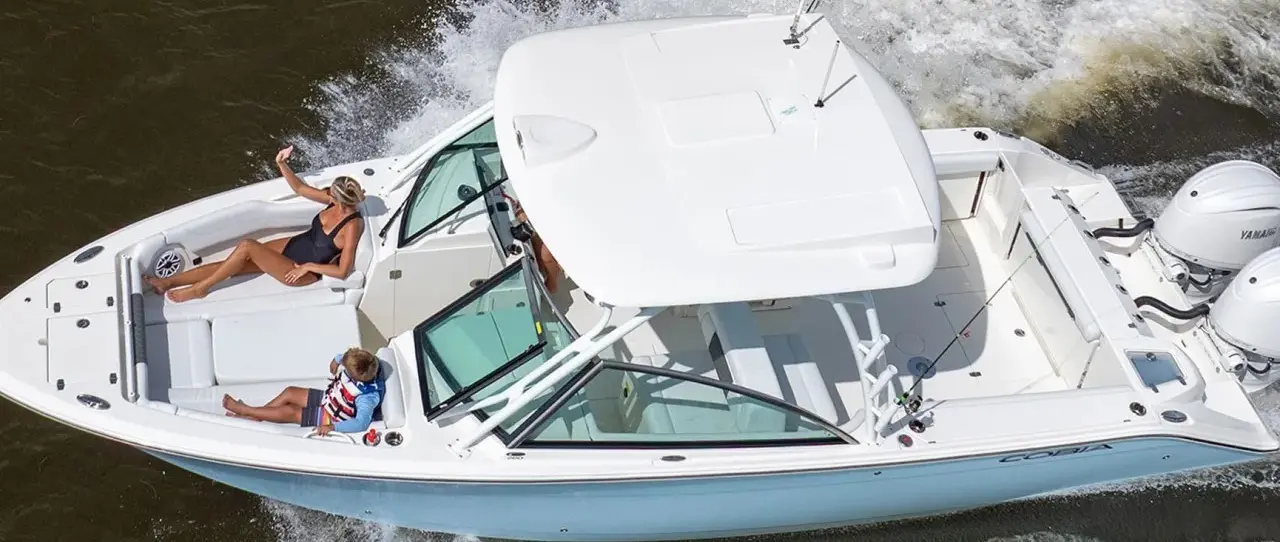
The case for a dual-console 27-footer
Cobia's 280 DC is designed for boaters whose day rarely follows a single theme. A morning spent cruising can become an afternoon of watersports, a beach landing or a short fishing session, all without changing boats. The manufacturer places the model in its dual-console family, where a walk-through centre passage joins separate helm and companion areas and helps guests circulate between the forward and aft parts of the deck.
The published length is 27 feet 7 inches, putting the 280 DC in a useful but substantial dayboat class. Buyers should still establish the complete dimensions of the ordered boat, including its engines and any hardtop equipment, before selecting storage or a berth. A few inches of extra clearance at a home dock can matter more over years of ownership than a comparison-chart advantage on purchase day.
What distinguishes this model is the way Cobia treats lounging, waterside access and practical work space as equal requirements. The dual-console shape can shelter the helm and part of the cockpit while allowing open-air seating forward. It does not provide full cabin protection, but it can make changing weather more manageable than a completely open centre-console layout for some kinds of family cruising.
Social spaces that can change function
The manufacturer describes seating for up to ten passengers and a cockpit and helm area that can be transformed for lounging when the fishing is over. That flexibility is more than a matter of upholstery. An owner who routinely carries several generations of family needs places to sit securely, a way to reach the water and circulation routes that do not force people to climb over loose bags or coolers.
Additional bow lounges create a separate forward gathering place, while a hardtop and an available electric cockpit sunshade address protection from strong sun. These are important distinctions for warm-water owners who may spend hours at anchor rather than running continuously. Before selecting the sunshade, a buyer should check coverage when deployed, headroom below it and whether it obstructs the preferred fishing or watersports equipment.
Cobia lists USB outlets at the seating positions, reflecting the reality that guests bring phones and small devices aboard. Owners should not let such conveniences eclipse the fundamentals: protected electrical fittings, dry stowage and readily accessible safety gear. A boarding demonstration with the usual number of passengers is still the best way to determine whether the seating layout meets the demands of a busy weekend.
Swimming, beaches and a usable kitchenette
A hideaway bow ladder is one of the 280 DC's more distinctive practical features. For calm-water beach visits or sandbar stops, forward boarding can be less awkward than making everyone return to the stern. The ladder should nevertheless be used only where the operator has assessed bottom depth, current, approach and engine safety. It is an access option, not a licence to beach without checking conditions.
The builder also lists a fully featured kitchenette and a walk-down head. These amenities can make a significant difference over six or eight hours afloat by letting guests prepare simple food and drinks and use a private toilet. They do not turn the boat into a conventional overnight cruiser; storage, water supply, refrigeration provision and any shore-power arrangements should be confirmed in the written specification.
The importance of these features becomes clear during ordinary use. After swimming, guests need somewhere to rinse and change, find a drink and sit out of the sun; the operator still needs clear access to the helm and lines. A boat that manages those transitions efficiently feels more spacious than its measurements suggest. The owner's job is to verify the process, not merely admire a photo of an empty cockpit.
Fishing provision is more than an afterthought
While the 280 DC clearly courts social users, Cobia retains notable fishing equipment. The published description includes a 25-gallon livewell, rod storage and two insulated cockpit fish boxes, each described as 41 gallons in the equipment details. Those facilities give a weekend angler credible places for bait and catch without requiring guests to surrender every seat for the entire trip.
The critical question is how quickly the cockpit can change role. Where does the aft lounge fold or move, can crew reach the livewell easily, and will the fishing lines clear the swim access? Owners should test these questions with the boat in its normal cruising configuration. Deck drains, pump controls, hatch hinges and cleaning access also deserve inspection because fishing brings water and debris into spaces intended for family leisure.
Anglers who fish regularly should specify the rod positions and electronics they actually need before ordering. A configuration that accommodates occasional bottom fishing may not suit offshore trolling, and the presence of a livewell does not make every fishing style equally practical. Conversely, a family may prefer to preserve comfortable seating rather than add hardware that projects into its most-used social spaces.
Power, fuel and seamanship
Cobia lists a maximum of 600 horsepower and a 172-US-gallon fuel capacity for the 280 DC. Maximum power is a design limit, not a recommendation to select the highest rating automatically. The right engine package should be judged alongside typical loads, local service availability, noise expectations and the distance usually travelled. Operating cost estimates should be based on the installed engines and realistic cruise settings.
For a boat hosting ten people, payload planning deserves attention. Passengers, full tanks, provisions, watersports gear and other equipment all contribute to weight and trim. A sea trial with only two people aboard may not reveal what happens during a family outing. The seller should provide the certified capacity information and demonstrate handling with a representative load, subject to safe test conditions.
A 172-gallon tank may support substantial day cruising, but fuel volume alone cannot establish a safe range. Consumption depends on engine choice, speed, weather and loading, and the skipper should preserve a suitable reserve. For an itinerary involving beaches and anchorages, attention to depth and anchoring conditions can be more important than the theoretical farthest destination reached on a single tank.
What to verify before committing
The 280 DC's strongest proposition is a realistic blend of sheltered controls, social seating, bow access, a head, kitchenette and equipment for occasional serious fishing. That combination makes sense for owners who will use the vessel in several ways every week. It is less compelling if the boat will serve one specialised activity and spend most of its life carrying unnecessary fittings.
Before purchase, inspect the convertible seating hardware, test every hatch and ladder, examine access to bilge equipment and request a complete option list. It is also worth asking the dealer to demonstrate the boat at a normal marina approach and at comfortable cruising speed, rather than only during a high-performance run. These experiences reveal details that dimensions and publicity photographs cannot.
All quoted specifications and features in this assessment come from Cobia's published 280 DC information. Availability can vary by build and market, so buyers should confirm exact fit-out, safety certification and warranty terms on the boat being ordered. For a family that genuinely mixes cruising, water access and angling, the design offers a considered alternative to a more single-purpose craft.