
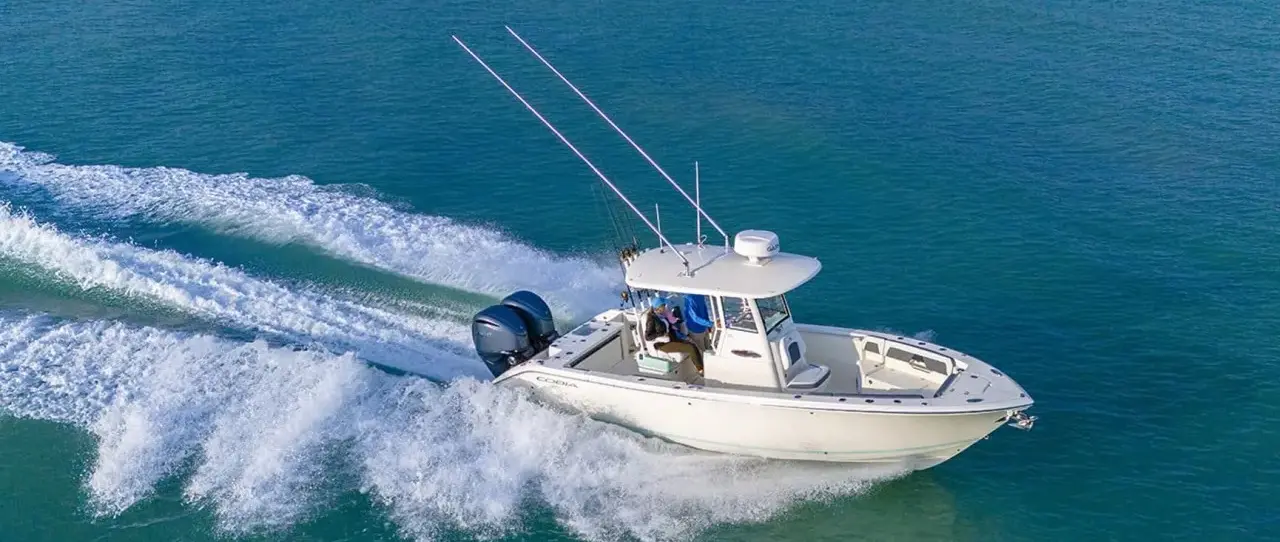
The everyday appeal of a midsize centre-console
A centre-console has long appealed to anglers because movement around the boat is generally uncomplicated. That same open circulation can make sense for families who want to swim, anchor near a beach and enjoy a comfortable run to lunch. The Cobia 265 CC sits in a size range where those goals can coexist without moving into a considerably larger boat with greater storage and berthing costs. Its usefulness, however, depends on how effectively seating, equipment and boarding arrangements share the cockpit.
Cobia describes its 265 CC as a boat intended for more than one kind of day on the water. The official current model page highlights an inward-opening side entry door, a hideaway aft bench with a backrest and a helm that can accommodate two 16-inch displays. These are not merely decorative features. The door changes the boarding routine, the bench can alter deck use, and the electronics arrangement influences whether a skipper can keep navigation information visible alongside fishing instruments.
Dimensions and carrying considerations
The builder gives a length of 26 feet 5 inches, a beam of 9 feet 5 inches and an approximate hull draft of 19 inches. Its published weight is approximately 6,450 pounds with engines, while the fuel capacity is stated as 161 US gallons. The manufacturer lists a maximum horsepower rating of 500 and a 21-degree deadrise. These are useful comparisons for shoppers, but the exact all-up displacement will change with fuel, passengers, gear, batteries, water and installed options.
That broad beam can benefit deck space and stability at rest, yet owners should investigate transport and berth requirements before assuming the boat will fit an existing arrangement. The advertised draft should also be interpreted with caution near shallow water because the depth required for safe manoeuvring can differ from a static hull figure. A buyer should request a current dimensional drawing, engine installation details and the correct trailer or lift specifications for the exact configuration under consideration.
A helm planned for different kinds of use
Cobia says the helm can accept up to two 16-inch displays, and the model can be specified with an integrated hardtop frame, tempered glass enclosure, wiper and vent. On a working centre-console, the view from the helm and the accessibility of controls matter more than simply filling the dashboard with the largest electronics. Assess visibility when seated and standing, particularly when the bow rises during acceleration or when the sun is low ahead. Try reaching essential controls while one hand remains on the wheel.
The optional navigation and fishing systems should be selected according to planned use. Anglers may prioritise sonar presentation and connectivity to equipment such as a trolling motor, while a coastal family may value clear chart detail and straightforward route planning. Ask which features are standard and which require paid packages. Cobia also discusses the Seakeeper Ride automatic trim system on the model page, but its configuration and actual availability should be confirmed against the boat’s order sheet rather than assumed from an editorial summary.
Boarding and the flexible cockpit
The inward-opening side entry door is a practical point of interest. For a family with children or older relatives, it may ease boarding from a suitable pontoon compared with climbing over a high gunwale. The fit with local docks still needs checking because fenders, tide range and the height of the boarding platform can alter its usefulness. Once aboard, passengers need a clear route to seating without stepping around tackle boxes or obstructing the helmsman’s working space.
At the stern, the hideaway bench provides another choice between seating and a more open fishing deck. Buyers should operate it themselves to see how securely it locks, what it obstructs when deployed and whether the materials are easy to rinse after saltwater use. The bow can be configured with additional seating and a table to support more social outings. As with many multipurpose boats, the strongest design decision is one that allows a fast, predictable change of use instead of requiring a long rearrangement of loose cushions.
Fuel planning and the fishing brief
The 161-gallon tank provides a useful planning datum, but it cannot establish cruising range without reliable consumption figures for the precise engine pair, load and sea state. A prudent owner bases passage plans on observed burn at realistic speeds and keeps sufficient reserve for detours, wind and unexpected slow running. The same caution applies to claims about offshore capability. Size, horsepower and hull angle describe the boat; a forecast, crew experience and maintenance condition determine whether a particular day’s outing is sensible.
Fishing-oriented buyers should check rod storage, fish-box access, bait handling and the circulation space left when several people work aft. The 265 CC also promotes an available trolling-motor installation for holding position in appropriate conditions. That may appeal to anglers who spend time over structure, but battery capacity, mounting requirements and control integration all need specific inspection. Owners who mostly cruise with family should decide whether the additional hardware justifies its space and cost.
Questions to settle before buying
Begin with the boat’s intended operating area and the number of passengers routinely carried. Then compare its layout with a similar dual-console to see whether open walk-around access outweighs the extra shelter a second console may provide. Review the actual engine choice, fuel economy, warranty, electronics and all optional packages in writing. A published base price is rarely a reliable guide to the final cost of a properly outfitted and delivered boat, so obtain a complete dealer quotation.
Most importantly, arrange a sea trial with realistic loading and test the side-entry door and foldaway seating at a dock. Observe spray, low-speed manoeuvring, turning response and where passengers naturally hold on. A centre-console is at its best when its simple, open deck makes boating feel intuitive. The Cobia 265 CC appears to have been designed with that outcome in mind, but the purchasing decision should rest on verified specifications and a first-hand assessment of how the boat serves your particular crew.