
A production catamaran becomes part of the circular-composites story
A September 2026 METSTRADE report on Chomarat and Groupe Beneteau's materials programme identifies the Excess 11 as a recent beneficiary of efforts to put recycled reinforcement back into boatbuilding. For Leisure Boat Guide, the significant detail is the model's size: the Excess 11 is a genuine production cruising catamaran under twelve metres, rather than a laboratory panel or an experiment confined to much larger yachts. The organiser's article describes an industrial partnership involving Chomarat, Groupe Beneteau, Veolia, Composite Recycling, Arkema and Owens Corning, with the aim of reusing valuable components from glass-reinforced plastic. The report attributes 45 per cent recycled glass-fibre content to the latest application described. That is an encouraging manufacturing direction, but it should not be confused with a statement that 45 per cent of the complete boat by mass has been recycled. A clear explanation of the material stream is needed before owners can judge what the change actually means.
Why fibreglass waste has been difficult to recover
For decades, many recreational boats have been built from glass fibres held together with cured resin. This produces durable hulls, but separating the reinforcing fibres from the surrounding polymer at the end of use is not straightforward. Large composite parts may also contain cores, metal fittings, paint, adhesive and contamination from service. Manufacturing generates its own waste in the form of trimming scraps, rejected laminate and old moulds. These materials can be bulky and expensive to dispose of, particularly when they are mixed. Recycled glass fibres may be shorter, damaged or differently treated compared with virgin reinforcement, so they cannot automatically replace every structural layer. The industry's challenge is to recover useful material at a repeatable quality and then convert it into products suitable for controlled boatbuilding. This is the industrial problem that the Chomarat partnership is trying to address, rather than a simple scheme to grind old hulls into new ones.
How the reported circular process works
METSTRADE describes a sequence in which Veolia gathers composite production waste and transfers it to processing in western France. Composite Recycling uses a pyrolysis process to separate material streams from cured composite scraps. Arkema works with a recovered oil stream in the production of recycled-content resin, while Owens Corning and Chomarat are involved in creating glass-fibre and reinforcement products that can return to new manufacturing. Groupe Beneteau then incorporates suitable materials in selected production boats. Each link matters because recovering loose fibres alone does not create a qualified structural boatbuilding material. The fibres need to be processed consistently, formed into usable reinforcements and paired with a resin system that performs to the builder's technical requirements. This programme is an example of an industrial chain being developed across several specialist companies, not evidence that ordinary leisure boat owners can place a damaged fibreglass hull into a household recycling service.
What forty-five per cent actually describes
The METSTRADE report says the Excess 11 application uses low-carbon and recyclable resins alongside 45 per cent recycled glass fibres. In this context the percentage refers to the reported fibre or material use within a specified manufacturing application, not a measured reduction in the carbon footprint of the entire catamaran. A complete boat includes engines or propulsion equipment, batteries, stainless steel, aluminium, windows, upholstery, timber, electronics and numerous other materials. The environmental performance of those items is not represented by a figure for one reinforcing stream. The model's construction may also vary by hull series or specification. It would therefore be incorrect to state that every Excess 11 afloat contains an identical percentage of recycled glass or that a photograph of an earlier boat proves its exact laminate composition. Owners interested in a particular hull should request documentation from the builder identifying where the new material is used and which build numbers or production periods are covered.
The Excess 11 is firmly inside the leisure-boat market
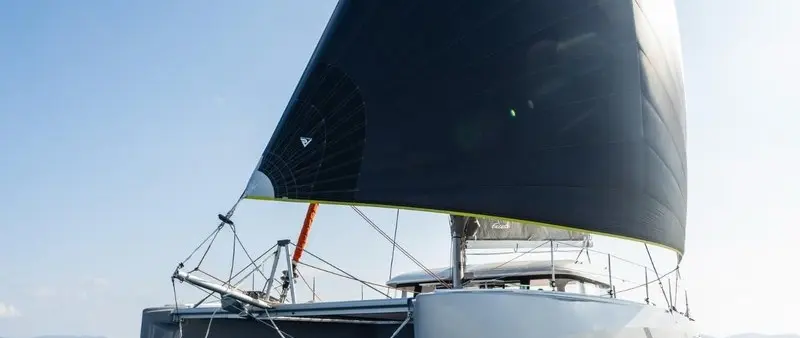
The official Excess Catamarans specification gives a hull length of approximately 11.33 metres and an overall length around 11.42 metres, so the model falls within Leisure Boat Guide's under-twelve-metre coverage. It is a cruising catamaran, not a dinghy, and its size makes the material story relevant to owners seeking a small offshore-capable multihull. A catamaran uses substantial hull and deck mouldings, making reinforcement and resin choices important both to construction quality and production waste. Buyers may be interested in a lower-impact construction process but will still judge the boat on seakeeping, layout, loading, sail performance and structural reliability. The original builder image used here is a genuine Excess 11 photograph from the 2026 manufacturer gallery, but it cannot prove what recycled percentage was used in that precise pictured hull. Its role is to identify the type of craft affected by the industrial programme.
A recycled reinforcement must still do its structural job
A boatbuilder cannot accept a new reinforcement solely because its recovered content sounds attractive. Hull panels and bulkheads are designed for loads, fatigue resistance, local impact and acceptable long-term behaviour in water. A recycled-fibre mat or fabric may have different handling and processing characteristics from a conventional material. Resin compatibility, fibre orientation, wet-out, void content and curing conditions can all influence the finished laminate. Production quality assurance is essential, especially when a revised material is incorporated into an existing boat design. Owners should ask whether the builder has completed its normal structural validation and which warranty provisions apply. It would be wrong to suggest that recycled glass automatically weakens a boat, just as it would be wrong to claim that the same material guarantees equal strength in every application. The important news is the effort to qualify recycled input within industrial production, where performance can be measured against the established design requirements.
The manufacturing-waste opportunity is substantial
The organiser's story points out that boat construction can generate significant composite offcuts during trimming and mould preparation. If some of that material can be collected and processed for reuse, manufacturers may reduce the amount that goes to disposal while retaining some value from purchased inputs. Production waste is generally easier to trace than the mixed materials found in a boat that has been repaired and modified over several decades. That makes factory scrap a logical starting point for a circular supply chain. The programme's longer-term ambition can include different sources of recovered composite, but the condition and composition of those inputs will influence what can be produced from them. A recycling process needs consistent sorting and documentation to achieve the quality required for boatbuilding. The percentage of scrap successfully reintroduced to new material is as important as the total amount sent to a recycler.
What the reported material totals tell us
METSTRADE cites a Groupe Beneteau update indicating that 12.6 metric tonnes of Elium resin and fourteen tonnes of recycled or natural fibres had been used in new boat production through related collaborations, with the report attributing an estimated seventy per cent carbon dioxide saving to the resin comparison alone. These figures refer to group-level material activity and a particular comparison, not to an independently established life-cycle reduction for an individual Excess 11. A material-level saving should not be multiplied across the mass of a whole boat without a properly constructed life-cycle study. The figures nevertheless show that the programme is being described as a manufacturing activity rather than only a future laboratory aspiration. For a consumer, the strongest evidence would be a published scope explaining which materials were compared, how transport and processing were accounted for and what remains outside the estimate.
Understanding the role of Elium resin
Arkema's Elium system is frequently discussed in connection with thermoplastic composite approaches and the possibility of recovering value from material that would otherwise be difficult to process. Boat owners may be familiar with conventional thermoset resins, which harden through chemical curing and cannot simply be melted back into their original state. A different resin chemistry can create recycling opportunities, but commercial performance depends on the whole laminate design and the actual recovery process. The METSTRADE account describes recovered outputs feeding into resin production, yet it does not establish that every composite component is fully recyclable by every local operator. Owners should distinguish the technical potential of a material from the existence of a convenient end-of-life collection network. The latter may take years to build. A boat using a more recoverable system still requires responsible service, repair and eventual disposal arrangements.
Chomarat brings a history of textile engineering
Chomarat's earlier work in woven and multiaxial reinforcements gives context to the new project. The company has also described a glass-and-hemp hybrid reinforcement developed with Groupe Beneteau, illustrating a separate approach to incorporating alternative fibres in marine parts. Natural fibre and recycled glass are not identical routes. Hemp can be used to reduce dependence on certain virgin materials in suitable applications, while recovered glass seeks to reuse reinforcement already manufactured. Each has different technical characteristics and processing needs. The combination may give boatbuilders more options for selected components, but there is no reason to assume that every hull panel can adopt every formulation. The manufacturer must make choices based on load paths, cost, production speed and required finish. The 2026 circular-composites report is notable because it brings several of these material ambitions into a coordinated industrial supply chain.
What this means for repair work
Owners of an existing fibreglass cruiser may be tempted to assume that a recycled-material hull is easier to repair or that any familiar repair resin will work with it. Neither conclusion follows automatically. A repair must be compatible with the actual laminate materials and structural requirements, and new resin systems can have specific surface preparation or bonding conditions. Builders should provide repair guidance to authorised yards and owners where appropriate, especially if a model uses revised reinforcement in particular components. The presence of recycled fibre within a laminate does not by itself determine its repair procedure. A small-boat owner considering a used Excess 11 should therefore seek its precise build specification and service history, just as they would for any other modern composite boat. Accurate documentation is more useful than relying on a broad model name and an industry news headline.
Recycling does not replace a good service life
A craft that remains reliable for many years can deliver substantial value from the original material investment. The environmental discussion should therefore include good maintenance, appropriate winter storage, repair and eventual resale, not only what happens at the end of a hull's life. A boat incorporating recovered reinforcement still needs dependable fittings, correct operating loads and timely inspections. Replacing a poorly maintained vessel prematurely can undermine some of the material savings made at construction. The same logic applies to production quality: a process that reduces waste but creates more rejected parts would need careful evaluation. The long-term goal is to keep high-quality boats in use while reducing waste from making and eventually retiring them. Industrial recycling and ordinary ownership discipline are complementary parts of that goal, not competing solutions.
What the official reporting verifies
The 30 September 2026 METSTRADE organiser report names Chomarat, Groupe Beneteau and partner companies in the recycling alliance, describes the processing steps and identifies the Excess 11 as a recent production beneficiary. It presents claimed recycled content and material volumes that can be reported with attribution. The builder's official Excess 11 pages establish the model dimensions and provide genuine photographs of the vessel. These sources do not independently verify the content of every individual hull, the embodied emissions of the complete boat or the precise commercial arrangements for receiving end-of-life consumer vessels. This article therefore reports the manufacturing development and its implications without exaggerating it into a universal recycling solution. The first-party model photograph is credited to EXCESS and its original photographer, and is not represented as a microscopic view of recycled fibres inside that specific pictured boat.
What buyers should ask the builder
A prospective Excess 11 owner interested in the programme can ask the dealer which build periods and components use the revised glass-fibre content, whether the materials have been validated under the manufacturer's normal engineering programme and whether there is a published life-cycle assessment. It is reasonable to ask how structural repairs are documented and what support will be available later for maintenance or eventual recovery. Buyers should not assume that a percentage quoted for one reinforcement means the entire craft contains that same recycled share. At the industry level, the more interesting prospect is a repeatable system capable of taking valuable material from production waste and putting it into new boats without sacrificing performance. If that system can be scaled and transparently documented, the benefits could extend well beyond one model. For now, the verified 2026 development demonstrates that circular-composite manufacturing has moved into at least one genuine under-twelve-metre production-catamaran story, while leaving important questions for builders and materials specialists to answer.
Primary reporting and image credit
Primary manufacturer and organiser source(s): https://www.metstrade.com/news/construction-and-material/circular-economy-pioneer. © EXCESS Catamarans / original marine photographer. Authentic official 2026 Excess 11 boat photo from builder gallery, not verification of 45-percent recycled material used in the pictured hull. Image is used only for correctly attributed factual editorial coverage and never represented as open-licence stock photography.