
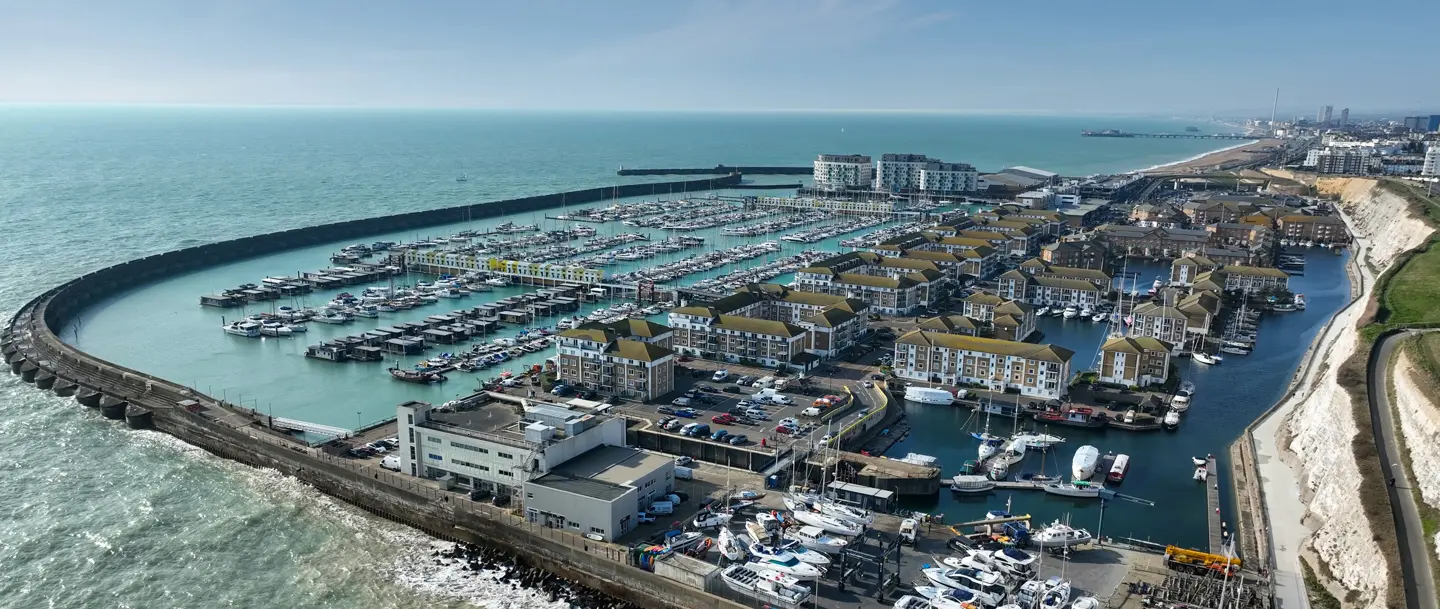
Brighton Marina has moved another step towards restoring routine maintenance dredging, but permission to begin work has not yet been granted. Premier Marinas announced on 19 October 2026 that it has submitted a new marine-licence application to the Marine Management Organisation, or MMO, covering dredging at the Sussex marina and disposal of the resulting sediment at an established marine site off Newhaven. The operator is seeking a ten-year licence, with a stated ambition to resume maintenance operations in spring 2027 if the application is approved.
The distinction between an application and a final authorisation matters to berth holders and visiting skippers. Premier says its earlier ten-year licence was quashed in 2025 and that it has been unable to dredge while the next approach has been assessed. Sediment continues to accumulate in marina entrances and navigational areas, making reliably available depth a practical concern. The new submission begins another period of regulatory scrutiny and public input rather than resolving those questions immediately.
Why a marina needs maintenance dredging
Harbours and sheltered marina entrances are places where currents can slow and suspended sediment can settle. Over time, deposits can reduce available depth or alter the most convenient approach for a vessel with a substantial draft. Maintenance dredging is intended to remove accumulated material and preserve safe access within the limits of the marina's authorised operations. At Brighton, Premier explicitly links its proposal to the need to maintain dependable entry and exit for customers and marine businesses.
A berth holder should not assume that an anticipated dredging project changes the depths available today. Skippers still need current harbour guidance, charts, tidal information and any notices issued by the marina or relevant authorities. Surveyed depths and the controlling areas of an entrance can change between visits, particularly after adverse weather. The 2027 ambition is a planning objective, not a navigational assurance for a passage being made this week.
Why the proposed Newhaven disposal route matters
Premier's new application would send dredged material to an established disposal site near Newhaven, rather than treating the disposal question as a minor detail after excavation. The operator says it reviewed alternative Sussex-coast options and commissioned specialist consultancy ABPmer to model how material might disperse. Working with Newhaven Port, the assessment considered fifteen disposal scenarios, including activity associated with both locations at a high anticipated intensity. The results form part of the evidence submitted for examination by the regulator.
One environmental question is the potential effect on the Beachy Head West Marine Conservation Zone. According to Premier's announcement, the commissioned dispersion modelling found that adding Brighton-derived sediment would not create interaction with the conservation zone from the proposed disposal activity. That is the applicant's description of its technical evidence, not an independent determination by this publication that environmental effects are impossible. Regulators and statutory advisers will have the opportunity to evaluate the supporting material during the formal licence process.
What the environmental screening actually established
The Marine Management Organisation completed screening in June after an application covering the Brighton and Newhaven works was submitted in May, Premier reports. The operator says the MMO concluded that a full Environmental Impact Assessment was not required for the proposed works. A decision at screening stage is not the same as an unconditional approval of the dredging programme. The marine-licence application must still be assessed against the applicable requirements, including the material provided on sediment movement and disposal.
Premier also describes a regulated sediment-testing process. Accredited specialists collect samples and separate accredited laboratories analyse them, with the regulator advising which substances require testing. That separation is designed to make the evidence reviewable beyond the marina operator itself. It remains important for the eventual decision to distinguish the need for safe navigation from the environmental questions associated with removing, transporting and disposing of sediment. Both considerations belong in a credible maintenance plan.
How and when the public can respond
Premier says that, once the application is validated, the MMO will begin formal technical assessment and consultation with statutory advisers and the public. The operator expected consultation to open in late October or early November 2026 under application reference MLA/2026/00477. That was an expectation reported on 19 October, so readers should check the regulator's current notices before relying on a particular opening or closing date. Submitting a comment outside a formal consultation may not amount to participation in the statutory process.
Berth holders, marina workers, commercial boat operators and local residents may have different information to contribute. A sailor could explain how changes in access depth influence tidal passage planning, while a marine-service business might describe the effect of uncertainty on customer bookings. Others may focus on sediment management, ecological safeguards or the proposed disposal route. The value of a consultation is that representations can be considered against the submitted evidence, rather than only through the applicant's preferred account of the project.
The wider business dependence on navigable access
The economic figures in Premier's statement underline why the matter has attracted attention. It estimates that nearly 150 businesses are directly dependent on the marina and around 1,200 people work across the site. The operator also cites approximately £130 million in annual gross value added and more than eight million visits to the wider marina site each year. These are figures advanced by Premier as context for its application and should be read as operator-reported estimates.
Not every business on the site depends on a pleasure boat crossing the entrance each day, but the marina's appeal is rooted in being a functioning waterfront. Fishing, diving, sail training, recreational boating and charter operations require safe and predictable access for different kinds of craft. Restaurants, retail and leisure facilities form part of the associated economy. Maintaining navigable depths can therefore influence confidence well beyond the owners of permanent berths, without removing the need to assess environmental impacts properly.
What owners should check before a Brighton visit
For a skipper approaching Brighton in the coming months, the immediate priorities remain the published harbour instructions, conditions on the day and advice from the marina. A boat's draft should be considered alongside available depth and the state of tide, with realistic allowances for sea conditions and safe manoeuvring. A proposed dredging programme is not proof that a familiar entrance has retained its previous depth. Anyone uncertain about access should contact the marina before departure and avoid relying on outdated recollection.
Visiting arrangements and commercial services can also change while a project is under review. The operator's public notices are the correct place to look for any confirmed works, temporary restrictions or changes to navigation. A dredging vessel, when actually deployed, will introduce additional operational considerations that need clear communication to harbour users. None should be assumed to be in effect merely because an application has been submitted, and a spring target should not be mistaken for an announced construction schedule.
The next milestone is a licence decision
The October submission is a notable development after the disruption to Brighton's earlier licensing route, but the most consequential steps still lie ahead. The MMO must validate and assess the application, invite appropriate views and issue a determination. Any permission could include conditions affecting the scope, timing or monitoring of work. Equally, it would be premature to describe the ten-year proposal as secured before a decision has been made.
For leisure boaters, the essential point is straightforward: reliable marina access depends on physical maintenance as well as transparent regulation. Premier's Newhaven disposal assessment is part of the evidence now being offered to support its preferred solution. The community can follow the formal consultation and, once the regulator has ruled, assess what it means for navigation in 2027 and beyond. Until then, careful passage planning and attention to current marina guidance remain the practical priorities.