
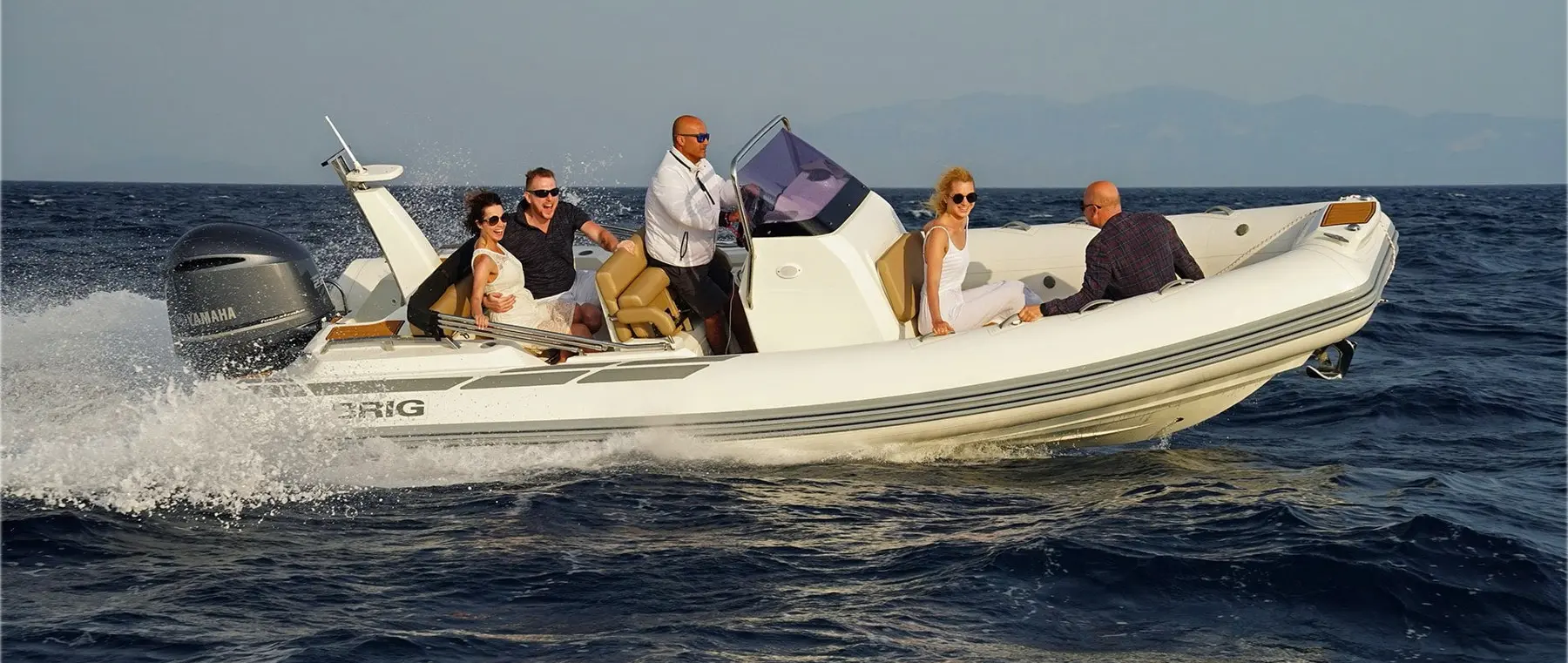
An established family-RIB format, reconsidered
The BRIG Eagle 6.7 occupies a useful middle ground between a small inflatable and a more demanding coastal motorboat. At 6.70 metres long and 2.55 metres wide, it offers room for company without turning every short outing into a complicated operation. The manufacturer presents the model as an evolution of its established Eagle family.
Central to the design is a redesigned deep-V hull, with inflatable tubes positioned to support its running attitude. BRIG highlights handling, responsiveness and stability as the objectives of the revision. Actual ride quality still depends on speed, sea conditions and loading, so prospective buyers should experience the boat on their own waters.
The official specification lists an empty-boat weight of 810 kilograms and a 191-litre fuel tank. Neither number should be mistaken for the towing weight of a fully equipped boat or a guaranteed cruising range. Engines, equipment, passengers and a prudent fuel reserve must all be accounted for.
A flexible deck for the way families actually boat
BRIG includes forward and aft storage lockers and a folding table because family outings often involve more time stationary than under way. A typical trip might alternate swimming, a sheltered picnic and a dash back to harbour. Storage that keeps loose bags and lines away from passengers becomes important when activities change.
The combined pilot seat and bolster supports a practical helming posture, while the aft seating includes a soft backrest. A multi-purpose navigation mast and a dashboard suited to modern displays place essential equipment within reach. Owners should check precisely which electronic instruments a particular dealer package contains.
The builder specifies an antiskid deck, navigation lights, a towing eye and an automatic bilge pump. Optional choices extend to shade, a boarding ladder, an anchoring system and fresh-water washdown. Extra equipment should be chosen for genuine needs because every addition changes cost, weight, maintenance and the space available for movement.
Capacity and power require context
The Eagle 6.7's manufacturer lists design categories B and C, with passenger numbers that differ by certification. The published figure is seven people for category B and eleven for category C. Quoting eleven occupants without explaining that difference would give a misleading impression of what the boat is approved to do.
The global model specification gives a maximum outboard rating of 225 horsepower and an extra-long shaft arrangement. Engine selection should follow the actual builder plate and intended use, rather than a simple search for the largest motor. Owners who mostly explore sheltered bays may prioritise a different balance than frequent tow-sports users.
The 2.55-metre beam also matters before the boat first reaches the water. Road width rules, ramp access, trailer mass and the storage height of any fitted T-top can affect where this RIB can be kept. It is easier to settle those questions before agreeing a new-boat specification.
Where the Eagle 6.7 fits
Sun-lounge options, removable cushions and watersports fittings give the boat more than one personality. Yet the core arrangement remains an open RIB without cabin accommodation or a fixed galley. That is a deliberate trade-off for deck room, simplicity and easy swimming access.
For children and guests, inspect the handholds and the means of reboarding the craft from the water. Loading arrangements and seating comfort matter at least as much as the quoted engine rating. A demonstration with the people and equipment normally carried will reveal more than a spotless showroom inspection.
BRIG's Eagle 6.7 is interesting because its practical refinements address ordinary boating: casting off, carrying everyone's kit, stopping safely and returning with minimal fuss. Its strongest qualities will come through in a package properly matched to the local coast, not necessarily the longest options list.