
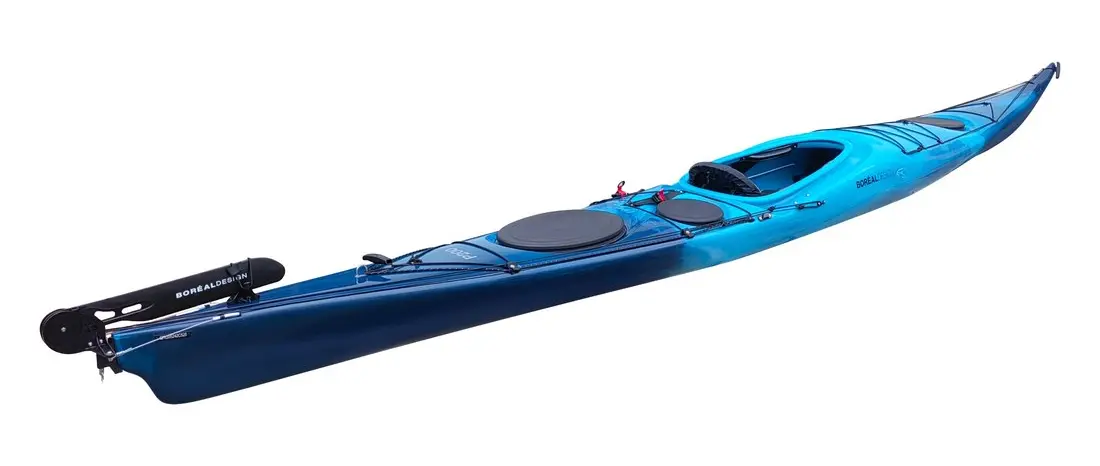
A touring boat familiar to rental operators
BoréalDesign has presented its Epsilon P200 Rudder in the Paddle Sports Show's 2027 sea-kayaking selection, highlighting a kayak that has become a regular choice for tour operators and rental fleets. The company positions the model as manageable enough for a range of paddlers while offering the waterline length, storage and outfitting required for longer trips.
That combination is significant because a rental business must use equipment that performs reliably for people of different experience levels. A kayak needs to support appropriate instruction without feeling unnecessarily demanding to control. The manufacturer says the Epsilon series has built a reputation around predictable handling rather than a narrow focus on speed.
Length and beam for extended journeys
The Epsilon P200 is listed at approximately 5.17 metres long and 58.5 centimetres wide, with a published height of about 33 centimetres. The trade-show specification gives a weight of roughly 32.3 kilograms and a carrying capacity of around 134 kilograms. These proportions create room for touring equipment while keeping a relatively narrow profile through the water.
Owners should remember that maximum load includes the person and all equipment. A kayak packed near its limit may sit differently and require additional effort to manoeuvre. A long hull may hold direction comfortably on open water but be less convenient in tight rivers or when carrying it across a parking area.
A rudder for more consistent course keeping
The Epsilon P200 includes a rudder intended to support directional control when wind or current tries to turn the boat away from the intended route. On a long passage, reliable tracking can reduce the need for repeated corrective strokes. The device is particularly relevant to guides managing a group over a measured distance.
A rudder still requires inspection and suitable adjustment. It can be vulnerable at shallow launches or around submerged obstacles and should be protected as recommended by the manufacturer. Proper boat-handling skills remain essential: a novice who depends entirely on the rudder may struggle if the steering line fails or the blade becomes obstructed.
Adjustable footrests broaden the fit
BoréalDesign describes easily adjusted foot sliders intended to accommodate paddlers of different heights. The Epsilon also uses a Flex 4 seat with Drytech fabric and a fully adjustable arrangement. For rental operators, the ability to adapt the cockpit efficiently between customers is valuable when a group is preparing to leave the shore.
Fit affects comfort and control. A person needs enough legroom for a natural paddling position while maintaining contact with the boat through the feet and thighs. An instructor should help newcomers adjust their seat and footrests before launching, and the paddler should understand how to exit the cockpit safely during a capsize.
Hatches support a longer itinerary
The official specification identifies two sealed storage compartments and a dedicated day hatch, together with bulkheads separating them from the cockpit. This creates organised space for food, spare clothing, camping gear and safety supplies on tours extending beyond a few hours. The day hatch can keep selected essentials accessible without unpacking larger equipment.
Storage is useful only when cargo is appropriately secured and protected from moisture. Dry bags remain advisable for critical belongings, and heavy items should be arranged to avoid unwanted trim. Paddlers considering multi-day journeys also need to assess access to permitted camps and drinking water rather than assume the available hull volume guarantees an easy expedition.
Safety details in the deck arrangement
The Epsilon includes high-visibility deck safety lines and self-rescue straps. These can assist trained paddlers with certain recovery techniques, while giving guides points of contact when managing boats alongside one another. Reflective or bright fittings may also improve visibility in appropriate lighting conditions.
No collection of accessories substitutes for cold-water protection, flotation equipment and a route suited to the weather. Guided operations should have clear plans for recovering a person who leaves the boat, and customers need basic instruction rather than being left to discover the equipment's purpose during an emergency.
Rotomoulded polyethylene in commercial use
The hull is made from rotomoulded high-density polyethylene, a material widely used where durability and ease of routine maintenance are important. This can suit rental fleets because craft are launched and handled by many different people, not always with the care shown by an experienced private owner.
A polyethylene hull still requires inspection, particularly after contact with rocks or transport equipment. Boats should be supported properly in storage and protected from unnecessary deformation due to heat or poor rack placement. Commercial operators also need dependable replacement parts and clear service records to keep a fleet ready throughout the season.
A practical rather than novelty-led entry
The Epsilon P200's inclusion in the 2027 product selection should not be confused with the launch of an entirely new design or proof that it received a category award. Its appeal is rooted in a combination of stable handling, adjustability and real storage. The manufacturer image shows the actual kayak in a single view, enabling readers to understand the hull without an unrelated collage.
For Leisure Boat Guide readers, the model demonstrates how a mature touring kayak can continue to serve different kinds of owners. A private paddler may value the storage for longer journeys, while an operator prioritises fleet reliability and fit. An on-water trial remains important before deciding which design will provide the most comfortable experience.
Fleet experience and private boat ownership
BoréalDesign's familiarity with commercial kayak fleets can inform the habits of a private Epsilon owner. Guides and rental operators regularly inspect seating, rudders, hatches and deck lines between journeys. These are sensible routines even for a boat that enters the water only a few times each month. Regular attention to small fittings can prevent an ordinary day trip becoming a repair problem at an inconvenient location.
An owner planning a longer tour should also practise loading, trimming and recovering the boat under supervision when appropriate. Supplies carried in multiple compartments can change the handling compared with an empty demonstration hull. Local clubs may offer opportunities to practise assisted recovery with similar sea kayaks. Familiarity with the specific boat is ultimately more valuable than a promotional claim about expedition capability.