
Applications open for marine founders
Yachting Ventures and European Boating Industry have opened applications for the 2027 Startup x Investor Day pitch competition, giving emerging leisure-marine businesses a route to the investment-focused programme at boot Düsseldorf. The event is scheduled for Tuesday 26 January 2027 at the Blue Innovation Dock, during the German boat show's nine-day run. Applications must be submitted by 4 December 2026, with the selected founders due to be identified before Christmas. Those dates are more immediate for a prospective entrant than the January event itself, because eligibility, pitch preparation and travel planning begin well before the exhibition opens.
The organisers' announcement, dated 30 October, describes a programme of startup presentations, investor perspectives and conversations about fundraising. It is a business-development event inside a major marine exhibition, not an announcement that any participating firm has secured investment. Companies developing recreational-boating technology, equipment or services can consider applying, but a place on the stage is selective rather than automatic. For founders weighing the opportunity, the central question is whether their product and commercial stage match what the investors and established marine businesses attending are likely to seek.
The date, place and show context
The pitch day will take place on 26 January, within boot Düsseldorf's 23–31 January 2027 schedule. Messe Düsseldorf says the overall exhibition is expected to gather more than 1,500 manufacturers, dealers and destinations across 15 halls, with more than 1,000 boats and yachts anticipated. The trade fair also brings together marine engines, services, sailing, watersports, diving and holiday operators. Those numbers describe the organisers' forecasts for the show as a whole; they are not the expected attendance at the Startup x Investor Day itself.
Boot's Blue Innovation Dock is positioned as a meeting point for industry, technology, business and policy discussion. The fair's 2027 reorganisation includes a different hall distribution while building work is undertaken, but the organisers identify the Blue Innovation Dock as the setting for this particular event. Founders should therefore separate the location of their pitch session from the wider exhibition halls that house prospective distributors and customers. The appeal of the dates is that relevant companies, suppliers, media and marine investors are already travelling to Düsseldorf for the same international industry gathering.
A £550 fee for selected pitchers
The official application announcement is explicit that each startup selected to pitch must pay a participation fee of £550. This is an important consideration when comparing the programme with no-cost accelerator applications or general visitor networking. The fee is attached to a selected pitching place, according to Yachting Ventures, and should not be interpreted as a guarantee of an investment meeting, commercial contract or prize. Founders should seek the organisers' latest terms directly before making spending commitments, particularly if they will also incur airfare, accommodation and exhibition costs.
The application deadline is 4 December rather than the event date, leaving applicants several weeks to assemble a clear account of their product, customer problem, commercial traction and funding requirements. The precise pitch length, jury membership and full competition rules had not all been published in the initial announcement; the organisers said further details would follow. A prudent applicant can prepare a factual presentation now without assuming a specific number of slides or minutes. Preparing a concise financial story, evidence of customer demand and a realistic growth plan will be useful regardless of the eventual stage format.
What founders will hear first
The day is expected to open with a keynote by Jack Molyneux of IDOSY, who is scheduled to discuss building a business in yachting and lessons from the company's recent fundraising. A founder speaking about actual fundraising experience is a different proposition from a generic investment lecture. The programme description focuses on how entrepreneurs identify appropriate backers, manage expectations and develop relationships beyond a single presentation. Molyneux's planned appearance was announced by the organisers, but the report does not claim to know the eventual content of his address in advance.
For a marine startup, those lessons are useful because the route from prototype to profitable distribution can involve testing, standards compliance, production tooling, warranties and service partners. A technology that performs impressively at a demonstration may still need an installation network and a credible support plan before boatbuilders or owners adopt it at scale. Investors can therefore be interested in evidence of deployment and repeatable revenue as much as headline innovation. These are general considerations for the sector, not special criteria that the organisers have said every entrant must satisfy.
Investor reverse pitches and a founder panel
One planned feature is a reverse-pitch segment in which investors explain their own priorities to founders. Conventional pitch competitions place the startup under scrutiny, but reverse pitches can also help entrepreneurs decide whether a prospective backer's interests and investment horizon fit their project. The organisers additionally plan a panel with founders discussing the decisions and difficulties encountered when growing leisure-marine businesses. Both formats shift at least part of the conversation away from a one-way contest and towards a practical assessment of investment compatibility.
That distinction matters in an industry spanning consumer hardware, vessel software, infrastructure and business services. A boatbuilder with a capital-intensive production model does not have the same financing needs as a subscription-based fleet-management platform. Neither can be evaluated sensibly on a single metric divorced from the venture's stage. For an attending founder, listening carefully to investor criteria may save time pursuing funding sources whose sector focus or preferred cheque size is unsuitable. No particular investor or committed fund is promised in the organisers' published programme.
More time before and after the stage
Yachting Ventures and European Boating Industry say they are developing additional networking around the formal sessions, including coffee before the main programme and a reception afterwards. These are proposed elements of the 2027 format, but the initial announcement expressly leaves their exact times and reception venue to be confirmed. That uncertainty matters for visitors trying to coordinate exhibition appointments across a large site. The main date is published; peripheral arrangements should be checked closer to travel rather than treated as final.
Networking can produce commercial value even for a founder who is not chosen to pitch. An introduction to a component supplier, dealer, boatyard or technical adviser may help test whether a proposed product fits existing installation and procurement practices. It is also a chance to ask potential customers directly about maintenance, training and support requirements. Those benefits are possibilities, not guaranteed outcomes of attendance, and startups should plan meetings with specific objectives instead of assuming that the exhibition audience will automatically discover their business.
Why European Boating Industry is involved
European Boating Industry is participating alongside Yachting Ventures to connect young companies with more established players in the recreational-marine economy. In the announcement, EBI secretary-general Philip Easthill emphasised the value of access to investment, experience and businesses able to help startups move towards commercial opportunities. The partnership gives the programme an industry-association dimension as well as the entrepreneurial community assembled by Yachting Ventures. Its purpose is to facilitate relevant connections, not to endorse every product placed before the jury.
The collaboration also reflects a broader issue facing boat companies: promising new solutions often emerge from small teams without a large marine distribution or service footprint. Established manufacturers can provide testing access and customer understanding, while an early-stage firm may bring specialised software, materials or design techniques. Neither side benefits if a product is announced before its real-world limitations are established. A useful pitch event therefore creates room for technical questions, commercial due diligence and honest discussion of the obstacles to reaching a repeatable market.
Where startups could fit in the industry
The official invitation is open to founders developing products and services for leisure marine, a broad description that covers more than new boats. Potentially relevant categories include onboard monitoring, navigation support, safety equipment, marina systems, maintenance software, propulsion accessories and customer services, provided each applicant meets the organisers' final criteria. These are examples of the sector's range, not a published list of guaranteed eligible categories. Applicants should verify the specific terms before spending time tailoring a proposal to the competition.
Founders selling to boatyards may need to demonstrate integration with existing electrical or mechanical systems. A consumer-facing boating application has different challenges, including user adoption and seasonality, while a marina product may be sold through longer procurement cycles. The value of a concentrated investor day is the ability to test those assumptions with people who understand marine markets. A company should be ready to explain not only what its technology does but also who pays, who installs or supports it, and why adoption is plausible within an established industry.
Preparing a credible application
A strong submission can begin with verifiable basics: the company's legal identity, the customer problem, a short description of its solution and evidence that the problem is worth solving. Product testing and early paid customers are more informative than unsupported market-share projections. If money is being raised, founders should be able to connect the requested financing to specific milestones, such as certification, production readiness or expansion of a dealer programme. Those are practical preparation suggestions from this newsroom, not stated assessment criteria issued by the event organisers.
Financial presentation is particularly important for physical marine products because manufacturing costs, inventory, warranty claims and after-sales service can affect cash needs. A digital-service company will have different cost drivers, but still needs to show how customers are acquired and retained. Founders should avoid presenting awards or media coverage as substitutes for revenue evidence. They can also decide in advance what information is suitable for a public pitch and what should remain confidential until a genuine due-diligence discussion. The official application link is available through Yachting Ventures' event announcement.
What to watch before January
The next confirmed milestone is the 4 December closing date, followed by the organisers' intention to inform selected startups before Christmas. Jury details, final programme arrangements and the networking timetable are still expected. Meanwhile, boot Düsseldorf has announced the wider trade show's 23–31 January schedule and new hall organisation. A prospective entrant should monitor the event organiser's own updates for procedural changes and use the official application route rather than relying on a reposted form or an outdated competition brief.
The significance of Startup x Investor Day will ultimately be judged by the quality of connections it facilitates, not simply the number of pitches delivered. For small marine companies, access to investors who understand long product cycles and demanding customers can be valuable, but productive relationships require follow-up after the stage lights are switched off. As of 6 November 2026, the news is that applications are open, the January date and £550 selected-pitcher fee are published, and further programme details remain pending. That is enough for founders to make an informed first decision about applying.
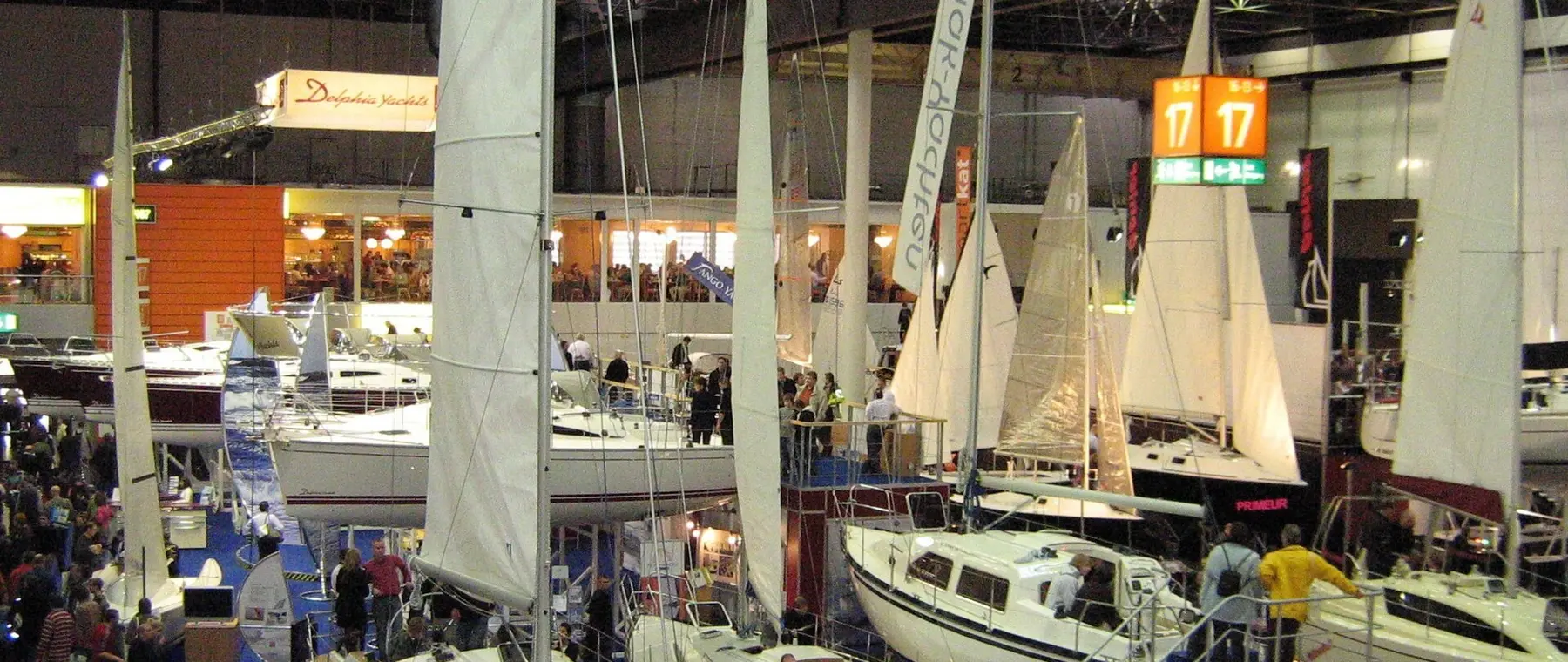
Image: Archive photograph of the boot Düsseldorf exhibition hall in 2007 (not the forthcoming 2027 event). Sir James / Wikimedia Commons, CC BY-SA 2.0 Germany; resized for presentation.
