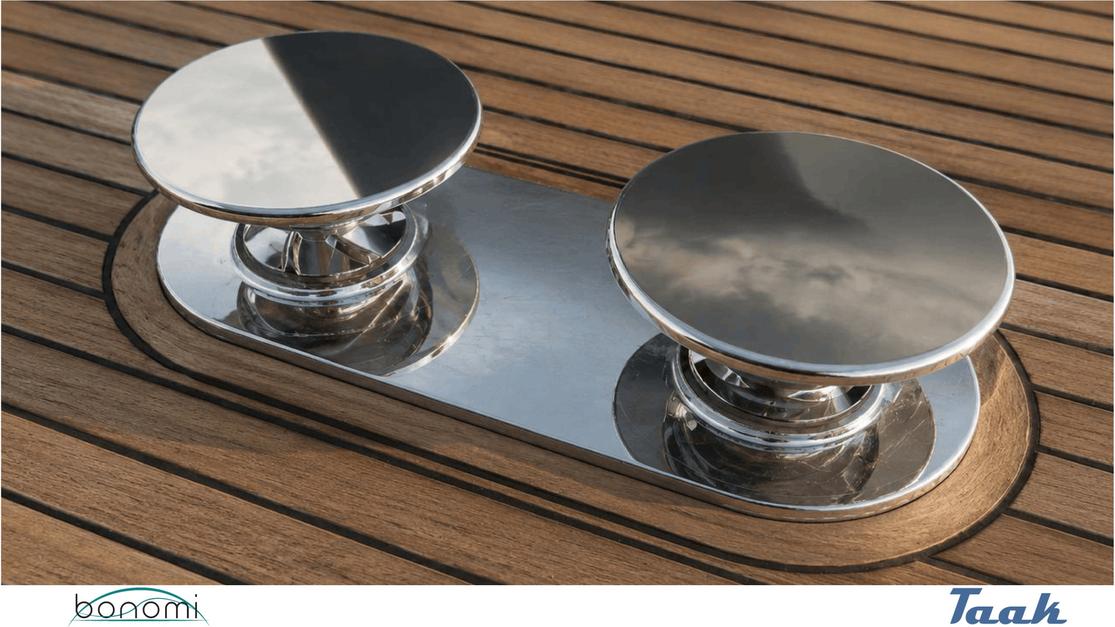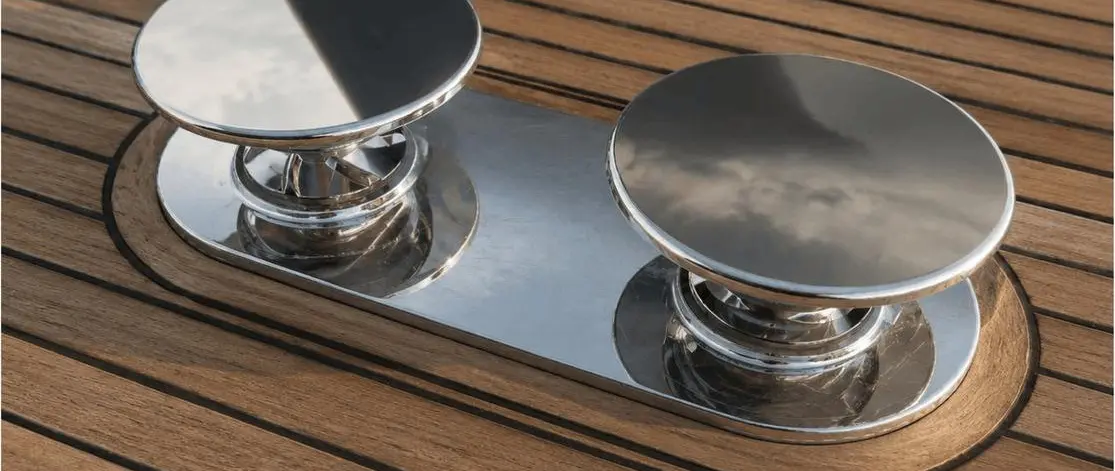
A cleat that is intended to disappear when it is not needed
Italian marine equipment supplier Bonomi srl is showing its TAAK motorised retractable cleat in the METSTRADE 2026 catalogue, describing a powered fitting designed to reduce exposed hardware on deck while remaining available when a boat needs to be secured. The exhibitor product entry is dated 8 September 2026 and presents the concept as a way to make mooring procedures easier and improve movement across deck spaces. Although retractable cleats are often associated with the clean lines of larger yachts, the idea may also be of interest to designers of recreational boats under 12 metres, where people move through narrow cockpits and over small foredecks. Suitability is not established by appearance alone. The public listing does not provide the complete load rating, electrical specifications or the permitted sizes of vessel, so this is an assessment of the technology and the questions that a small-boat builder should resolve rather than a claim that every runabout can accept the product.
What is confirmed by the official source
The manufacturer describes TAAK as a motorised retractable cleat intended to make mooring easier and to reduce unnecessary exposed deck fittings. It highlights visual simplicity and freedom of movement as reasons for concealing hardware when it is not being used. The official product page does not identify the cleat's safe working load, bolt pattern, installation depth, motor voltage or emergency operating method. Those missing specifications matter more than the clean appearance of the unit. A cleat is a load-bearing structure that connects the vessel to a quay or other approved mooring arrangement. If it is too small for the expected forces or mounted in unsuitable structure, the installation may be unsafe even when the mechanism works perfectly. The manufacturer should be asked for the correct technical documentation and evidence of suitability for the particular boat and intended use.
Why exposed deck hardware is a small-boat concern
On a boat with a narrow side deck, every projecting fitting can be a place where clothing, lines or footwear catch during boarding and mooring. A traditional cleat is normally a simple, robust piece of hardware, but it does occupy space when it is not in use. Recreational boat designers may seek alternatives that preserve a smooth walking route without making essential fittings difficult to find. A retractable cleat could help with that goal if it remains accessible, secure and correctly sized. However, removing projections does not automatically make a deck safe. Non-slip surfaces, handholds, suitable lighting and the movement of people under way still matter. A crew should not have to search for the cleat during an urgent manoeuvre or depend on an unfamiliar button to find the only available attachment point. Good design balances uncluttered appearance with an instantly understandable working arrangement.
The essential role of a mooring cleat
A mooring cleat may hold a boat against wind, current, passing wakes and changes in water level. The load transmitted through a line can increase sharply when a vessel moves against a short or poorly led rope. On a small craft, the structure beneath a fitting may include a relatively thin deck moulding or reinforcement placed specifically for the original hardware. Replacing a conventional cleat with a motorised unit may require changes to that reinforcement. Owners should not assume that the replacement can be mounted through the same holes or carry an equal load. The builder's drawings and the hardware maker's ratings should guide the installation. A marine engineer may need to consider backing plates, sealing and access from below. The basic requirement remains unchanged: the cleat must be suitable for the forces the line can impose on the hull.
What motorisation might improve
A powered retractable unit may allow a boat user to raise or lower a cleat without manually lifting it from the deck. This could be convenient for some owners, particularly where the fitting is difficult to reach while the boat is stationary at a dock. But operating a mechanism adds complexity to a piece of equipment whose conventional form has no electrical parts. The user must know which control activates it, whether movement is visible and how quickly it responds. A motor that operates unexpectedly could create a pinch hazard for fingers or a line. The manufacturer's public summary does not describe every interlock or protective feature, so an installer should request the operating instructions. The most important improvement would be convenient access without compromising the reliability and predictability expected of a mooring point.
The importance of a manual fallback
Electrical equipment can fail because of low battery voltage, damaged wiring, corrosion or mechanical obstruction. If a powered cleat remains retracted while the boat approaches a berth, the crew may have fewer options to secure a line. For that reason, a buyer should ask whether the exact TAAK configuration provides a manual release or another approved way to make the fitting available during a power failure. The public catalogue does not answer that question, and it would be wrong to promise such a feature without the manual. A sensible boat layout should retain sufficient independent mooring points and a plan for operating without the powered component. The aim is to make normal handling more convenient while ensuring that a technical fault does not leave the crew unable to secure the boat safely.
Space below the deck is part of the design
A conventional cleat may need only fasteners and backing structure beneath the deck, while a motorised retractable mechanism can require additional installation depth and space for wiring. Small boats may have buoyancy compartments, storage lockers or drainage systems directly below the proposed location. The installer should check for interference before cutting a larger opening. Water entering the deck through an incorrectly sealed penetration can damage internal structure or equipment over time. The product's full dimensions, service access and sealing requirements must therefore be available before design work begins. A stylish demonstration at an exhibition does not show what must be fitted out of sight. Builders can avoid expensive changes by modelling the complete assembly, including movement and maintenance clearance, early in the design process.
Electrical protection in a wet environment
A powered deck fitting is likely to be exposed to rain, spray and washdown. Its motors, controls and wiring need protection suitable for the intended environment, and the installed system must tolerate ordinary use without unexpected operation. The TAAK source does not specify the environmental rating or supply voltage, so an owner should not assume compatibility with every 12-volt or 24-volt small-boat system. A qualified installer should establish the correct circuit protection, cable routing and isolation method. Controls should be placed where the operator can observe the fitting while it moves. An accidentally activated cleat could damage a line or trap fingers, making an appropriate control arrangement important. The owner should also understand what happens if the boat's battery becomes depleted while the cleat is deployed.
Keeping the fitting clean
Any mechanism recessed into a deck can collect salt deposits, sand or small debris. On a boat launched from a beach or kept in a sandy marina, dirt may accumulate around the opening. The manufacturer should explain the approved cleaning procedure and what types of lubricant, if any, are suitable. A boat owner should not attempt to force the cleat through resistance or use a high-pressure wash without checking the environmental and maintenance instructions. The motor and moving surfaces must remain accessible to technicians where required. A useful design should allow ordinary inspection without dismantling large amounts of interior trim. If replacement parts can be obtained easily and the mechanism can be serviced in its installed position, ownership may be more straightforward. These questions matter particularly to boats used frequently by different people.
Line handling must remain intuitive
A mooring crew may have only a short time to place a line on a cleat while the boat moves alongside a pontoon. The fitting's position should be obvious and its operation familiar before the manoeuvre begins. Owners can brief guests and crew on how to deploy it and where to keep hands clear. A retractable cleat that appears at the right moment may be convenient, but the skipper should not depend on it opening automatically unless that behaviour is specifically documented and tested. The manufacturer's idea of making mooring easier must be evaluated in real conditions: wind, low light, movement and the stress of a crowded marina. Practice in calm conditions can reveal whether the equipment adds useful convenience or an unnecessary step. The captain should maintain alternative safe options if the powered unit is unavailable.
Considering load paths and deck reinforcement
The engineering of a cleat extends beyond its metal shape. Load passes from the line into the fitting, through its base and fasteners, and onward into the deck structure. That path should be examined for the loads expected in service, including surges from passing vessels and changes in weather. A powered mechanism may have different fixing and load-transmission arrangements from a simple fixed cleat. The boatbuilder should confirm its suitability and determine whether a backing structure must be modified. Fitting the hardware into an unsupported moulding for aesthetic reasons would be a poor decision. Professional installation should also protect against water ingress through the fasteners and recess. A properly engineered mooring point supports the safety of the boat and those aboard; its retracting function is secondary to that basic duty.
Where it could fit in boats below 12 metres
Smaller recreational motorboats, day cruisers and some sailing craft may have limited space on side decks or swim platforms, making an unobtrusive fitting attractive. Yet the manufacturer has not established a universal small-boat size range in the public listing. A builder considering the TAAK should request load and dimensional information before deciding whether it belongs in the design. It may prove appropriate for a particular purpose but excessive, unsuitable or too deep for another boat. The owner should also consider how many cleats are needed and whether the chosen fittings are positioned correctly for bow, stern and spring lines. Replacing all the hardware with one powered style should not become a design objective at the expense of practical mooring. Real usability is determined by the complete deck layout.
Comparing a motorised cleat with simpler alternatives
A conventional fixed cleat is straightforward and easy to inspect, while a manually folding or retractable model may reduce deck projection without requiring an electrical system. TAAK offers a powered alternative, which could appeal to buyers who value automated handling or a consistent modern finish. The trade-off includes extra components, installation work and the potential need for specialist maintenance. An owner should compare those factors with the expected benefit rather than assuming that motorisation always improves the boating experience. The practical difference is most apparent when the crew raises and lowers a fitting frequently and can do so safely. For a small boat that remains tied at one berth for much of the season, the additional technology may have little operational value. Design choices should reflect how the vessel will actually be used.
A measured interpretation of the 2026 product announcement
Bonomi's official METSTRADE entry confirms the TAAK motorised retractable cleat and its stated intention to support convenient mooring and less cluttered decks. Its catalogue date is 8 September 2026. It does not provide sufficient public engineering information to declare it suitable for every recreational boat or to compare load capacity with conventional cleats. For Leisure Boat Guide readers, the worthwhile question is whether an appropriately specified powered fitting could make a particular under-12-metre craft safer and easier to use, while retaining reliable mooring capability. Buyers should insist on confirmed ratings, structural design, service access and an emergency fallback. The best outcome would be a simpler deck that still performs its most important job dependably when conditions are difficult.
Original industry sources and image credits
Reporting based on Bonomi srl manufacturer-authored Taak Motorized Retractable Cleat product listing, released 8 September 2026, METSTRADE.
Lead image: Bonomi TAAK Motorised Retractable Cleat Challenges Small-Boat Deck Layouts — manufacturer original product photograph. © Bonomi srl. Original supplier image.