
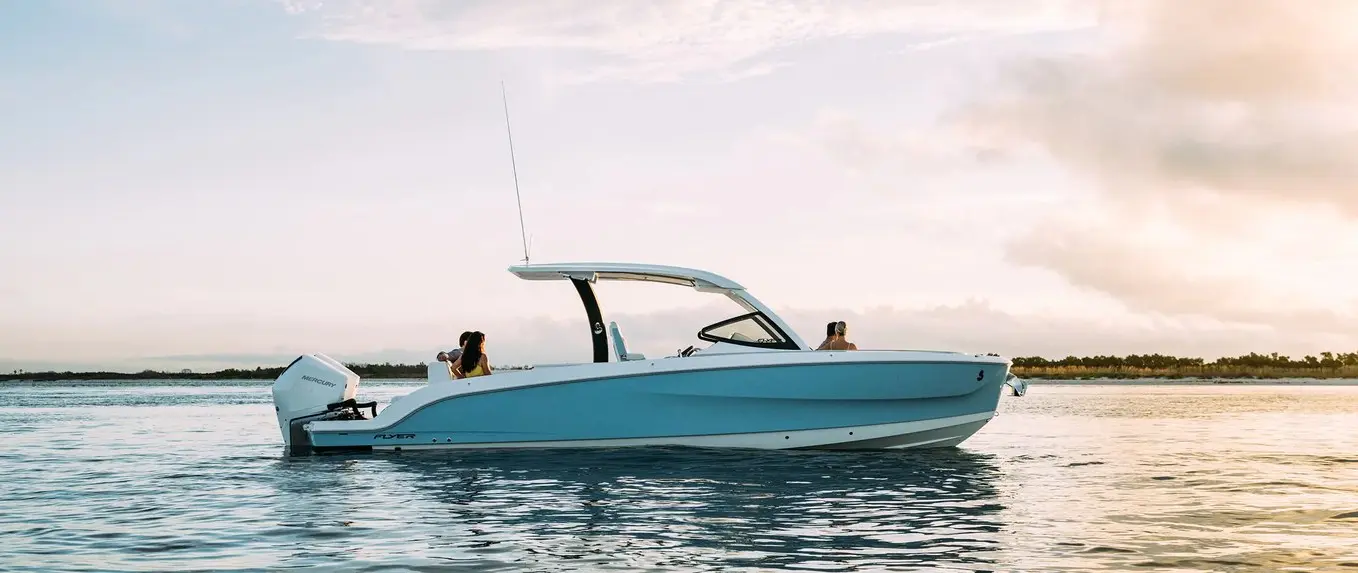
A new Flyer with a different deck philosophy
BENETEAU is extending its modern Flyer line with the Flyer 30, a new dayboat that emphasises fluid movement and adaptable use of exterior space. The design pairs a sporting hull with a more architectural arrangement above deck, including a protective roofline and seating zones connected by a largely single-level layout. This is a significant distinction from older dayboats whose circulation routes can be interrupted by deep steps, narrow passages or fixed furniture.
The company credits Michael Peters Yacht Design with naval architecture for the model. Its description frames the Flyer 30 as a boat for families and friends who might make an early coastal passage before spending most of the afternoon socialising or swimming. The new model's value will lie in how successfully it changes function during an ordinary day. It should be evaluated as a practical all-round dayboat, not only as a collection of striking design images.
Dimensions and a substantial fuel allowance
The official specifications give the Flyer 30 an overall length of 9.22 metres and a beam of 3.10 metres. BENETEAU publishes a 795-litre fuel capacity, equivalent to approximately 210 US gallons, and a 140-litre freshwater tank. Those are noteworthy capacities for a boat primarily marketed around open-air leisure. They support the possibility of travelling beyond a short afternoon circuit, although actual range must be calculated from measured fuel consumption and a sensible reserve.
The manufacturer describes twin-outboard propulsion and provides a maximum-power specification, but real performance depends on engine choice, hull loading and sea conditions. Buyers should resist treating fuel capacity as a guarantee of any distance or speed. A proper sea trial should cover the speeds at which the family will normally travel, manoeuvring close to a pontoon and comfort in the chop common to the intended cruising area. These observations are more useful than a headline top-speed estimate.
A walk-through deck built for social movement
The Flyer 30 uses what the builder calls a single-level asymmetrical layout to link the bow lounge, helm, cockpit and access to the water. An asymmetrical deck allocates space differently on either side rather than insisting on mirror-image walkways. BENETEAU's intention is to create a more generous social platform without sacrificing a practical route forward. On a nine-metre boat, that decision can affect how freely people circulate when several seating areas are occupied.
The wrap-around bow lounge includes details such as cupholders, dry storage and charging connections in the published layout. A bow seating area can be delightful in settled conditions, but guests should follow the skipper's instructions about when it is safe to occupy. Buyers should examine the height and continuity of handholds and the route around the helm. Good movement is a safety advantage only if the people aboard can use the arrangement naturally and securely.
Protection and a three-place helm
The builder highlights a curved, full-height windscreen with side windows and a wiper, combining wide outward views with better shelter than a minimal sports-boat screen. The driving position is arranged for three people, with adjustable seats intended to work both seated and standing. That means guests can share the forward view without crowding directly over the operator's controls, an important detail on a social boat that may spend many hours travelling between destinations.
The helm can be equipped with broad Garmin displays and other modern conveniences, including wireless telephone charging in the described configuration. These should be compared against the confirmed standard equipment list rather than assumed to appear on every boat. Owners should test whether screens remain legible in direct sun and whether vital switches are accessible without taking their eyes off the water. Protection, visibility and ergonomics form a connected practical requirement.
Flexible cockpit and useful galley facilities
Behind the helm, BENETEAU describes a wet bar with sink, work surface, storage and cupholders, along with adaptable cockpit seating. Backrests can change orientation, allowing the area to move between conversation, dining and sunbathing. This sort of design is especially valuable when the boat's owner regularly welcomes different groups. It can help a family spend a long day afloat without relying entirely on shore restaurants or an additional support craft.
The official equipment description also includes cooler storage and an optional drawer refrigerator, making it important to distinguish a standard insulated box from electrically refrigerated storage. A water supply and chilled provisions are useful, but owners should check drainage, tank service points and electrical demand before ordering. The practical test is whether the galley and seating leave enough unobstructed deck to move, board and handle gear when the boat is fully occupied.
Hull engineering and what still needs proving
BENETEAU describes a twin-step hull developed to improve lift and efficiency while preserving a composed ride. Stepped hulls can be effective in the right design and loading envelope, but a particular boat's behaviour needs testing with the engine installation actually ordered. The manufacturer's marketing statement should not be converted into an independent claim about superior fuel economy or rough-water capability. Buyers should seek evidence from comparable sea-trial conditions and understand the operational guidance in the owner's manual.
A full-beam transom passage and a broad boarding ladder are further examples of the boat's attention to everyday movement close to the water. The Flyer 30 is a fresh design that deserves consideration alongside other modern open cruisers, especially for families who value sociable seating without giving up useful weather protection. The next step for a buyer is a thorough inspection of the final standard specification, equipment options and safe operation of each convertible feature.
Explore our Beneteau company profile and consult the official manufacturer specifications for current equipment and availability.