
Why the enclosed Antares matters
The difference between a pleasant dayboat and a practical family cruiser is often measured in what happens when the weather changes. Beneteau's Antares 12 Coupé puts a substantial enclosed wheelhouse at the centre of its proposition, giving passengers a retreat from wind, spray and evening chill without surrendering outside access. The model complements the Antares 12 Fly, but takes a noticeably different route through the question of how people actually use their boats in variable conditions.
At 12.97 metres overall with a 3.78-metre beam, this is a substantial motor cruiser in the context of the Antares range. Those dimensions create room for proper separation between people who want to sit inside, guests using the aft cockpit and crew moving along the decks. Its appeal is less about a dramatic top-speed headline than about making repeated weekends possible in places where a sunny forecast cannot be assumed.
The styling reflects that practical mission. A long roof extends aft over the social area, broad hull windows break up the topsides and an integrated glasshouse gives the vessel an unmistakably cruising-focused profile. Sarrazin Design is credited for design work, with Beneteau responsible for development. Viewed as a whole, it is a boat designed to keep people comfortable for longer periods rather than to provide a single exhilarating afternoon.
Wheelhouse, cockpit and waterfront access
The main saloon is organised around a U-shaped seating area, storage and a galley, creating a sheltered gathering point when everyone comes indoors. An electrically operated glazed roof introduces light and ventilation above the dining space, while large surrounding windows help the helm and social zones retain an outside connection. This matters when children are resting or one adult is preparing food while another monitors progress on the chart.
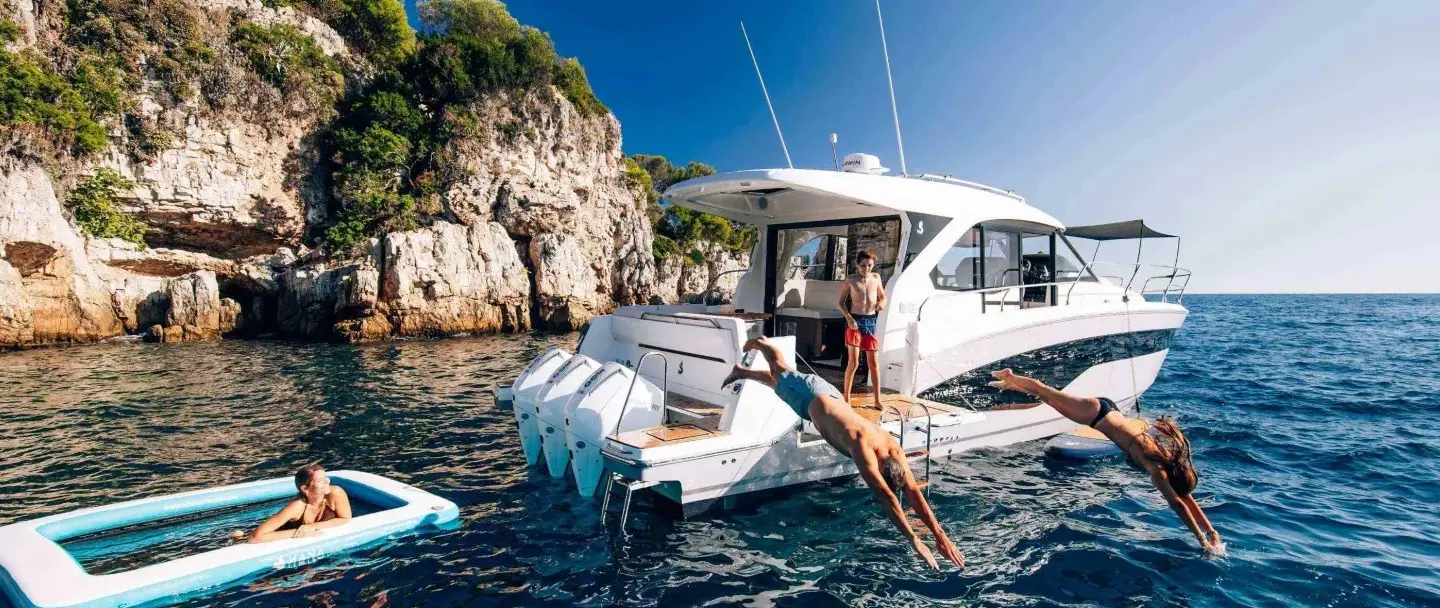
Beneteau has also treated the transition between the wheelhouse and cockpit as part of the usable living area. Opening glazing allows those spaces to communicate more naturally in settled conditions, while the long aft overhang provides a measure of shelter when sunlight becomes intense. An optional enclosure can add protection in cooler climates; a canvas sunroof in the canopy is another configuration choice rather than an assumed standard feature.
One distinctive feature is the electrically operated starboard side platform. Lowered in an appropriate anchorage, it broadens the water-facing area and creates a more useful spot for boarding a paddleboard or returning from a swim. Buyers should consider the practicalities of deploying this mechanism alongside a quay and how their intended berth is arranged, because a feature that is rewarding at anchor may have limited use when moored close to another vessel.
Accommodation and power decisions
The cabin plan is unusually flexible for a family cruiser below 13 metres. The principal cabin has its own bathroom, and the guest cabin has separate washing facilities, which can make a considerable difference when two couples or a family travel together. A third space can be configured as an extra bunk or used for storage, recognising that different owners bring very different amounts of equipment aboard.
Beneteau says the convertible wheelhouse seating and the below-deck spaces can provide sleeping accommodation for up to eight people. That figure illustrates flexibility, but it is not the same as eight independent permanent berths with equivalent privacy. Owners imagining long cruises should look closely at ventilation, overnight locker capacity and how easily a converted saloon becomes a comfortable dining area again the following morning.
Outboard propulsion choices are described by the builder as twin 400-horsepower engines or three 300-horsepower engines, paired with joystick manoeuvring capability. The published maximum power is 3 x 300 hp, and fuel is carried in two 587-litre tanks. Engine selection will affect running costs, maintenance access and the balance of stern space; any range assumption needs to be checked against the specific installation, loading and sea state rather than guessed from tank capacity alone.
Practical ownership and the bigger picture
The published draught is 1.1 metres and the maximum air draught is 4.4 metres, figures worth measuring against local marina constraints before committing to a berth. The stated CE category is B10/C12, but owners should always use the certified load and passenger limits applicable to their exact configuration. The suitability of a passage depends on planning, weather, equipment and competence rather than on an impressive category letter.
An optional gyroscopic stabiliser and connected monitoring through Beneteau's Seanapps ecosystem show how this category of boat is moving beyond basic weekend shelter. Stabilisation can reduce discomfort at rest for some users, while remote visibility of selected tank, battery and maintenance information may simplify ownership. Neither eliminates the need for ordinary checks, and buyers should establish exactly which hardware and subscriptions are included.
The Antares 12 Coupé ultimately makes most sense as a shared-use boat. Its sheltered social spaces, accessible aft deck and configurable sleeping areas allow a family to vary the day without constantly rearranging the vessel. It is not presented as a long-range ocean expedition craft; it is a capable coastal cruising platform whose strongest argument is the prospect of going boating more often, in more seasons, with fewer compromises.