
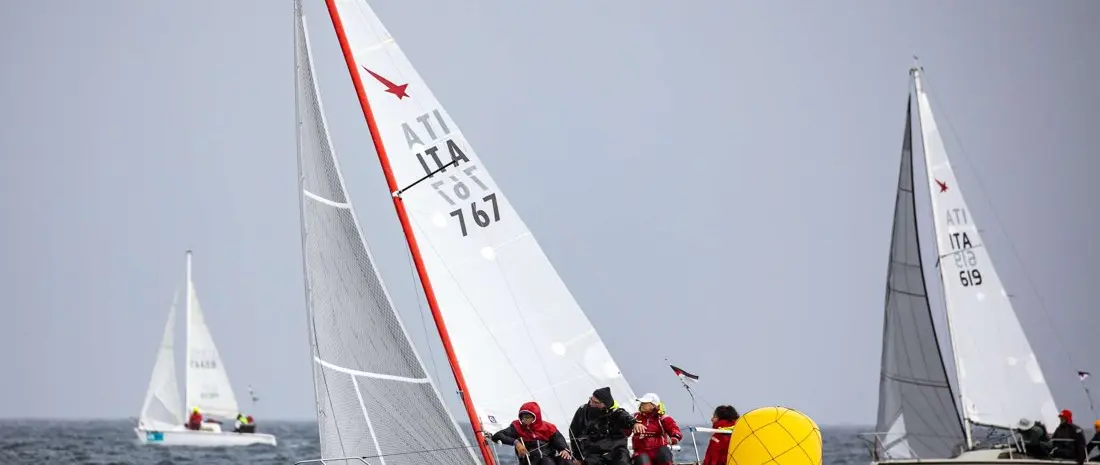
Basilico takes the Meteor title at Barcolana58
Basilico, helmed by Matteo Sampiero, has won the 53rd Italian Meteor Championship in the Gulf of Trieste, one of the many class events forming part of Barcolana58. The championship concluded off Grignano on 9 October 2026, with the winning crew finishing five races and a discard on seventeen net points. Enrico Michel's Frivolotto took second with twenty points, while Pekoranera Ensto, helmed by Davide Sampiero, completed the podium on twenty-two.
The regatta was organised by the Italian Sailing Federation together with Società Nautica Grignano and Società Velica di Barcola e Grignano. Sixty-two boats were classified, a substantial fleet for a tightly contested one-design keelboat event. The final order was subsequently reported by the class association, confirming that the racing produced more than a headline result for the leading team.
The winners came from Circolo Vela Erix
Matteo Sampiero sailed Basilico with Andrea Nocentini and Andrea Onnis, representing Circolo Vela Erix. Their success was built over a series in which the weather often limited racing, making it especially important to avoid expensive results when boats finally reached the course. Basilico had already moved into a promising position before the final day and managed to defend its advantage against determined rivals.
That approach is typical of a championship decided by a small number of races. A skipper must judge when it is worthwhile to seek clear air and a decisive move, and when preserving a strong finishing position is more valuable. Crew communication, sail handling and an ability to respond to changing wind can matter as much as raw speed around one part of the course.
A narrow margin separated the top three
Frivolotto, entered by the local Società Velica di Barcola e Grignano with Enrico Michel at the helm, ended just three points behind the champion. Pekoranera Ensto, also representing Circolo Vela Erix, was two points further back. Five points covered all three podium positions after five races and the permitted discard, illustrating how easily a single poor start or tactical mistake could have changed the standings.
The official results also named Ismo, helmed by Luca Taglialegne, fifth overall with thirty points. The local club therefore placed two boats among the leading five. That competitive presence reflects the benefits of familiarising crews with regional weather patterns and training against one another, although local knowledge does not replace the need to handle an unfamiliar wind shift or a difficult racecourse.
Youth and female-helm awards add depth
Bee Wave, helmed by Tommaso Salvi, finished ninth overall and led the Under-25 classification, earning the Trofeo Patelli. The best-placed female helm award went to Margherita Mesini aboard Bloody Mary, who was classified fourteenth overall. These results were announced alongside the main championship to recognise sailors whose achievements extend beyond the overall podium.
Class racing offers younger sailors a particularly useful learning environment when crews share broadly similar equipment and must make their gains through handling and tactics. Mixed-age fleets can create opportunities for mentoring and direct comparison with experienced competitors. The individual awards recognise achievement, but they do not imply that young sailors or female helms are operating in separate races from the wider fleet.
Weather made the four-day event complicated
The opening day was delayed by light wind, and only one shortened race could be completed after the course was set. Later races brought more varied conditions, including periods when the wind disappeared and the committee had to wait before attempting another start. By the closing stages, a thunderstorm system and a shift towards the Bora were affecting several Barcolana race areas, adding to the demands on organisers and competitors.
These conditions help explain why a four-day championship ended with five valid races rather than an uninterrupted daily schedule. Race committees must consider visibility, lightning risk, course stability and the ability of safety boats to respond before sending a compact fleet out to compete. A fair contest requires enough racing to distinguish crews, but achieving that cannot take precedence over safe operations on the water.
Meteor racing rewards precise small-boat handling
The Meteor is a small keelboat class that has developed a strong Italian following through club regattas and national championships. With modest crews and closely matched boats, there is little room to hide an untidy tack, an inefficient spinnaker manoeuvre or an inaccurate starting approach. Small differences in trim and positioning accumulate over repeated laps, especially when the wind changes direction during a race.
These characteristics make the class relevant to leisure sailors who want to develop their skills without organising a much larger offshore racing campaign. Owners should still remember that competitive equipment and experienced crews operate under established class and race rules. Participation requires suitable safety gear, a well-maintained boat and attention to each event's sailing instructions.
Barcolana gives a local championship a bigger stage
The Meteor regatta took place during Barcolana58, the extensive sailing festival that culminates in the main Autumn Cup off Trieste. Events throughout the week bring different categories of yachts, community programmes and visiting crews to the region. The waters off Grignano and nearby Miramare Castle formed the backdrop for the Italian Meteor fleet, while other racecourses hosted classic yachts and larger offshore competitors.
Being part of a wider sailing festival can give a class championship greater visibility, but it also creates logistical complexity. Race areas, support boats and spectator traffic need to be coordinated across a crowded harbour environment. Leisure boaters visiting Trieste should observe race notices and stay clear of competition areas, particularly when dense fleets are starting or rounding marks.
A new champion with more racing to come
After the national championship, the leading Meteor crews were invited to continue racing in the Barcolana By Night Regional Cup in the San Giusto Basin, alongside selected young competitors. That follow-up event provides a different setting and another chance to compete, but it does not change the result of the national title already earned off Grignano. For the winning Basilico crew, the central achievement is the 2026 Italian crown.
The results also provide a useful snapshot of a healthy small-keelboat racing community: a large starting fleet, a close podium and specific recognition for emerging sailors. For visitors accustomed to seeing Barcolana through the spectacle of its largest race, the Meteor championship demonstrates how much competitive sailing also takes place in smaller boats during the festival.