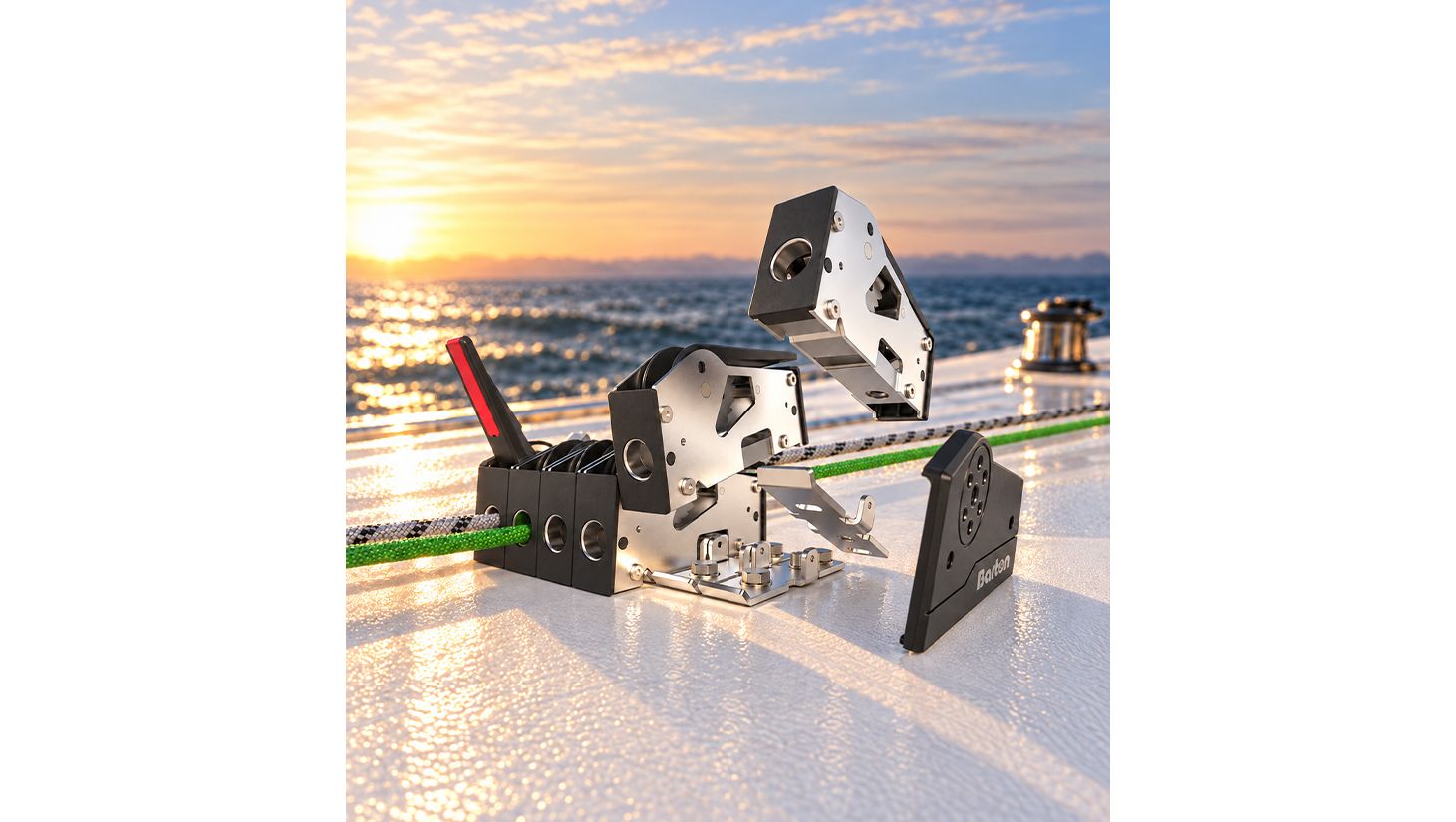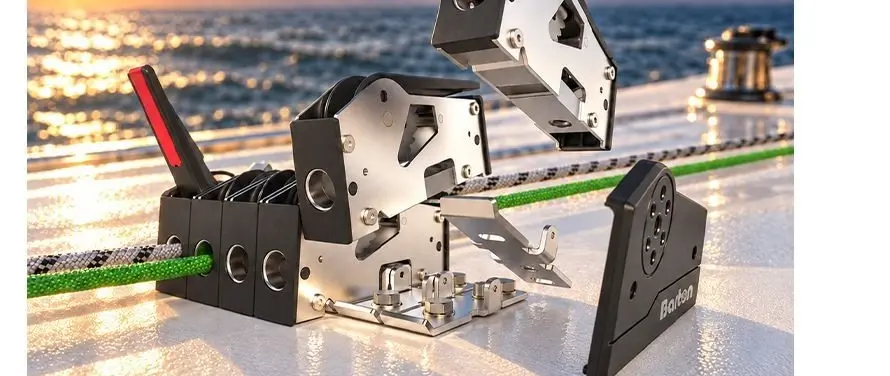
British equipment manufacturer Barton Marine has introduced the MCS 1000, a modular rope-clutch system for sailing boats, at METSTRADE 2026 in Amsterdam. A British Marine member announcement dated 10 November describes a new arrangement in which owners can begin with a clutch and two end plates, then add individual modules to build the number of clutches needed for a particular deck layout. Barton quotes compatibility with lines from 6 to 12 millimetres and a maximum holding capability of up to 1,000 kilograms on suitable larger-diameter rope. For owners of sailing craft under twelve metres, the interest is practical: a compact bank of controls may be easier to specify, fit and maintain than several unrelated clutch units. The quoted capacities still require careful matching to individual rope and load conditions.
A modular approach to a familiar deck fitting
A rope clutch holds a control line while allowing a sailor to release or adjust it when appropriate. Clutches are often fitted where halyards, reefing lines or other sail controls lead back to the cockpit. On a compact boat, several lines may need to be handled from a small area of coachroof or deck. Conventional independent clutches can occupy considerable space, especially if several different models have been added over time. Barton's new system aims to create a common structure that can be expanded as needed. The idea is not to eliminate every separate fitting on deck, but to give builders and owners more control over the layout of a bank of clutches.
How the starter pack works
According to British Marine's presentation of the Barton product, an owner can buy a starter pack with two end plates and a single clutch, then add bare internal clutch modules. These modules are intended to lock side by side, producing a group sized to the boat's requirements. The company describes banks containing one, three or even ten units. The example of ten is a statement about modularity, not a suggestion that every small yacht needs a large assembly. A boat with just two sail controls may require only a modest fitting. The important advantage is that the layout can be specified deliberately instead of being built up through a series of separate purchases.
Why rope diameter matters
Barton describes the MCS 1000 as compatible with ropes between 6 and 12 millimetres. A wide range can be convenient for owners whose boats use different line sizes, yet compatibility must not be taken as proof that every rope will grip identically. Line construction, fibre type, cover texture, age and wetness can affect how a clutch behaves. A soft line may flatten differently from a stiff high-modulus rope, and a highly loaded halyard may demand particular handling. Buyers should consult the manufacturer's detailed load and compatibility tables and test the arrangement under controlled conditions. A generic diameter range is only the starting point for a safe specification.
The quoted load requires context
The announcement refers to holding performance up to 1,000 kilograms on larger rope diameters. That is a substantial figure for an accessory fitted to a leisure sailing boat, but it is not a universal safe working load for every line size or installation. The structure supporting the clutch must also resist the transmitted loads. Deck laminate, reinforcement, backing plates, fasteners and the angle of the line all matter. Owners should distinguish breaking strength, holding performance and the appropriate working load specified by the manufacturer. A product can have an impressive laboratory capability yet still be unsuitable if the supporting deck or rope arrangement is not engineered correctly.
Cam teeth are intended to protect rope
Barton describes a cam-tooth profile designed to grip while reducing damage to the line. Rope protection is a meaningful consideration because halyards and control lines can be costly, and damaged covers may reduce reliability. A clutch that slips can create sudden changes in sail trim, while one that grips too aggressively can accelerate wear. The manufacturer's claim should be understood as a design objective rather than a promise that ropes will never suffer abrasion or compression. Regular inspection remains necessary, particularly where a line enters at an angle or is held under repeated high load. The crew should also know how to release a loaded clutch without causing uncontrolled line movement.
A compact bank can make the cockpit neater
The greatest benefit of a modular system may be seen in the arrangement of lines returning to the cockpit. A well-planned bank can create an obvious order for controls, allowing crew members to identify a halyard or reef line without searching among scattered fittings. But compactness is not an end in itself. Clutches must be accessible, and crew members need enough room to operate handles safely while using winches. Lines should enter the clutches at appropriate angles and leave without excessive friction. A neatly aligned group will not work well if it forces a poor lead from a deck organiser. Layout planning is essential during both new construction and refurbishment.
Replacement may make use of existing holes
Barton says its new base plates can allow replacement of some other brands' units using existing drilling patterns. That could be useful for a boat owner who wants to improve the deck arrangement without making additional holes through a coachroof. Yet the company does not claim universal compatibility with every old clutch. Owners should measure the existing fixing pattern, inspect the condition of each hole and confirm the backing structure before ordering. Old fastener holes may contain moisture or damaged material and require professional repair even if a new plate lines up. Reusing a hole is valuable only when its condition and structural suitability are established.
The base-plate idea also helps boatbuilders
For original equipment manufacturers, Barton suggests fitting base plates during production and supplying clutch modules in a finishing pack for installation during the pre-delivery inspection. That may reduce the risk of components being damaged while a boat is transported, stored or completed at a dealer. It may also give builders flexibility to change the number of modules late in the process. Those are potential manufacturing advantages rather than verified savings for every production line. A builder would need to examine costs, assembly times and how the modules interact with deck mouldings. The system's success in production depends on repeatable quality and straightforward installation as much as the theoretical ease of changing the configuration.
Two stock units simplify the supply chain
British Marine notes that suppliers could carry a starter pack and additional internal modules rather than numerous preconfigured clutch banks. Reducing the number of separate stock-keeping units can help chandlers, distributors and repair businesses serve a wider variety of customers. This is a meaningful design objective because a boat owner may need replacement parts years after a model was built. A simplified stock arrangement is only useful, however, if parts are actually available and compatible over time. Dealers should confirm how modules, end plates, handles and any service parts will be supplied. Long-term support matters to owners who intend to retain their sailing boats for many years.
Stainless steel and engineering polymer form the structure
The announcement identifies 316 stainless steel and a marine-grade Nylon 7 material among the components used. These materials are commonly selected because they can offer a combination of strength, wear characteristics and resistance to the marine environment. Their presence does not make the assembly immune to corrosion, ageing or incorrect installation. Stainless steel can suffer problems in certain conditions, and polymer components need to be used within their rated limits. Owners should follow the maker's maintenance recommendations and avoid applying aggressive cleaners or lubricants without checking compatibility. Any fastener specification should also consider galvanic interaction with nearby metals and the suitability of the deck structure.
Design for eventual maintenance and recycling
Barton says the modular approach allows components to be separated for refurbishment and recycling, and that base plates or side cheeks may be retained during a later refit. This is a useful life-cycle consideration because equipment is often replaced when only part of it has worn. Separating different materials can support responsible disposal, but the actual environmental benefit depends on service life, local recycling facilities and what components can be reused safely. The announcement does not provide a verified life-cycle assessment or a quantified carbon saving. Buyers should therefore regard repairability as a practical feature worth investigating rather than infer a specific environmental performance that has not been independently demonstrated.
The role of a clutch when reefing
On a small cruiser, reefing lines can be among the most important controls led back to the cockpit. A clutch must hold the chosen line reliably while the sailor reduces sail area and manages the load on a winch. If the line slips unexpectedly, sail shape may change and crew members can be surprised by a sudden movement. A modern clutch can make the operation more convenient, but successful reefing still depends on proper line routing, sensible load management and crew training. Owners should label each control and ensure everyone aboard understands how it is used. A better-fitting clutch bank can support those practices without replacing them.
The relationship with winches and deck organisers
A clutch is rarely an isolated fitting. Its performance depends on how the line travels from the sail or mast, through organisers and turning blocks, to the clutch and winch. Sharp angles, excessive friction and poor alignment can damage rope or overload a fitting. When retrofitting a modular bank, a rigger should assess the whole path rather than simply match the old fixing holes. The most convenient position for a handle may not be the position that produces the best rope lead. Owners of boats under twelve metres sometimes have limited room to improve an existing arrangement, which makes careful measurement particularly valuable before drilling or purchasing.
A demonstration is more useful than a photograph
The MCS 1000 was introduced to the trade at METSTRADE, where visitors were invited to examine the system at Barton's stand. A physical demonstration can answer questions that a product brochure cannot. Prospective buyers can observe the handle movement, the way adjacent modules connect and how different line diameters are held. They can also examine whether the base plates suit a particular deck. A photograph may make a clutch appear compact, but it cannot show whether there is sufficient clearance for a winch handle, other controls or a crew member's fingers. Those practical details should be addressed before specifying a new bank for an existing yacht.
The price and availability need confirmation
The British Marine announcement describes the launch and product design but does not establish a single retail price for every configuration. Because the system is modular, total cost will depend on the number of units, base plates, fasteners and installation work. A boat owner should obtain a complete quotation from an authorised supplier and clarify which components are included. Availability may also vary between regions following the Amsterdam introduction. Claims about universal compatibility or immediate stock would go beyond the source. The manufacturer's current technical sheet, parts list and warranty information should be reviewed before making a purchase.
An interesting improvement for compact sailing boats
The MCS 1000 addresses a practical problem that owners and riggers have faced for years: fitting several sail-control clutches neatly, maintaining the correct rope grip and keeping components serviceable over time. Its modular architecture, 6–12 millimetre rope range and stated load performance make it a development worth examining for small cruisers and racing boats. Its benefits will depend on proper engineering, not simply the number of modules that can be joined. The November 2026 METSTRADE launch provides a starting point for comparison and professional assessment. For Leisure Boat Guide readers, the key question is whether a well-planned clutch bank can make routine sail handling clearer, easier and more dependable on their own boats.
Official sources and photography
Reporting independently based on Original primary publisher announcement.
Original lead product photograph: Barton Marine MCS 1000 modular rope clutches mounted on a sailing-boat deck, subject-centred crop of original British Marine member press photograph. Original image rights remain with the source publisher and photographer. Official press-image source.