
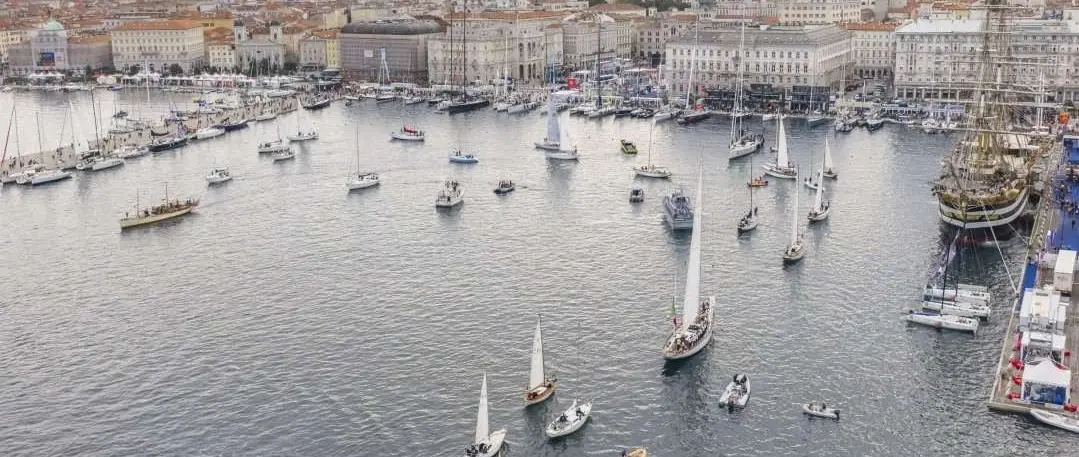
Final registration count gives Trieste an exceptional fleet
Barcolana58 presented by Generali has closed entries with 1,858 sailing boats registered for its flagship Autumn Cup in the Gulf of Trieste on Sunday 11 October 2026. The final count was confirmed by organiser Società Velica di Barcola e Grignano as teams made their preparations along the city's waterfront. It is a substantial increase from the 1,300 entries reported during the opening week and gives the event one of the largest fleets in recreational racing.
The announcement concerns entries, not the number of yachts confirmed to finish the race. Weather, technical issues and last-minute crew decisions can affect the number of starters, while the eventual finishing order depends on conditions on the course. What is already established is the scale of participation and the logistical work required to bring such a varied fleet onto the water.
A traditional cannon start connects many kinds of yacht
The organiser scheduled the Autumn Cup for 10:30 local time on 11 October, using the traditional starting cannon to send the fleet onto the course. Barcolana is unusual because privately owned family sailboats, smaller racing craft and much larger yachts can share the same spectacular opening scene. The mass start draws spectators to quays, viewpoints and supporting vessels around the Gulf of Trieste.
Such variety demands careful seamanship. A small cruiser may not accelerate or turn like a highly optimised racing yacht, and both may be operating close to many other boats during the early stages. Competitors need to study the sailing instructions, keep a proper lookout and be realistic about their manoeuvring room. Spectators on leisure boats should remain outside the restricted areas and avoid adding to congestion.
The organiser credits a large support operation
Mitja Gialuz, president of Società Velica di Barcola e Grignano, reported that approximately 1,250 people were involved in organising and delivering the festival. Their work covers more than the race committee: marshalling, registration, safety, waterfront access and supporting programmes are necessary to manage a sailing event of this scale. The organiser described the 1,858-boat result as close to the preceding year's figure.
A visitor may see the fleet as an astonishing photograph, but much of the event's achievement lies behind the scenes. Entry processing, communications and coordination with local authorities all become more demanding as participation increases. The same applies to a modest club regatta on a smaller scale: clear instructions, trained volunteers and credible emergency arrangements are essential foundations for enjoyable racing.
Women's sailing produces its own result
Before the main race, the Barcolana Women in Sailing by Generali event took place in Seascape 18 one-design yachts, with the aim of encouraging women to take more active leadership roles on board. Originally scheduled for Friday and postponed because of unsuitable weather, the event was eventually sailed in extremely light winds. The organisers managed to complete one race, won by Michela Stefani ahead of Jamila Cerdeira and Ivica Kostelić.
The event's significance extends beyond the result. Mixed-gender crews and an emphasis on leadership can create opportunities for less experienced sailors to take responsibility for tactical decisions, helm work and sail handling. The Seascape 18 is a comparatively compact boat, making it useful for an intensive short-format competition where teams must cooperate effectively under changing conditions.
The classic fleet encounters difficult conditions
Light wind disrupted more than one programme during the build-up. The Barcolana Classic – Trofeo SIAD was unable to complete its planned race following the traditional parade in the San Giusto Basin, while the Este24 European title also remained undecided because suitable racing conditions did not develop. These decisions underline the difference between attracting a large entry and guaranteeing a full competitive schedule.
Light weather may appear harmless, but it can create its own challenges. A boat moving slowly has less steerage, particularly in a crowded fleet, and the race committee may struggle to establish a fair course if the breeze changes direction repeatedly. Cancelling or delaying a race can therefore be a necessary sporting and safety decision, not evidence that the organisers have underestimated the fleet.
Ocean research enters the waterfront programme
Philanthropist and sailor Wendy Schmidt visited Barcolana Village, including The Ocean in Me installation and the Deep Blue Exploration Zone. She also met students involved with the Ocean Research Challenge, a project encouraging young people to consider practical responses to marine environmental problems. Schmidt was due to sail the main Barcolana race aboard a Melges 24, connecting the education programme with participation on the water.
That meeting demonstrates how a large sailing festival can support projects beyond sporting results. Research vessels and advanced underwater equipment may attract attention, but practical ocean literacy begins with understanding ecosystems, pollution pressures and how everyday boating decisions affect the sea. Students can bring new perspectives to those questions, while experienced sailors can contribute observations from time spent on the water.
An inclusive programme accompanies the Amerigo Vespucci
The event programme also incorporated activities associated with the Amerigo Vespucci and the final stop of the Vespucci World Tour's North America campaign. A village at Molo dei Bersaglieri was scheduled to host meetings about disability and sporting opportunities, including the VELANDO project. Organisers also arranged selected ship visits for people with disabilities, extending the festival's reach beyond active yacht crews.
Access to tall ships and working waterfronts can be difficult for people with limited mobility, so a structured visit requires attention to boarding, gangways, staff assistance and suitable timing. These activities matter because an international sailing event should provide ways for non-racers and people with different needs to take part in the maritime atmosphere. The details of each visit remain subject to the organisers' safety arrangements.
The final count is not the final race result
Barcolana58 combines a major competitive race with exhibitions, village activities, education and cultural events spread across Trieste. In that context, the registration figure of 1,858 boats is a significant organisational milestone, but it should not be confused with either the starting list or the eventual trophy winner. Any report declaring a race victory must wait for verified results from the event organisers.
For recreational sailors, the attraction of Barcolana remains its shared experience: crews of different backgrounds preparing their boats, choosing sails, studying the forecast and entering the same waters. The closing entry count illustrates the endurance of that tradition. Whether the wind proves light or brisk, the event depends upon well-prepared participants, attentive safety teams and respect for the conditions in the Gulf of Trieste.