
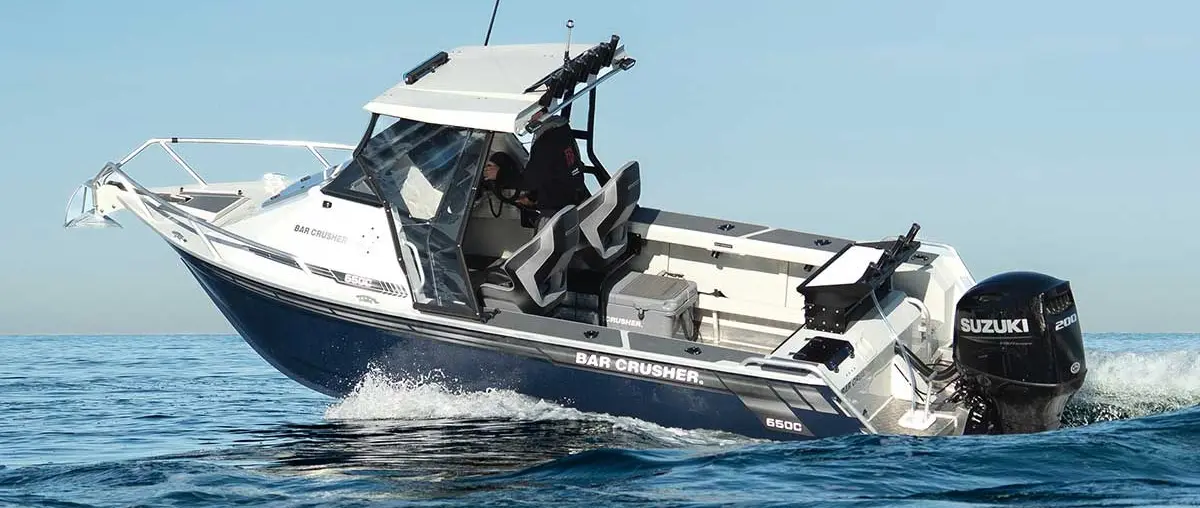
Two New Boats Enter the 6.5-Metre Gap
Australian builder Bar Crusher brought two additions to its fishing-boat range to the Melbourne Boat Show in October 2026: the 650C cuddy cabin and the 650HT hard top. Both occupy the space between the established 615 and 670 families. The move gives buyers who found a smaller model restrictive, but did not need the size of the 670, a fresh pair of configurations to assess in the popular trailerable offshore fishing category.
The manufacturer announced the boats ahead of the show held at Docklands from 15 to 18 October. The company has since published dedicated model specifications, making it possible to examine the two craft beyond the initial launch announcement. Although the names suggest different styles, the decision between them is about more than appearance. Weather protection, trailer height, cabin access and the way the crew uses the cockpit all matter to an owner.
Shared Measurements, Different Deckhouse Choices
Both models are listed at 6,450 millimetres overall with a 2,290-millimetre beam. Bar Crusher publishes internal freeboard of 790 millimetres and a maximum capacity of six people for each. The manufacturer also lists 215 litres of fuel capacity and a ballast capacity of 360 litres. These common numbers create a useful baseline when evaluating the actual layout differences and the effect of the roof on ownership and use.
The shared length does not mean the two boats have identical weights or storage requirements. The published dry towing figure is approximately 1,840 kilograms for the 650C and 1,920 kilograms for the 650HT, before the full realities of equipment and a trip-ready load are considered. Bar Crusher explicitly warns that weights and measurements are approximate and should be verified with a dealer before ordering. Buyers must check towing limits with the complete trailer package in mind.
The 650C's Cuddy Cabin Approach
On the 650C, Bar Crusher emphasises a cuddy arrangement, folding hard top and windscreen, and a rear bench that can be folded away to maximise usable fishing space. The cabin gives passengers some shelter while maintaining a configuration oriented around anglers moving to rods and tackle. The manufacturer positions the model for activities ranging from a coastal fishing day to an overnight stop in a bay, although the buyer should assess how comfortably its cabin suits their own plans.
The folding roof is particularly relevant to owners who keep a boat at home or pass through height-restricted storage entrances. Bar Crusher gives a trailer height of roughly 3,010 millimetres with the roof raised and 2,210 millimetres with it folded. Those figures can affect whether an otherwise suitable boat fits a driveway or building. An owner should measure actual clearance and allow for the complete trailer and accessories, not assume nominal specification figures guarantee a fit.
How the 650HT Differs
The 650HT trades the cuddy version's folding roof arrangement for a more fixed, sheltered hard-top helm environment. Bar Crusher highlights a toughened safety-glass windscreen intended to give extensive visibility, along with an open working cockpit and its Game Lock coaming. The enclosed-feeling upper structure may appeal to anglers who spend longer hours exposed to wind or spray, but it naturally changes the boat's profile when stored and transported.
The builder lists an approximate 3,150-millimetre height on the 650HT trailer, and the specification does not give an alternative folded-roof height. That could be decisive for owners comparing garage or shed storage with outdoor parking and a cover. In return, the hard-top layout offers more permanent overhead protection. The choice should be made on how the boat is genuinely used, not simply on which version looks more purposeful in a show display.
Plate Aluminium Construction
Bar Crusher builds its fishing craft in plate aluminium and applies a range of named construction systems to the 650 models. Both published sheets give five-millimetre bottom plating and four-millimetre top sides. The company promotes its Rigideck engineered sub-floor arrangement as part of the structure. Those are measurable specification points, although claims about relative toughness or performance require independent comparative testing to establish beyond the manufacturer's own descriptions.
An aluminium fishing boat has a different maintenance profile from some composite craft, but it is not maintenance-free. Owners still need to care for electrical connections, deck hardware, paint finishes and any fittings where dissimilar metals meet. Regular inspection after saltwater trips remains sensible. Buyers should ask the dealer about the specific build, warranty and recommended care schedule rather than assuming that a particular construction material automatically makes a boat suitable for every task.
The Hull, Ballast and At-Rest Behaviour
Both boats use Bar Crusher's Waveslicer deep-V hull philosophy and Quickflow water-ballast system, according to the company's product pages. The builder presents the hull design as a means of managing motion underway and the ballast arrangement as a way of improving steadiness when stopped. The listed ballast capacity is 360 litres for each 650. These features are relevant for crews standing on one side to fish or working in exposed coastal conditions.
The balance between underway ride and stability at rest is one of the recurring challenges in small offshore fishing boats. No hull removes the need to read weather, waves and loading, and a ballast feature should not be treated as permission to ignore seamanship. A meaningful sea trial would examine steering, trim response, heel at rest and how the boat behaves with a realistic crew and fishing equipment. Those observations are more valuable than design claims viewed alone.
Outboard Power and Tank Capacity
Bar Crusher specifies a 150-horsepower minimum and 200-horsepower maximum outboard rating for both the 650C and 650HT. That allows buyers to discuss propulsion packages with a dealer within an established rating window. The 215-litre fuel tank is another planning reference, but it does not by itself establish the boat's range. Consumption will depend on the particular engine, cruising speed, sea conditions, propeller selection and the load carried.
For a fishing crew planning an offshore trip, safe range calculations must include the outward leg, the return, an appropriate reserve and the possibility of less favourable weather. A larger outboard can alter acceleration and running characteristics, but it can also affect the total package price and running costs. These are considerations for a real boat-and-engine quotation, supported by performance data and a trial in conditions appropriate to the owner's intended use.
Fishing Space and Practical Details
The builder highlights large working cockpits, rod-carrying arrangements and purposeful transom access across the new models. The 650C's fold-away rear seat can open the space needed for active fishing, while the 650HT uses its coaming and hard-top layout to support an extended day on the water. Differences in seating, sightlines and the ability to move around the boat are worth checking in person with the number of people normally aboard.
Features that appear minor in photographs can be important during an ordinary trip. Crews should look at where wet gear is stored, how fish and bait are handled, whether deck drainage remains clear and how safely an angler can work at the stern. Bar Crusher also lists its Bar Catch trailer-launch system in the product information. Buyers should watch a complete launch and recovery demonstration, particularly if they expect to operate with a small crew.
The Buying and Towing Equation
The 650 range's trailerable size will be a major part of its appeal, but storage and towing should be assessed before settling on the preferred cabin. Bar Crusher lists an overall trailer length of about 8,060 millimetres for both models and a trailer width of 2,290 millimetres. Those figures make the entire package substantially larger than the bare hull length, especially when considering parking space or the ability to manoeuvre around a residential property.
The published dry tow weights also exclude some of what an owner will carry on a normal trip. Fuel, water, safety equipment, anchors, batteries, tackle and personal gear can add appreciably to the loaded combination. Vehicle towing capacity, towball limits and local road requirements must be checked against the actual completed package. Anyone who intends to use a compact family vehicle should do that calculation early, before an attractive boat specification becomes an expensive logistical problem.
What the Launch Adds to Bar Crusher's Range
The October introduction gives Bar Crusher a fresh intermediate choice in two familiar styles rather than forcing customers to choose only between its existing 615 and 670 offerings. The 650C can suit buyers who value a flexible roof and easier height management, while the 650HT makes a case for more permanent protection at the helm. Their shared dimensions, engine rating and fuel capacity help buyers concentrate on the functional difference between the layouts.
The company's launch material also placed the models within a wider display of fishing boats at Docklands, supported by show-specific equipment promotions. Those offers related to the October event and should not be assumed to remain available in November. Prospective buyers now have an advantage over early visitors: the published model sheets give clearer figures to examine before a dealer visit. A realistic sea trial, complete quotation and verified towing assessment remain the next steps.
Source: Bar Crusher – 2026 Melbourne Boat Show introduction and official 650 model specifications.