
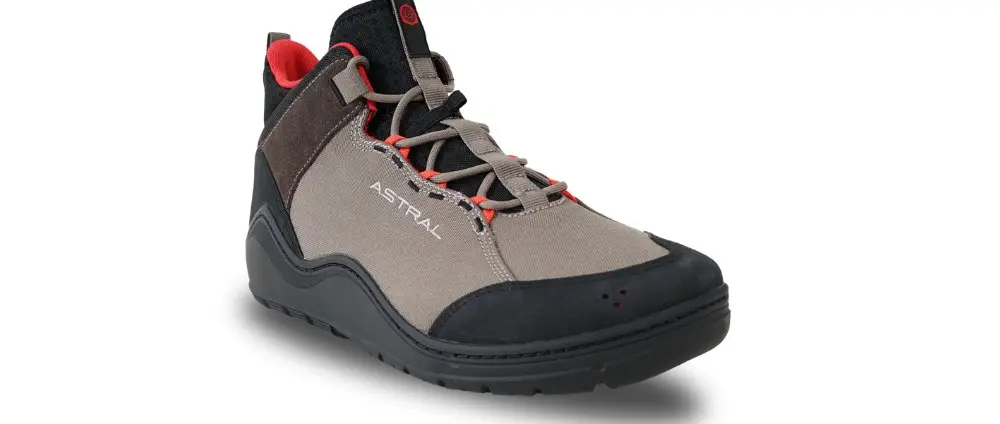
Footwear developed for demanding rivers
Astral has presented the Pusha amphibious boot as a candidate in the Paddle Sports Show's 2027 apparel and equipment selection. The design is aimed at paddlers who regularly move between wet terrain and a boat, including challenging river approaches with slippery rocks and uneven banks. Its main attributes are a high-traction rubber outsole, reinforced fabric upper and low-profile footbed intended to maintain control without unnecessary bulk.
A reliable pair of shoes can contribute to safety before a kayak even enters the water. Carrying a boat across wet stones or stepping from a moving raft onto shore involves different forces from walking on a dry pavement. The Pusha's product concept responds to that particular environment, although the correct footwear still depends on the demands of the location.
A sticky G.ss Rubber outsole
Astral identifies its G.ss Rubber compound as the principal material of the Pusha's outsole, intended to offer traction on slippery rock and other surfaces encountered during river activity. The sole is bonded and stitched to the upper, a construction approach designed to provide a secure connection between the parts under repeated wet use. That may be valuable where equipment is exposed to abrasion and flexing.
Traction should never be interpreted as an ability to walk safely on every wet surface. Algae, polished rock, mud and oil can alter how rubber responds, and a paddler needs to remain cautious about footing. A buyer should compare tread design, sole stiffness and fit rather than rely on a manufacturer's description of grip alone.
The meaning of a 900-denier canvas upper
The boot uses a 900-denier canvas upper, a relatively substantial fabric selected for resistance to wear in demanding environments. A rough riverbank can damage ordinary lightweight footwear quickly, and repeated contact with kayak outfitting may abrade the toe or sides of a shoe. The Pusha is designed to tolerate this kind of use while remaining suitable for movement in and around a small craft.
Fabric strength is only one part of durability. Stitching, sole adhesion and the way water drains or remains inside the boot also affect how the product performs over a season. Owners should follow the maker's care instructions and inspect areas that experience repeated abrasion, especially after a journey involving sharp rock or gravel.
A zero-drop Level Footbed
Astral specifies a Level Footbed with zero drop, keeping the heel and forefoot at a similar height instead of elevating the rear of the foot. The manufacturer pairs this arrangement with its Biodynamic Shape, intended to allow a natural position and steady contact with uneven ground. These features are aimed at control when carrying gear or moving around slippery approaches.
A zero-drop platform can feel different from conventional walking footwear. People used to substantial heel support may not find the change immediately comfortable, especially when wearing a loaded backpack or carrying a heavy boat. The right fit should be assessed during a proper trial rather than assumed from the design description.
An amphibious boot means mixed conditions
The Pusha is described as amphibious because it is intended for use in and out of water rather than for dry hiking alone. The upper and outsole must manage repeated immersion, drainage and contact with wet surfaces, while remaining secure enough for climbing a bank. For kayak owners, that means one item may potentially serve a full river outing rather than requiring frequent footwear changes.
This does not make the boot a substitute for insulating or protective footwear in every cold-water environment. Water temperature, clothing layers and the duration of immersion determine whether additional protection is necessary. Paddlers should also ensure the footwear fits inside their kayak or raft without obstructing controls or interfering with an emergency exit.
Why foot security matters in a cockpit
An overly bulky shoe may press against a kayak's footrests or make movement difficult in a confined cockpit. Conversely, footwear that fits loosely may slip when a person needs to brace or exit the craft. The Pusha is intended to combine a secure fit with a foot shape suitable for active paddling, though each kayak has its own dimensions.
Trying the boots inside the actual boat is therefore important. A paddler should be able to move the ankles, operate foot controls and leave the cockpit promptly if necessary. In a pedal-driven craft, loose laces or excess material must not become entangled in moving components. Practical compatibility matters more than how rugged the boot looks.
Care after river outings
Mud, grit and river sediment can remain within footwear long after an outing ends. Cleaning and drying the Pusha according to Astral's instructions can help protect the upper and reduce unnecessary wear. The sole should be checked for embedded stones, and signs of separation between materials deserve attention before the next trip.
Moving between waterways also raises environmental considerations. Small organisms or plant material can travel on wet boots, making cleaning and drying relevant to invasive-species prevention. Following local instructions for equipment decontamination contributes to protecting the next river or lake visited.
What the 2027 product entry confirms
Astral's Pusha has been put forward in the 2027 apparel and equipment selection, with its official photograph depicting the actual boot rather than a generated hero image. This is a product presentation and not proof that the design won an award or has passed any particular independent traction test.
The most useful assessment is a fitting with the footwear used for the intended activity, followed by careful observation of how it performs on familiar, suitably safe ground. For river paddlers and small-boat crews who regularly encounter difficult shorelines, dependable footwear deserves the same attention as a suitable paddle or flotation device.