
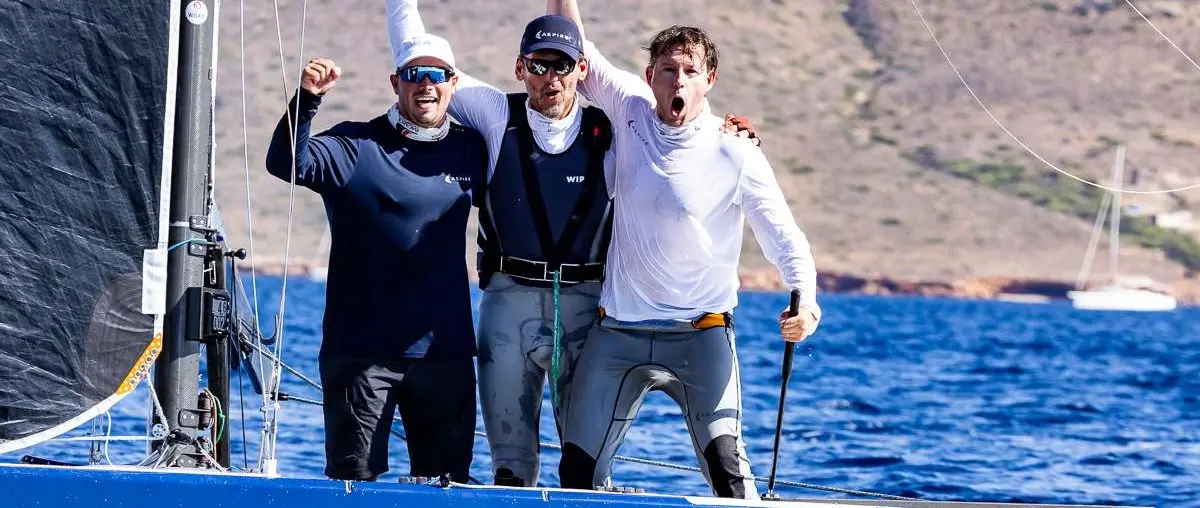
Aspire clinches the world title in Lavrion
The Polish-flagged 5.5 Metre yacht Aspire has won the 2026 World Championship in Lavrion, Greece, completing a tight final-day duel with Norway's Artemis. The championship was decided on 9 October after two races in a southerly breeze of approximately eight to ten knots, with Aspire finishing the eight-race series on sixteen points. Artemis ended on eighteen points, while Ku-Ring-Gai III took bronze with twenty-seven, just one ahead of Ali-Baba.
The decisive result is significant because the fleet had already spent much of the event waiting for usable racing weather. Organisers lost six days out of nine to strong winds, leaving crews with limited opportunities to establish a reliable points advantage. The closing races therefore carried more weight than a normal regatta day, with small errors capable of reversing the championship standings.
The final race settled a one-point contest
Ahead of the last start, Aspire and Artemis were separated by a single point. In the penultimate race, Ku-Ring-Gai III took the win, while Aspire recovered from a less convincing opening beat to finish third. Artemis came home eighth, bringing the title fight back into close range. The championship had become a contest of composure as much as boatspeed, with each team aware that one more mistake could be decisive.
In the eighth and final race, Aspire established an early advantage and led around the first windward mark before staying ahead to the finish. Artemis worked through the fleet to second but could not overturn the remaining points deficit. The result underlined the benefit of keeping tactical decisions clear under pressure: the eventual champions did not simply defend their earlier position, but sailed assertively when the series required a winning performance.
Three experienced sailors formed Aspire's crew
Aspire was raced by helmsman Przemek Gacek, Olympic gold medallist Mateusz Kusznierewicz and Kilian Weise. Kusznierewicz, a highly experienced international sailor, has been involved in the crew's earlier 5.5 Metre successes, but the 2026 triumph came with Gacek on the helm. The team described its strengths in terms of consistent starts, sail trimming, communication and a willingness to keep fighting for places after a difficult beginning to a race.
The combination of established experience and continuing development is central to the story. The same crew had previously won a world title in 2023, then returned to the podium with bronze and silver in later championships before regaining gold in Greece. Each campaign supplied lessons about the boat, the fleet and race management that were relevant during a particularly demanding week in Lavrion.
The podium contest remained open to the finish
The battle for third was nearly as close as the fight for the championship. Ku-Ring-Gai III, sailed by Jay Cross, Rob Scrivenor and Andrew Palfrey, won the seventh race and moved within a point of Swiss entry Ali-Baba. With MELX IV well placed in the final race, Ku-Ring-Gai III only needed to maintain a sufficiently strong finish to take the bronze medal. The Australian-associated crew delivered fourth in that last race.
Ali-Baba, raced by Flavio Marazzi, Julie Marazzi and Eline Marazzi, finished fourth overall on twenty-eight points. Britain's Girls on Film completed the top five on thirty-two. The narrow margins illustrate that several teams were capable of scoring strongly on individual days. A single finishing position can matter substantially when boats are closely matched and the series contains fewer races than originally anticipated.
What makes 5.5 Metre sailing distinctive
The International 5.5 Metre class is a development keelboat category governed by a measurement rule, not a fleet in which every hull is necessarily identical. Designers and sailors can explore different solutions within the class parameters, producing boats that reflect both technical knowledge and practical race experience. The name describes the class rule rather than the literal overall length of every yacht.
That design freedom makes the class interesting to leisure sailors and boatbuilders even though these vessels are specialised racers rather than typical cruising yachts. Keel configuration, hull balance, sail design and deck ergonomics all influence performance, while the small crew demands efficient coordination. A competitive result depends on how well the technical package and its operators work together across changing conditions.
Heavy weather reshaped the championship timetable
Strong wind dominated much of the period in Greece, preventing racing on six days of the nine-day event. Competition finally resumed strongly enough to complete eight races, including three on an earlier day when fifteen-to-twenty-knot conditions tested crews' handling. The closing Friday then supplied lighter, more settled breezes that allowed the race committee to complete the final schedule on time.
For organisers, that contrast creates difficult decisions about safety and fairness. A forecast suitable for experienced racing crews may still be unsuitable for launching, rescue coverage or safe recovery in a particular harbour. Postponement can be frustrating for competitors and visitors, but the priority is to conduct racing under conditions that the class and local authorities consider manageable.
Lavrion provides an eastern Mediterranean backdrop
The championship was hosted in the Lavrion area, with support from the Yacht Club of Greece and Olympic Marine. The port is an important yachting gateway near Athens and the islands of the Saronic and Cycladic regions. For visiting competitors, a race venue needs dependable launching and berthing arrangements as well as a course area where the race committee can respond to different wind directions.
Leisure boaters watching racing fleets should remember that a regatta course can involve temporary restrictions, dense manoeuvring and frequent changes of direction. It is sensible to remain well clear of competing boats and support craft, follow local notices and avoid crossing a racing fleet at close range. A compact boat may change course much faster than a casual observer expects.
The next Worlds move to northern Germany
The class intends to stage its next Scandinavian Gold Cup and World Championship in Glücksburg, northern Germany, in 2027. The shift from the eastern Mediterranean to the Baltic region will bring different seasonal weather, tidal and logistical considerations. Teams will have opportunities to reassess equipment and tactics before competing again, while the reigning champions return with the confidence of a hard-earned victory.
For Leisure Boat Guide readers, the 2026 final offers a reminder of how absorbing small-keelboat racing can be. The final result came from eight races, a narrow title margin, changing weather and the determined efforts of several crews rather than one dominant display. Aspire's title is confirmed, but the next season will start with every competing team free to improve its performance.