
A paddle built for demanding river conditions
Aqua Bound has presented the Torq in the Paddle Sports Show's 2027 paddle category, focusing on equipment for whitewater paddlers who need strong strokes and durable construction. The design pairs a carbon shaft with fibreglass blades and is offered in different configurations for river running, creeking and packrafting. It is intended for technically demanding use rather than as an entry-level recreational lake paddle.
The manufacturer's description stresses the balance between immediate power and the ability to withstand regular contact with rocky environments. Those attributes matter when a paddler relies on a quick stroke to move between currents or keep the boat in a safe position. The presence of technical features still requires the user to understand what the equipment can and cannot achieve.
Seven-hundred square centimetre blades
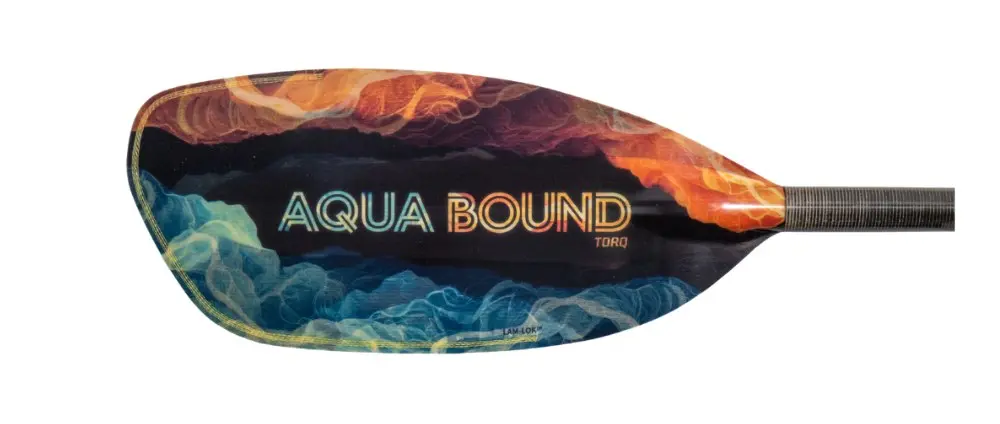
The Torq uses blades with a published area of approximately 700 square centimetres and a high-angle profile intended to provide a strong catch. The shape can be useful where decisive steering, bracing and corrections are part of ordinary paddling. Such a blade may respond differently from the narrower shapes used for relaxed long-distance touring.
A more powerful stroke is not automatically preferable for every body type. Blade area, technique, strength and injury history influence comfort, and an unsuitable paddle can become tiring over a long outing. Before buying, a paddler should compare sizes and consider the conditions in which they normally use the boat.
Lam-Lok edge reinforcement
Aqua Bound highlights its patent-pending Lam-Lok technology as a way to mechanically secure the layers of the fibreglass blade at the edge. The intention is to improve resistance to delamination and damage in areas that receive repeated contact with objects in the water. Such protection can be attractive for whitewater paddlers whose blades are exposed to more impact than a typical recreational paddle.
No edge reinforcement makes a blade immune to breakage. Hitting sharp stones under heavy load can still damage the laminate or the connection to the shaft. Owners should inspect the blade surface after difficult trips and follow the manufacturer's advice when repairing or retiring equipment. A cracked blade can become unreliable at an inconvenient moment.
Carbon shaft and blade connection
The manufacturer specifies a carbon shaft intended to keep swing weight relatively low and contribute to quick response. It also describes a carbon blade-peg insert to support the transition from shaft to blade. The physical feel of that connection may influence how accurately a paddler can place the blade and control the direction of a technical kayak.
Material combinations involve trade-offs in stiffness, flex and durability. A buyer should judge the complete paddle rather than assuming that more carbon content always delivers a better result. Whitewater paddlers may prefer different flex characteristics depending on the kind of strokes they use most frequently.
Several formats for different journeys
Torq is offered in one-, two- and four-piece configurations. The one-piece version may suit someone prioritising a direct, continuous feel, while the four-piece option is aimed particularly at packrafters who need to carry equipment through remote terrain before reaching the water. Dividing the paddle into smaller pieces can make travel significantly easier.
Every joint introduces components that must be maintained and assembled correctly. A breakdown paddle should be inspected before departure, with sand and grit removed from the connections and sections locked according to the instructions. Packrafters should also consider how the paddle will be secured when carried on foot or stored with other expedition gear.
Adjustment for selected versions
Aqua Bound says adjustable versions use its Versa-Lok ferrule arrangement, providing continuous feather-angle settings and approximately five centimetres of length adjustment. That flexibility may help paddlers tune the blade orientation for different strokes or changing equipment. It can also be useful when a packraft and a conventional kayak have different seating positions.
The ability to adjust should not encourage experimentation during dangerous water. A paddler should establish a comfortable setting on a safe stretch and verify that the joint is secure before tackling more technical conditions. Maintaining consistent grip and blade orientation helps reduce unnecessary confusion when rapid responses are needed.
Light weight without assuming easy water
The manufacturer gives a weight of approximately 964 grams for the one-piece Torq. This is a useful specification for comparing equipment, but the paddle's intended environment remains demanding. A lightweight, powerful paddle does not turn strong rapids into a beginner activity or replace rescue training and suitable flotation equipment.
The company also positions longer versions for surf paddling or rocky coastal use. Those activities involve additional environmental hazards and need specific experience. Buying the equipment is not the same as acquiring the judgement required to use it safely under changing water conditions.
A 2027 presentation from Wisconsin
Aqua Bound states that the Torq is handcrafted in Osceola, Wisconsin, and places emphasis on the construction of the fibreglass blades. Its inclusion in the Paddle Sports Show selection shows the model is being presented to the industry, but does not establish that it won the final category award. The official product image depicts the actual blue-patterned blades and the shaft arrangement.
For Leisure Boat Guide readers, the Torq illustrates how small-craft equipment can become increasingly specialised. The most valuable features are those that match the paddler's skills, transport needs and expected environment. Choosing a configuration after a genuine trial is better than treating every advanced whitewater feature as a universal improvement.