
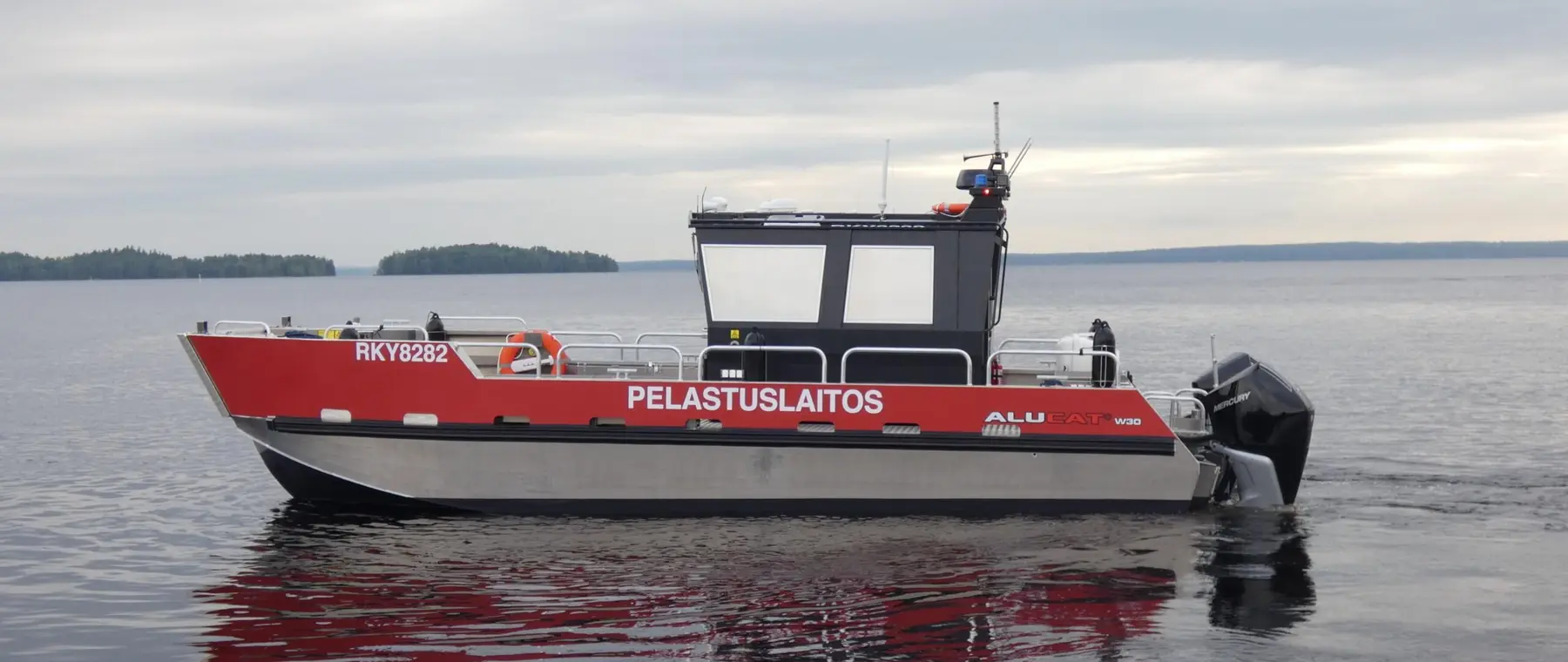
A Finnish Rescue Boat Enters Service
Finnish boatbuilder Alucat has delivered a W30 CAB4 PRO to the Kymenlaakso Rescue Department, placing a new aluminium catamaran into professional service. The company says the first boat of this configuration was handed over in September 2026 and published details of the project in October. Its intended role is markedly different from a pleasure cruiser, but the design illustrates how compact twin-hulled craft can be arranged for rapid coastal access, equipment transport and tasks that demand dependable deck space.
The central idea behind the boat is operational flexibility. Instead of prioritising a large passenger saloon, the builder has fitted a four-person cabin while leaving much of the surrounding platform open to work. That layout reflects requirements identified with the customer before construction, according to Alucat. It offers a useful case study in design driven by specific missions rather than by the number of amenities that can be included in a catalogue.
The W30 Platform and Its Published Dimensions
Alucat describes the rescue vessel as a wide, shallow-draft platform with approximately thirty square metres of usable deck. The company gives a beam of 3.9 metres and a bow ramp about 1.95 metres wide. Those figures explain much of the boat's character: the wide deck supports work that requires personnel to move around equipment, and the ramp allows loading or transfer at the bow rather than through a narrower side opening.
There is a small difference between the builder's two published length descriptions. Its October project report calls the delivered rescue craft approximately 9.5 metres long, whereas the current W30 CAB4 PRO specification sheet lists a 9.95-metre hull length. Both refer to the manufacturer's own material and may reflect different measurement conventions or configuration detail. Buyers should request a current, vessel-specific drawing instead of assuming the figures can be substituted for one another.
Room for Equipment, Not Just Passengers
The builder lists payload capacity at around three tonnes and says the W30's deck was arranged to carry varying rescue tools and mission equipment. That capacity is particularly meaningful on an emergency-services boat, where different calls may require hoses, pumps, salvage gear or other loads. The company does not suggest every item can be carried simultaneously. The appropriate load plan must still be calculated for the actual vessel and mission, including people and fuel.
An open working deck also creates questions that do not arise in quite the same way on a conventional family boat. Equipment needs secure stowage, crew movement must remain safe when the surface is wet and a ramp must be managed carefully during transfer. Alucat says the deck is unobstructed and treated with a non-slip finish, while self-draining arrangements are intended to improve working conditions. Those choices are functional components of the rescue design.
Why the Cabin Is Kept Compact
The CAB4 PRO name identifies the four-person cabin fitted to the delivered rescue boat. Alucat says the enclosure is insulated against noise and vibration, and its wider W30 description explains that the cabin is mounted on rubber isolators. The builder also refers to workspace, storage and information-technology systems required for rescue duties. The cabin therefore serves as a protected working position rather than merely a place to sit while travelling between assignments.
Keeping the cabin relatively small preserves deck area for people and equipment outside. That is a trade-off: a larger enclosed space could protect more crew members but would occupy part of the footprint reserved for operational work. Alucat offers other W30 cabin configurations, so the delivered CAB4 arrangement should be understood as a choice for one customer's priorities. A different authority might prefer another balance according to its expected crew and mission types.
Access in Shallow and Difficult Locations
Alucat puts the W30's draft at approximately 0.6 metres when fully loaded. In combination with the broad deck and bow ramp, that shallow figure can be valuable around beaches, low quays and coastal locations where conventional deep-draft craft have limited access. The manufacturer says the layout was developed for demanding rescue and authority operations, although the actual ability to land depends on seabed conditions, waves, local hazards and the vessel's load.
The ability to approach a shoreline is only one part of a safe landing or recovery. Crews need to know what lies below the surface, whether the vessel will remain stable as people cross the ramp and how to leave if conditions change. A shallow draft helps extend the options available to an experienced crew; it does not remove those decisions. The W30's specification is therefore best considered as a design enabler within an established operational procedure.
Twin Outboard Propulsion
The Kymenlaakso rescue vessel is fitted with two 250-horsepower Mercury outboards, according to Alucat's delivery report. The builder's broader W30 technical sheet recommends twin installations from 250 to 300 horsepower per engine. Having two independent outboards may provide useful manoeuvring characteristics and a degree of propulsion redundancy, subject to how the specific installation and onboard systems are configured. Neither feature should be assumed to replace standard contingency planning.
Fuel capacity is published as two 400-litre tanks for the W30 CAB4 PRO model, but the builder does not provide a measured endurance figure for the delivered boat in its project announcement. Range and operating time will depend on loading, speed, weather and the duty cycle. A rescue operator needs different calculations for a rapid response followed by extended low-speed work than for a straight cruising passage. Actual sea-trial consumption is the appropriate basis for dispatch planning.
Professional Category and Material
Alucat says the W30 CAB4 PRO is approved as a Class B professional boat and identifies marine-grade 5083 aluminium as its construction material. The certification reference is an important part of the vessel's intended service, but a purchaser should establish precisely which approval documentation applies to an individual hull and its equipment configuration. An approval category alone does not define the procedures, crew training or local operating permissions needed by an emergency organisation.
The material and twin-hull form are also relevant to maintenance. Aluminium structures require regular inspection for damage, corrosion risks and the condition of fittings, while outboards and control systems need manufacturer-specified servicing. An authority may require a higher level of equipment availability than a recreational owner, because a breakdown can affect response capacity. The value of a design must therefore include ease of inspection, access to spares and support over many years.
A Boat Built Around the Customer's Tasks
The manufacturer says it worked with the rescue department to define how many people the vessel would carry, what equipment it would transport and which operating conditions were expected. This consultative process led to the particular cabin size, deck arrangement and onboard technology selected for the delivered unit. It is an example of specification-led procurement, in which practical duties inform layout and equipment before construction rather than being adapted after the boat arrives.
Such a process can matter as much as the chosen hull. If storage compartments do not suit the equipment carried or a working position creates an obstruction, a crew may lose valuable time even on an otherwise capable platform. Conversely, a well-positioned ramp, clear deck and familiar controls can support efficient repeated procedures. Alucat's published account shows its intentions, while the rescue department's long-term operational experience will ultimately demonstrate how well they translate into service.
What the Design Shows for the Wider Small-Boat Sector
The W30 is a workboat rather than a leisure launch, yet several of its engineering decisions are informative for builders of smaller recreational and support craft. Designers in both sectors must consider safe movement around a deck, the relationship between cabin volume and open space, engine access and the consequences of loading. A wide, shallow-draft aluminium catamaran approaches those choices from a particular direction, shaped by rescue rather than weekend cruising requirements.
There are limits to the comparison. A family fishing boat would not necessarily benefit from a broad rescue ramp or such a large working deck, and commercial certification does not make a boat a recreational design. The connection lies in the process of establishing requirements and testing whether the structure and systems support the intended use. That discipline applies to everything from small tenders and coastal fishing craft to specialist authority vessels.
A First Delivery With Practical Lessons
The September handover gives Alucat a concrete example of the new W30 configuration in use, backed by details of the deck area, intended payload, four-person insulated cabin and Mercury propulsion. Its October announcement offers more substantial information than a rendering or concept sketch because a customer has received the vessel. The manufacturer's description remains its own account, and no independent long-term performance data are provided in the source material.
For Kymenlaakso's crews, the decisive questions will concern everyday readiness, loading and safe operation in the conditions that actually occur in their area. For other departments considering a similar craft, the published measurements provide a useful starting point for discussions about missions and equipment. The broader lesson is that a boat of roughly ten metres can be configured as a substantial working platform when its design begins with the task it must perform.