
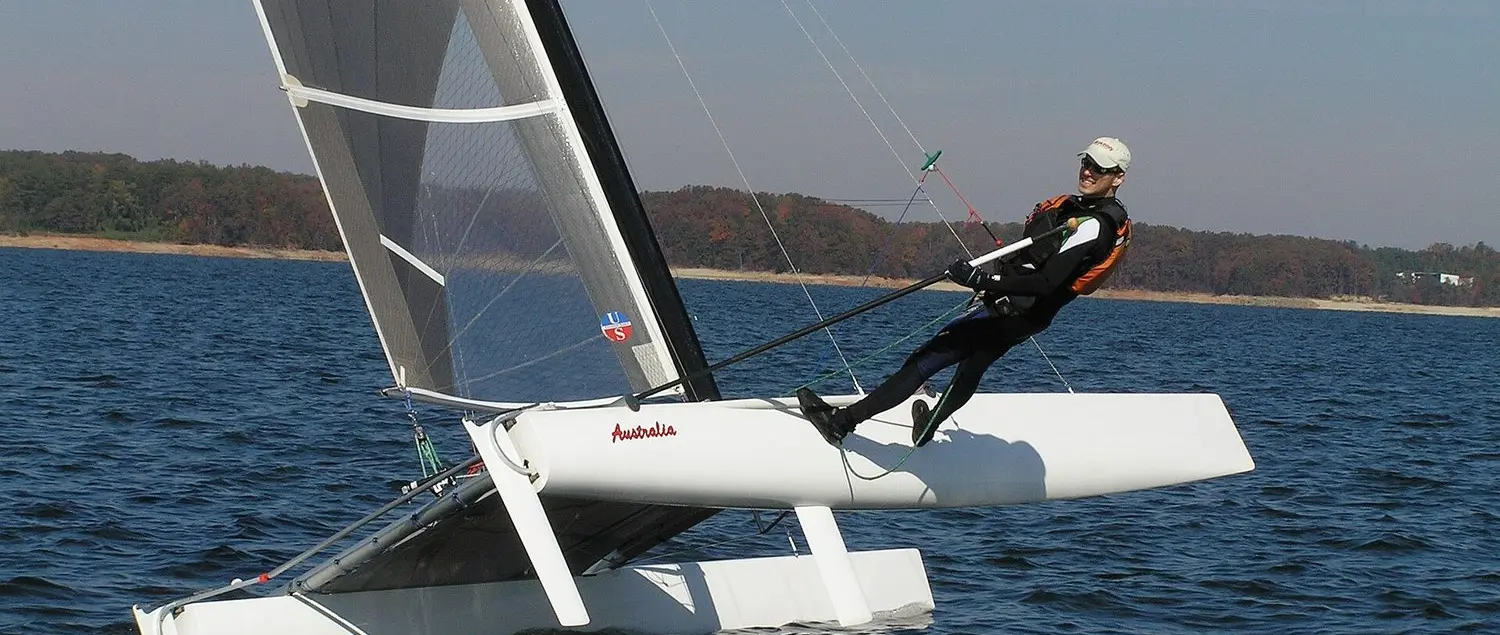
Tampa Bay prepares for solo catamaran racing
The 2026 International A-Class Catamaran World Championship is scheduled to begin its main racing programme at Davis Island Yacht Club in Tampa, Florida, on Monday 9 November. The event brings together 79 registered sailors from eleven national associations, divided into Open and Classic disciplines. The organiser's schedule places the first warning signal at 11:00 local time on the opening day, with competition planned through Friday 13 November and Saturday 14 November held as a reserve day. No results are assumed before races have been completed and confirmed.
The championship is firmly within Leisure Boat Guide's small-boat remit. An A-Class catamaran is a lightweight, single-handed racing craft, far removed in size and operation from a cruising yacht. Yet its sailing technology and techniques can be of considerable interest to club sailors, dinghy owners and people following the development of hydrofoils. The fleet combines conventional non-foiling boats with more specialised modern designs, making it possible to examine how different approaches to the same class rules perform on the water.
The 79 entries are split into two disciplines
Pre-event information describes 18 boats in the Open fleet and 61 in the Classic fleet. The distinction is important because the two groups use different approaches to sailing and are scored within their own championship disciplines. The Open fleet includes high-performance designs intended to foil, lifting substantial parts of the hulls clear of the water in suitable conditions. The Classic group focuses on non-foiling sailing, where precise hull balance, sail shape and tactical decisions remain central.
These are entries, not guarantees that every competitor will start every race. A boat may require repair, or a skipper may decide conditions are unsuitable. Nor should the number of foiling boats be taken as evidence that foiling is replacing all conventional catamaran racing. The much larger Classic fleet demonstrates that non-foiling designs remain an active and important part of this international class. Each discipline has its own technical and competitive demands.
Davis Island Yacht Club hosts the 2026 Worlds
The club's event headquarters are at 1315 Severn Avenue in Tampa, with racing based on the surrounding waters. Davis Island Yacht Club has published an official programme covering arrival, registration, measurement, practice racing and the championship. The wider event period runs from 7 to 14 November, while a separate Admiral's Cup pre-worlds regatta took place from 4 to 6 November. These dates should not be confused: a pre-event race does not count automatically as a world championship result.
The location offers access to Tampa Bay, where shifting wind and weather can influence course selection. Race officials may need to adjust the programme to suit safe conditions. A published first warning is a planned start procedure, not a promise that a race will go ahead regardless of wind. Competitors and support teams should consult the official notice board and current sailing instructions for changes, rather than relying on a preview written before the fleet launches.
Single-handed control makes the class demanding
An A-Class sailor performs the functions that several crew members might share aboard a larger yacht. Steering, mainsail trim, weight distribution, navigation around the course and tactical decisions all require attention from one person. In fast-changing conditions, there is little time to correct an error. The challenge is not simply how quickly the boat can accelerate; it is the ability to manage that performance while meeting racing rules and avoiding other competitors.
The lightweight platform responds to gusts and to shifts in the position of the sailor. Equipment tuning therefore becomes an important part of preparation. The skipper must understand how the hulls, foils where fitted and rig work together. A boat in this class can be rewarding for an experienced sailor, but its high performance should not be interpreted as a beginner-friendly recommendation. Training, physical fitness and appropriate supervision matter.
Foiling is one approach, not the only one
The Open discipline demonstrates the possibilities of hydrofoils on small catamarans. When conditions permit, properly designed foils generate lift and reduce the amount of hull touching the water, potentially allowing very high speeds. The process is sensitive to balance, sea state, wind and the skill of the sailor. A short burst of foiling does not mean a boat will remain airborne throughout an entire course. Transitions through manoeuvres or patches of lighter wind can be especially demanding.
The Classic fleet uses conventional non-foiling designs that can still provide intense tactical racing. Sailors rely on accurate starts, maintaining momentum, controlled tacks and the selection of suitable wind shifts. There is no universal conclusion that every owner should move from a conventional catamaran to a foiler. Each design carries different requirements for learning, maintenance, handling and storage. The separate championship disciplines help competitors race among boats with comparable performance expectations.
Helmets and safety procedures are specified
The event's Notice of Race places emphasis on safety and proper equipment. The Open discipline includes a requirement for a safety helmet while afloat. Classic boats are also subject to class identification requirements, including the specified red sail marking. Boats must present valid measurement certificates covering the hull, mast and sail, with detailed equipment rules governing their participation. These are not optional suggestions that can be set aside because the craft is small.
Safety arrangements reflect the risk of high-speed capsize and close racing. Sailors need appropriately fitted personal equipment and should understand how to recover from an inversion or injury. The event procedures also rely on support craft and communications to help manage the fleet. A person watching from another boat must avoid obstructing the course or approaching a capsized competitor without direction from race officials. Good intentions do not remove the need to operate safely around organised racing.
The pre-worlds Admiral's Cup adds preparation
The separate A-Class Admiral's Cup was scheduled from 4 to 6 November at the same venue. Such a regatta gives visiting sailors an opportunity to learn about the local water, test equipment and gain experience of the race management team before the major championship begins. It can also expose handling or tuning problems that need attention. Its results may be interesting, but they do not determine the World Championship title scheduled for the following week.
Organisers have arranged arrival and registration on Saturday 7 November, followed by further preparation and an opening ceremony on Sunday 8 November. This sequence is practical for a fleet whose boats may need technical inspection and assembly after road or air transport. A small racing catamaran can be portable relative to a keelboat, but proper rigging and inspection still take time. Rushing preparation may compromise equipment or performance once the racing starts.
Five primary racing days are scheduled
The official timetable provides championship racing on Monday, Tuesday, Wednesday, Thursday and Friday, 9–13 November. The first warning signal is listed for 11:00 each day. Saturday 14 November is reserved as an alternate racing day if required, followed by the awards banquet and closing ceremony. The distinction between scheduled days and actual races matters because weather or other circumstances can alter how many starts are completed. The race committee is responsible for announcing changes under the event documents.
A championship programme is a framework for fair racing rather than a guarantee of a particular number of results. Teams may need to manage wear, fatigue and repairs across several consecutive days. A sailor who performs well in one race must still maintain consistency. The scoring rules and formal notice board determine how the final championship is decided. Until those documents and results are applied, no participant can legitimately be declared the new world champion.
The international entry list adds depth
The organisers' pre-event reporting identifies competitors from eleven national associations, illustrating the class's international appeal. A-Class sailors travel considerable distances to race identical or closely governed types of small craft at world level. That involves transporting lightweight hulls, spars, sails and specialist equipment, often across different climatic conditions. The logistical effort is a reminder that a boat's physical size is only one part of the commitment required for serious competitive sailing.
The field also combines different experience levels and local conditions. A sailor accustomed to flat inland waters may need to adapt to the chop and wind patterns of Tampa Bay. Conversely, a sailor familiar with strong coastal breezes may find light conditions demanding. Boat preparation and tactical adaptability can be as important as raw speed. The entry list gives the championship depth, but actual performance must be established by racing rather than by reputation.
What small-boat sailors can learn from Tampa
The verified news on 9 November is that the A-Class World Championship is poised to begin its main racing with 79 registered competitors, divided into 18 Open and 61 Classic entries, at Davis Island Yacht Club. The planned programme runs through 13 November with a reserve day on the 14th. The event is especially relevant to small-boat enthusiasts because it showcases high-level single-handed sailing in both foiling and non-foiling formats.
For the recreational sailor, there are practical lessons in rig preparation, safety equipment, disciplined control and understanding when a craft's performance is appropriate for the conditions. Racing at this level is specialised, but the principles of maintaining a reliable boat and being prepared for changing weather apply much more widely. Results should be taken from the organiser's official postings as racing unfolds. This opening preview identifies the event and its competitors, not an outcome that has not yet been determined.
Sources: Davis Island Yacht Club official 2026 championship schedule, A-Class Catamaran Worlds organising site, and international pre-event entry report. Photograph: a Boyer Mk IV A-Class catamaran, credited to Yetanotheraccount1, Wikimedia Commons, public domain; an archival illustration of the class, not a 2026 Tampa image.
