
Normandy endurance organisers propose a new format
Rouen Inshore Racing has told prospective competitors that the 2027 24 Heures de Normandie powerboat event is planned as a single continuous twenty-four-hour race over 30 April and 1 May. That would change the format used in 2026 at Poses, when the endurance distance was divided into three heats of twelve, seven and five hours. The organiser has begun gathering expressions of interest from teams ahead of final sanctioning decisions, giving racing crews time to prepare boats and budgets.
The race has not yet received its final authorisations. The organiser says applications and an advance programme have been submitted to the sport's governing bodies and local authorities, but their responses remain outstanding. That distinction is central to the story. The proposed format and dates are an announced intention, not a guarantee of an authorised event. A published timetable must not be confused with a completed calendar approval.
Continuous running changes the challenge
A single twenty-four-hour contest means that teams would need to manage fatigue, equipment reliability and pit operations without the longer breaks provided by separate heats. Even when the total racing duration is unchanged, splitting an event into different sessions alters opportunities to inspect machinery, reorganise crews and respond to emerging problems. Running continuously makes team coordination as important as the speed of a particular powerboat.
The 2026 edition at Poses was spread over three days and included night running in the first twelve-hour heat. Organisers now describe an uninterrupted 2027 race, which would require carefully planned driver rotations, refuelling and emergency procedures across a full day and night. A comparison between the two formats should not assume identical conditions or competitive outcomes. The proposed change would shift the rhythm of the whole event.
UIM and French approvals are still required
According to the organiser's information reported by Powerboat News, official applications have been submitted to the Union Internationale Motonautique, the Fédération Française Motonautique and relevant local authorities. The organiser has also reserved the calendar dates, but it acknowledges that the event cannot be considered confirmed until the required decisions arrive. The fact that discussions have been positive is encouraging, yet positive discussions are not themselves authorisation.
Competitors considering participation should watch for the eventual sanction and official race documents before committing irrecoverable travel or equipment expense. Motorsport events depend on permits, safety plans, rules and venue arrangements that may change. Promoters sometimes release anticipated dates well in advance to help teams plan; responsible reporting keeps those provisional stages separate from a finished approval process.
Crash-box requirements prompt early preparation
The early expression-of-interest campaign is partly designed to help teams prepare for new UIM crash-box requirements expected for 2027. A crash box is a protective driver-compartment safety structure in the relevant racing configurations. Its design, installation and compliance are specialist technical issues, requiring reference to the governing regulations rather than informal assumptions about what will be accepted.
The prospective-entry form asks whether a boat will have a crash box meeting the 2027 UIM requirements and, if not, when the team expects to complete it. That is not simply administrative. Safety work may involve structural changes, fitment, inspection and testing. Teams cannot assume that an existing setup will automatically be legal in a revised championship. Technical requirements should be confirmed against the final applicable rulebook before modifications begin.
The organiser wants to understand team readiness
The expression-of-interest form requests the name and contact details of the team manager and up to four drivers, the team's nationality and the boat builder. It also asks entrants to assess how far along their project is on a scale from fully ready to not yet started. This enables the organisers to estimate a credible fleet while participants prepare their own resources. A form requesting information is not itself a final competition entry or acceptance.
Prospective competitors can use the process to identify questions about support crews, spare equipment, transport and the cost of participating. A twenty-four-hour powerboat race places considerable demands on fuel supply, driver changeovers and maintenance support. The organiser will need reliable information about likely entries to plan the venue, but it should not be inferred that every expression of interest will lead to a boat on the starting grid.
The event has a long Rouen heritage
The original 24 Heures Motonautiques was held on the Seine at Rouen from 1964 until 2019 and became a familiar fixture in international powerboat endurance competition. Its history was interrupted when authorisation in the city was withdrawn amid climate and energy concerns. The race was revived at Poses in 2026, farther upstream in the Eure. That transition demonstrates the importance of local permissions and environmental considerations in motorsport planning.
The 2026 return drew fifteen international teams according to the event report, with Mercury Racing joining the organisation alongside French motorsport bodies and the local Cercle Nautique Rouen-Poses. The names of previous participants and the existence of an established race history provide useful context, but do not establish who has entered for 2027. The newer event still has to satisfy current requirements rather than rely on its historic reputation.
Night racing raises distinctive operating questions
Endurance powerboats racing through darkness require lighting, navigation awareness, communication and fatigue management that differ from those of a daytime sprint. Drivers may have to handle reflections, changing visibility and wakes while maintaining the agreed course and observing race procedures. The governing rules and organisers' arrangements determine what equipment and operating conditions are acceptable; a spectator should not generalise from a racing image to ordinary navigation at night.
Crews also need a clear means to communicate mechanical concerns and arrange a controlled return to the pits. With long operating periods, small issues such as loose fittings or cooling problems can become significant. Endurance racing is therefore an engineering and logistical test rather than simply a prolonged top-speed contest. Even a powerful boat can lose considerable time if repairs, refuelling or crew operations are poorly managed.
Safety and environmental considerations remain central
Powerboat endurance racing uses specialist boats and trained crews in a controlled setting. It is not an appropriate model for how recreational skippers should operate on public rivers. The proposed twenty-four-hour format would require consideration of other waterway users, nearby communities, emergency response and environmental safeguards. Local authorities have a formal part in those decisions, which is one reason the event cannot be treated as confirmed at this stage.
For leisure boat owners, the wider issues are familiar: choosing an appropriate speed, navigating in changing conditions and maintaining reliable equipment. Environmental impacts and noise can affect where and when any powered activity is permitted. The endurance organisers must address such matters in the context of a major sporting event, while everyday recreational boating remains governed by its own rules and local restrictions.
Racing teams face commercial decisions as well
Organisers say they are seeking potential entrants early because both budgets and safety upgrades require lead time. Equipment purchase, crash-box installation, engine service, transport and accommodation may all become commitments well before the first engine starts. A team that depends on sponsors must assess whether enough resources can be secured for the planned programme. The organisers' request for readiness information is therefore a practical attempt to avoid last-minute uncertainty.
A prospective participant should distinguish confirmed commercial obligations from estimated expenses until the event is formally sanctioned. Written agreements and current regulations are essential for any major technical investment. Even with a familiar venue and a positive initial response from authorities, a change to timing or format can have real financial implications for teams. Sound planning leaves room for those eventualities.
What is known on 10 November
Rouen Inshore Racing's published intention is a continuous 24 Heures de Normandie on 30 April–1 May 2027 at Poses, with expressions of interest requested while authorisations remain pending. The 2026 precedent consisted of three heats, and the proposed revision would create a different endurance challenge for drivers, engineers and support crews. The event has not yet been sanctioned, and no confirmed 2027 starting grid should be inferred from the announcement.
The development is relevant to people following compact racing powerboats and specialised small-craft engineering. Its value lies in the clearly announced format proposal and the practical consequences for safety and team preparation. Leisure Boat Guide will treat the event as provisional until the governing authorities and organiser issue definitive instructions, and will avoid presenting anticipated race arrangements as facts already settled.
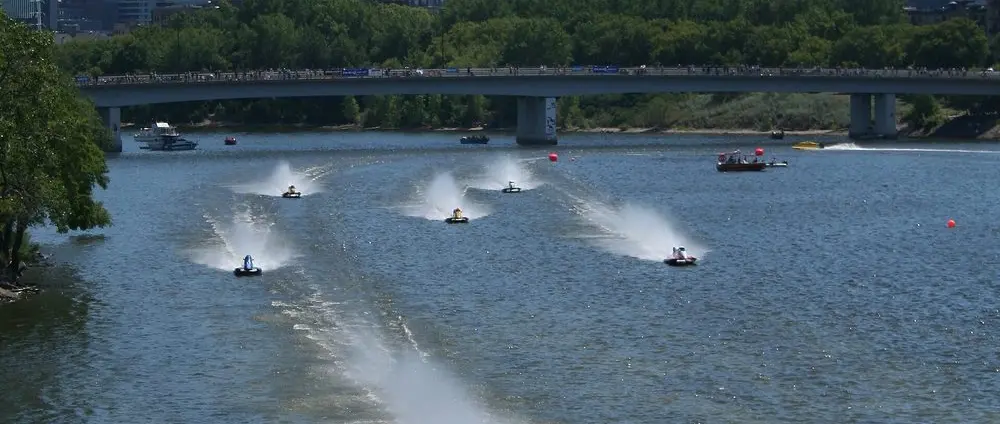
Sources: Powerboat News, organiser's 2027 provisional race announcement, 1 November 2026, and the French-language coverage. Photograph: an earlier F1 powerboat race photographed by Michael Hicks, Wikimedia Commons, CC BY 2.0; historical illustrative race image, not the 2027 Normandy event.
