
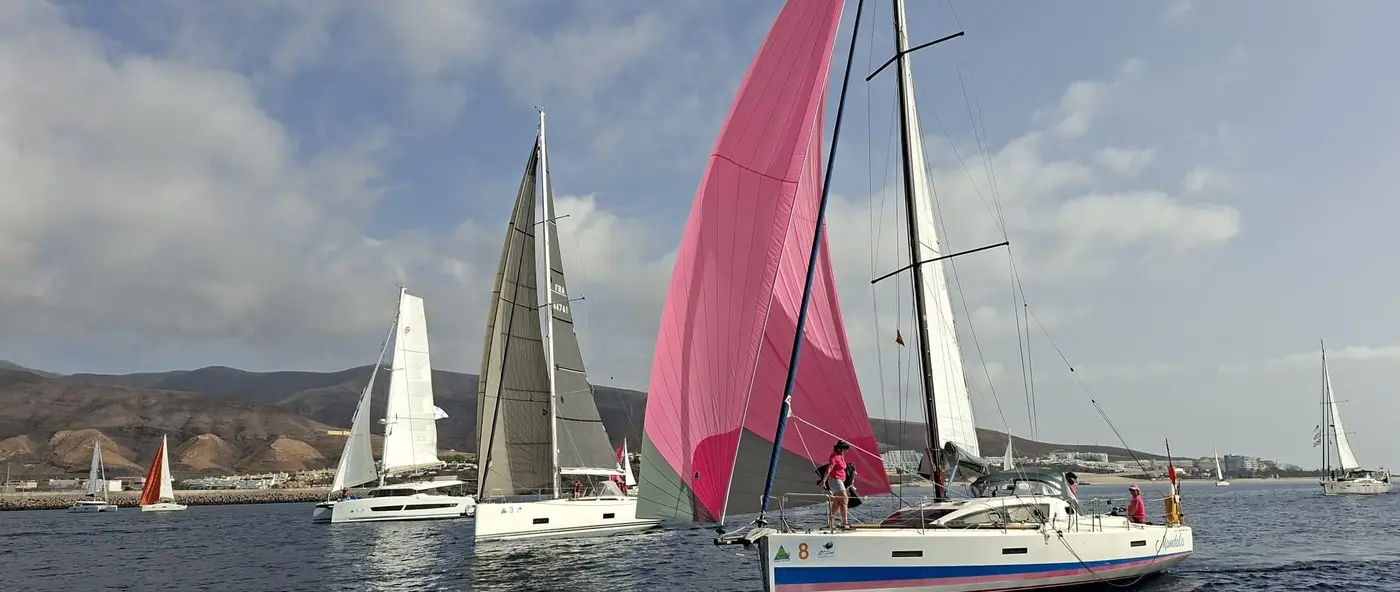
Atlantic passage under way
The eighth Rallye des Iles du Soleil is sending its cruising crews from Fuerteventura toward the Cape Verde islands and ultimately Marie-Galante in Guadeloupe. The organizer's departure report describes boats leaving Marina Jandia at the southern end of Fuerteventura for the first offshore stage to Mindelo on São Vicente. The story is not an ocean race with a single winning time; it is a supported Atlantic crossing shaped by individual crews, seamanship and the realities of cruising with several boats.
The first leg is described by the rally team as approximately 900 nautical miles, equivalent to around 1,667 kilometres. That is a substantial trip for families and private crews who may be using a passage to prepare for the far longer Atlantic stage. The report records departure-day preparations, photographs and farewells before the boats put to sea; exact arrival times remain dependent on weather and individual progress, not on a timetable printed before the start.
Marina Jandia departure base
The rally's starting point is Marina Jandia in Morro Jable, Fuerteventura, part of the Calero Marinas network. The event organizer says the facility has been the departure base for a second consecutive year, extending a partnership with Calero that developed through earlier editions. This location places crews close to the south of the island before they head toward the Cape Verde archipelago, reducing the need to return north after the final pre-departure briefing.
For visiting crews, the departure marina is more than a place to berth. It is where practical lists are finished, crew arrangements discussed, equipment checked and the final weather conversation takes place. A last social gathering before an ocean passage also creates relationships that can matter later if boats require advice or a helping hand. That shared preparation is a defining attraction of the rally model, rather than a minor detail around the sailing itself.
The weather at departure
In its report from the start, the rally team described light and irregular winds from the north and northeast, generally in the region of four to eight knots. It explained that the Azores high-pressure pattern was not yet sustaining reliable trade winds over the course. These were forecasts and observations for the departure period, not a prediction that identical conditions would continue for the whole passage or for the rest of November.
Light weather poses a challenge that is easy to underestimate. Crews must trim sails carefully, preserve concentration through changing pressure and think about the consequences of every small course adjustment. A boat that is fast in steady conditions may make slow progress in dispersed patches of breeze. The safest plan is not necessarily the one that appears shortest on a chart, and individual skippers must weigh their equipment and comfort against the latest forecast.
Strategic decisions offshore
The organizer discussed the possibility that some crews might seek more consistent airflow farther south or nearer the African coast before turning toward Mindelo. It also noted concerns associated with floating objects, fishing gear and activity close to the coast. Those observations illustrate the competing considerations in the first stage: finding wind, maintaining a safe watch and avoiding risks that are not obvious in a simplified route line.
No published departure note can prescribe a route for every boat once the fleet has dispersed. Weather models change, vessels carry different sail inventories and a crew's fatigue may alter the practical decision. The rally's account is therefore best understood as a snapshot of the pre-passage briefing rather than a live set of navigation instructions. Anyone following the fleet should consult the official tracking map for reported positions and avoid making assumptions from older forecasts.
Why Mindelo matters
Mindelo on the Cape Verde island of São Vicente is the planned intermediate stop before the transatlantic leg. The location gives participants time to review the passage from the Canaries, assess systems and supplies, and prepare for the major ocean crossing. The organizer's 2026 programme identifies a scheduled departure from Mindelo on November 11, although operational decisions remain subject to the conditions and readiness of individual boats.
A staged crossing can be valuable for crews who have not previously spent several days at sea. Experience from the first leg exposes how watch routines, galley storage and electrical systems behave away from shore. Problems that seemed minor in a marina often become clearer under a continuous operating cycle, which is one reason an intermediate port can have more importance than a simple line on the itinerary suggests.
Toward Marie-Galante
After the Cape Verde stop, the rally plans to cross the Atlantic to Marie-Galante, part of Guadeloupe in the Caribbean. The organizer's schedule gives an indicative arrival window of November 23 to 27, 2026, in the Baie de Saint-Louis. This is a destination window announced by the rally, not confirmation that any named boat has finished the crossing. Actual arrivals will emerge as each participating skipper completes the passage.
The Caribbean arrival represents a different type of cruising choice from the initial move to Cape Verde. Crews are crossing an ocean and then entering a region where local weather, anchoring and island-to-island passage planning create fresh tasks. The event's destination also gives participants a shared place to meet after weeks of independent movement. For private sailors, that social finish can be as meaningful as the satisfaction of covering the distance.
Crews with different experience
The organiser's departure account includes comments from participants with very different backgrounds. One skipper is returning after an earlier rally, another describes the ocean crossing as a new undertaking shared with a family member, and another has taken part several times. The range of experience matters because it reminds observers that a supported rally can appeal to people who want a first long passage and people who already know the route.
These accounts should not be flattened into claims that all participants have the same goals or skills. One crew may prioritize logistical support, another the chance to sail among familiar boats, and another the shared arrival. The organizer frames safety, preparation and camaraderie as recurring reasons for participation. None removes the skipper's responsibility for navigation, the vessel's seaworthiness or decisions made far from help.
Boats and supporting brands
The departure report identifies examples including a Fountaine Pajot 44, a Dufour 390 Grand Large and a Fountaine Pajot Hélia 44 among participating crews. Those references show the event includes production cruising yachts of different configurations. They should not be treated as an exhaustive fleet list, and they do not imply that every boat of the same model is equally prepared for an ocean passage. The rally also maintains an official 2026 crew listing.
Industry involvement reaches beyond the yachts themselves. The organizer names Dufour Yachts and Fountaine Pajot among builder partners, alongside marine services and technical supporters including Adrena Software and Garmin. This network reflects the broader equipment ecosystem around long-distance private sailing. However, the mere presence of a partner does not establish the precise electronics, safety gear or sail configuration fitted to any individual participant's boat.
Tracking the crossing
The Rallye des Iles du Soleil publishes a fleet tracking map through its ocean-tracking service, and the organizer encourages followers to consult that chart alongside official news. Position information can make the route easier to understand for family members and other sailors on land. It can also help explain why the fleet does not move as a single block once boats start responding to different patches of wind and individual schedules.
A map remains a reporting tool, not a replacement for communication with the boats or a source of guaranteed real-time safety information. Tracking intervals and availability can vary, and a boat that appears stationary on a public screen may simply have an outdated position. The right use is to follow broad progress and changing separation over time, while remembering that the published coordinates may lag behind decisions being made aboard.
The lessons of an Atlantic rally
The value of this edition will be measured in more than the number of vessels that arrive in Guadeloupe. A successful crossing is built from weeks of careful preparation, equipment checks, weather judgments and small daily decisions. Those processes rarely make dramatic photographs, but they form the heart of competent offshore cruising. The organiser's early account, with its emphasis on variable winds and last-minute briefings, provides a useful reminder of that quieter reality.
For other boat owners considering a transatlantic voyage, the rally offers a way to observe how private crews manage a route in stages and maintain a shared community. The latest official report confirms the start from Fuerteventura and the planned itinerary through Mindelo to Marie-Galante. The remaining developments must be reported as they happen, with weather and arrivals verified against fresh organiser updates rather than predicted from the initial timetable.
Source: Rallye des Iles du Soleil / Grand Pavois Organisation.