
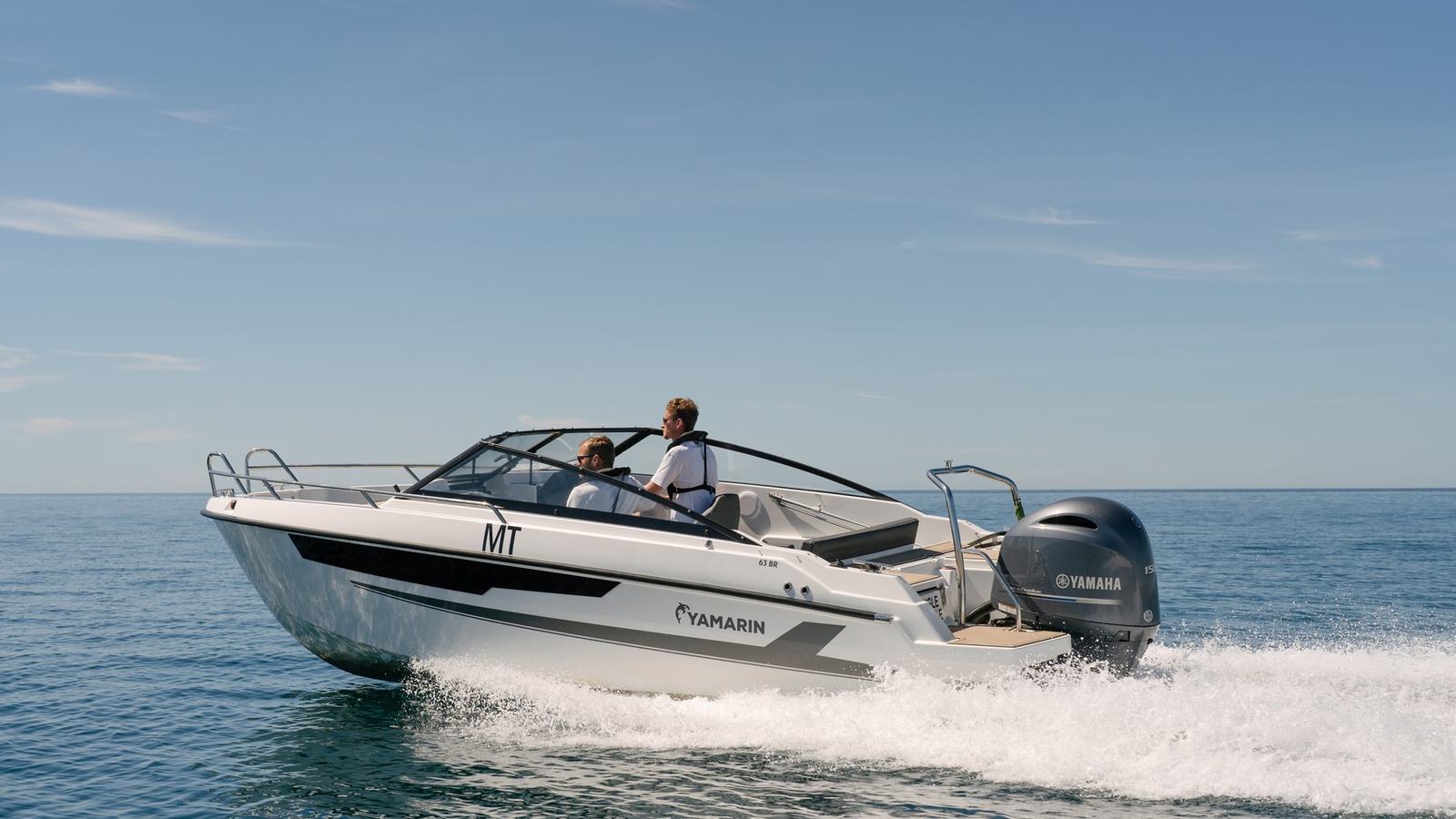
With a 6.35-metre hull, up to eight seats and an optional aft sunpad, the Yamarin 63 BR concentrates on easy family day trips and active boating in sheltered conditions.
A Nordic bowrider built around flexibility
Yamarin's 63 BR is a compact bowrider designed to make everyday boating feel straightforward, whether the plan is a quick swim trip, a watersports afternoon or a relaxed run along the coast. The Finnish builder lists a length overall of 6.35 metres, a 2.34-metre beam and accommodation for up to eight people in its current published specification. That is a substantial group for a boat of this size, so the suitability of any particular passenger load still depends on safe weight distribution and conditions.
The current design incorporates updated consoles, revised upholstery and improved ergonomics around the driving position. Yamarin also highlights the addition of a driver armrest, a detail that may sound minor until a boat is used for repeated trips in small coastal waves. Rather than adding complex living accommodation, the model concentrates on keeping the people aboard comfortable and making the journey between destinations enjoyable.
The builder offers a convertible aft seating arrangement, with an optional section that transforms part of the cockpit into a two-person sunpad. Moving the co-driver's backrest helps form the lounge, so the exact layout changes according to whether passengers are travelling or relaxing at anchor. This flexibility is most useful when the owner understands which configuration is safe for movement and which is intended only when stopped.
The 63 BR is an open boat, and that is both its attraction and its limitation. Open sightlines, direct deck access and a lively connection to the water are ideal on settled days, but the crew will need protective clothing and sensible shelter plans when the weather deteriorates. A bowrider is at its best when a skipper selects the day and route to match the boat rather than demanding all-weather versatility from a fully open cockpit.
What the performance figures tell us
Yamarin specifies Yamaha outboard options from 115 to 150 horsepower, and cites maximum speeds of up to 42 knots with the more powerful package. Those figures indicate an energetic boat, but top speed is seldom the most useful measurement for a family outing. A comfortable cruise is one at which passengers remain secure, visibility is clear and the boat is not being pushed harder than the sea state allows.
The model's fuel tank is listed at 160 litres, a useful reference for estimating how far a day trip may reasonably extend. Actual range requires the engine's consumption data at the chosen cruising speed, an appropriate reserve and an allowance for harbour manoeuvring and changing conditions. A high advertised maximum speed provides no direct assurance about the practical distance available on a busy weekend with friends aboard.
Yamarin's published owner documentation also gives a CE category C designation for the relevant 63 BR configuration. Owners should treat design categories as certification information, not an instruction to venture out simply because an upper wind or wave condition appears on a standard. Local sea state, crew ability, passenger comfort and safe return options remain the controlling considerations.
The hydraulic steering and redesigned helm layout should make routine boat handling less tiring than a poorly arranged driving station. Buyers should nevertheless try the boat at slow speed, during planing transitions and while approaching a pontoon. The view over the windscreen, the reach to controls and the ease of moving between seats can be as important as the headline specification when the same skipper uses the boat every weekend.
Room for day trips and water activities
The classic attraction of a bowrider is the distribution of people across bow and cockpit seating, giving small groups alternatives to sitting in one crowded row. Yamarin's layout can suit a family with children who want a sheltered-feeling place inside the windscreen while others enjoy the forward area at anchor. The important distinction is that seating arrangements must be used appropriately at speed and during rough conditions.
Yamarin includes anchor storage at the bow and stern, a fitted fuel system and details intended to make short stops and departures less awkward. For the weekend user, a tidy place for fenders, lines and wet gear is a significant quality-of-life advantage. Good storage practice also keeps the cockpit clear enough for passengers to move safely without stepping around loose anchors, bags or watersports equipment.
The convertible aft sunpad is likely to be most valued by owners who spend time stationary in quiet bays. Before choosing an optional seating conversion, consider how many people usually come aboard and where they will sit when the boat is underway. A feature that looks spacious in promotional photographs can reduce practical seat availability or access if the group and its equipment are not considered together.
A bowrider can support activities from swimming to towing suitable watersports equipment, but crew discipline makes the difference between fun and confusion. A person should be assigned to watch a participant in the water, lines must remain clear of the propeller and the skipper needs a predictable signal routine. The most useful boating habit is to explain the activity and return plan before anybody gets wet.
Making the 63 BR work for your season
The boat's modest overall size may appeal to owners who prefer day storage or a short trip from home to the launch ramp. Yet the published boat-only weight, given in Yamarin's current information as around 950 kilograms, is not the weight of the full transport package. The engine, fuel, trailer and extra equipment must be added before comparing the load with vehicle and licence limits.
The available options include a larger navigation display, and it is worth asking how much information a skipper genuinely needs on a boat operating primarily within familiar coastal waters. A clear chart, depth information and reliable communications are more useful than a large screen installed without a plan for updates and maintenance. Simplicity can make the helm easier for family members to understand.
Regional conditions should influence the accessories chosen. More shade is valuable in exposed summer anchorages, while a secure cover and practical drainage matter for boats kept outdoors. The correct fenders and a well-organised anchoring system may have greater impact on a typical trip than a purely decorative option, particularly when the owner regularly visits crowded visitor pontoons.
The Yamarin 63 BR demonstrates why the familiar Nordic bowrider remains a popular leisure-boat shape. It can be small enough to handle without a crew yet generous enough for family sociability, with enough power available for active outings. The best way to choose a configuration is to test it with realistic loading and decide whether open-air enjoyment outweighs the protection that a cabin boat would provide.