
A Lake District small-boat guide to Windermere, with current powered-vessel registration, registration deadlines, reduced-speed zones and safe boating.
Windermere is among England's best-known boating lakes, offering a varied landscape of wooded shores, villages and island views that can be enjoyed from a small motorboat or sailing dinghy. Its popularity also makes regulation important. The Lake District National Park Authority requires powered craft to be registered, with approved numbers and a current annual mark displayed before use. The lake has a general speed limit of ten knots, reduced to six knots in certain areas, and boat owners need to observe the byelaws governing launching, navigation and equipment. For someone planning a first visit with a trailerable motorboat, these rules are more useful than a general recommendation to 'take a cruise'. With registration arranged and the appropriate route selected, Windermere can provide an enjoyable slow-water holiday without the demands of a long coastal passage.
Why Windermere suits smaller boats
The lake offers a different kind of experience from offshore cruising. A modest motorboat can travel at a relaxed speed while passengers watch the hills and villages unfold from water level. An electric launch may provide a quieter way to enjoy the scenery, although electric propulsion does not exempt a privately owned vessel from registration when it falls under the powered-vessel rules. Sailing dinghies and rowing boats also have a place on the water, subject to the regulations relevant to their type. The broad choice of craft can make Windermere attractive to families with differing interests. However, the busy environment requires attention to commercial passenger vessels, hire boats, other leisure users and areas with special speed limits.
Registration before arrival is essential
The Lake District National Park Authority's current guidance says that all powered vessels must be registered under the Windermere scheme, including boats already recorded on the United Kingdom's Small Ships Register. The previous exemption for that register ended in 2011. Registration can be completed online, but it is not instantly valid simply because a form has been submitted or payment made. The authority advises allowing around ten days for registration numbers and annual marks to be delivered. The mark and numbers must be displayed correctly on the vessel before using it on the lake. A visitor planning a spontaneous weekend should therefore deal with the registration requirement early rather than discover it on launch day.
Fees for the current and coming years
The official registration page lists charges for the 2026 permit year and separately identifies increases for 2027. In 2026, new registration is listed at forty-eight pounds and renewal at thirty-six pounds, with additional charges for certain number sets or transfers. For 2027, the published new-registration charge rises to fifty pounds and the renewal to thirty-seven pounds fifty. These figures are a snapshot of the authority's published fee schedule, not a guarantee of future prices. Registration validity runs from 1 January to 31 December. Visitors should consult the live authority page when making payment, because the correct amount depends on the permit year and the nature of the application.
Getting the identifying marks right
The registration scheme requires the approved boat numbers and annual marks to be displayed in the manner specified by the Windermere byelaws. The authority offers guidance on their design and placement and warns that incorrect display can lead to enforcement. This is a practical issue for owners accustomed to keeping a vessel in another region or bringing a tender that normally operates without visible local marks. A temporary trip does not automatically remove the requirement. Owners should ensure the marks can be fitted to the hull as specified and remain legible during normal use. The simplest approach is to complete the administrative work before arranging the trailer and accommodation.
A broad ten-knot limit
Windermere's general powered-vessel speed limit is ten knots outside specified reduced-speed areas. That makes the lake more appropriate for leisurely sightseeing than high-speed performance boating. A smaller craft can still cover a useful distance at such a pace while providing passengers with time to appreciate the scenery. It is important not to confuse knots with miles per hour, as different recreational guides sometimes use inconsistent terminology. The formal byelaws should take precedence for compliance. A skipper should also remember that a legal maximum is not necessarily a sensible speed in poor visibility, congestion or near smaller unpowered craft. Slowing down can improve both safety and enjoyment.
Six-knot zones need attention
The official Windermere Navigation Byelaws identify six-knot areas around parts of the northern and southern ends and certain busy bays, including Bowness Bay and White Cross Bay. They also impose the reduced limit when a powered vessel is towing another vessel. These locations are relevant to visitors because they include parts of the lake where boat traffic and shoreside activity can be concentrated. A skipper should use the authority's current lake guide to understand the boundaries rather than rely on a rough description in a travel article. Speed zones are not an invitation to travel at the maximum possible speed elsewhere. Good seamanship includes adjusting speed and avoiding excessive wake whenever other users may be affected.
Launching at the right facility
A private boat needs a lawful and suitable point for launching and recovery. The Lake District authority identifies Ferry Nab as an important boat-launching facility and notes that the associated car park serves visitors using it. However, the current registration process is no longer handled in person at Ferry Nab, so boat owners should separate launch arrangements from registration. Rules and charges for use of the ramp need to be checked independently. A visitor should inspect the suitability of the ramp for the trailer, engine and hull, allow time for other users and understand where parking is allowed. Assuming a waterside beach is available for launching a powered vessel can lead to violations of byelaws or practical problems.
Bowness and a relaxed cruise
Bowness-on-Windermere is one of the lake's best-known visitor centres, with boating activity and views across the water. A small-boat holiday can include watching larger passenger vessels, enjoying the shoreline and returning at a manageable pace. The number of people and boats around the bay makes vigilance especially important. A private boat should not occupy moorings or jetties without permission, and the skipper should understand any local restrictions on landing. It is often enough to take a short tour and return rather than try to see the entire lake during one crowded afternoon. A well-planned outing can remain enjoyable even when the weather or traffic requires a conservative route.
The lake's islands are not all landing places
Windermere has islands that contribute to its scenery, but a view of an island from the water does not establish public access. Shoreline and island ownership, conservation needs and landing restrictions may differ, and private boaters should consult current maps and signs before attempting to go ashore. The Lake District authority's visitor guidance describes opportunities to row or sail around the central islands, not unrestricted camping or landing. The distinction is important when a family wants to stop for a picnic. Choosing a legal public landing or returning to the original launch is preferable to approaching a private shore without permission. The best moments of a lake cruise can be enjoyed without stepping ashore at every point of interest.
Safety in a heavily used recreation lake
Windermere is shared by sailing boats, kayaks, paddleboards, passenger cruisers, rowboats and motorboats. The skipper of a powered vessel should keep a proper lookout, give other craft room and anticipate that smaller boats may be difficult to see among waves or reflections. Personal flotation equipment should be suitable for everyone aboard, especially children and people unfamiliar with boating. A working kill cord is vital where fitted to an outboard or helm; the authority also publishes advice on carbon monoxide and other boat hazards. These subjects are not decorative recommendations. Correct equipment and a clear plan for getting people safely back aboard after an emergency are part of responsible lake recreation.
Wind, visibility and changing conditions
A lake surrounded by hills may appear sheltered from a distance, yet wind direction and strength can change the character of the water. A small motorboat should be capable of returning safely in conditions that may differ from those at departure. The crew needs enough fuel or battery reserve, reliable communication and an awareness of areas where visibility or traffic may be problematic. It is sensible to check current forecasts and avoid planning a demanding journey when poor weather is expected. An electric vessel should be operated within its practical range, allowing for wind and current rather than relying on an ideal manufacturer's estimate. A short, secure trip is a worthwhile holiday in its own right.
Registration when a boat changes hands
The Lake District National Park Authority requires owners to notify it in writing within fourteen days when a registered vessel is sold or otherwise disposed of. That is easy to overlook for someone buying a used motorboat specifically for lake holidays. The existing number alone should not be assumed to settle ownership and registration matters. Both buyer and seller should understand the correct transfer process and check what must be updated before using the craft. The official page lists procedures and contact details for transfers, renewals and changes of address. Maintaining accurate records supports the registration system and avoids preventable complications at the beginning of a boating season.
The photograph and its licence
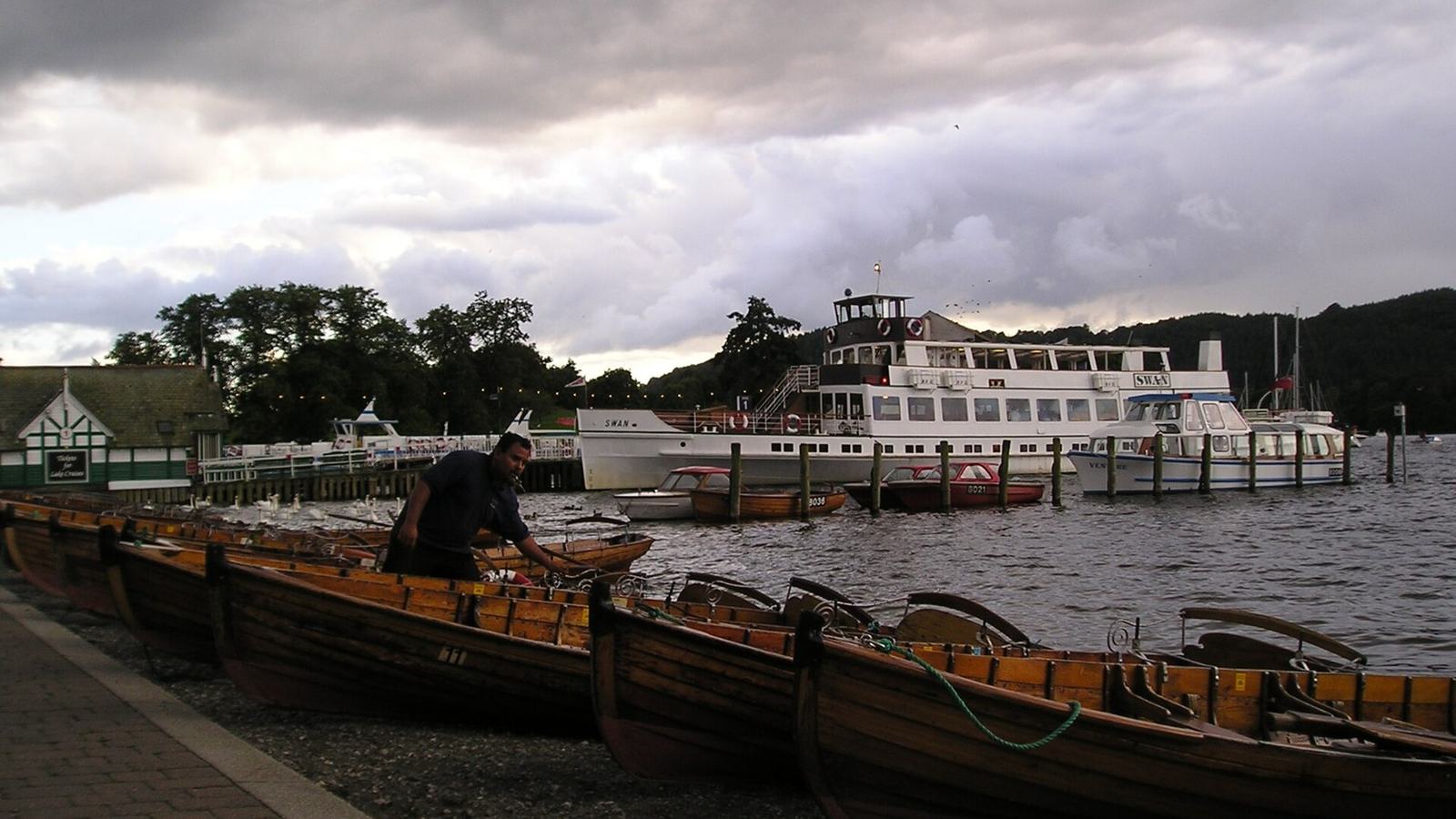
The lead photograph shows genuine rowing boats at Bowness Bay on Windermere, taken by Chris Holifield and made available through Wikimedia Commons under a Creative Commons Attribution-ShareAlike 2.0 licence. It illustrates the real boating setting but does not depict the specific motorboat registration procedure or guarantee current water conditions. The photograph has been resized for editorial use, with its creator and licence credited. The principal source for the article's current registration requirements and fees is the Lake District National Park Authority's Windermere boat registration page. Speed limits and navigation requirements are cross-checked against the authority's separate Windermere byelaws. Owners should consult both live sources before a trip.
A lake holiday built around sensible speed
Windermere offers an appealing small-boat experience because the destination is close to shore-based visitor services while retaining the pleasure of travelling independently over open water. Its controls on registration and speed do not prevent enjoyment; they are part of managing a heavily used lake where many kinds of craft share the space. A visitor who registers correctly, launches at an authorised facility and plans a modest route can enjoy the scenery without unnecessary pressure. The lake rewards good preparation and a willingness to move slowly. For a motorboat owner, that combination is an attractive alternative to a more complex coastal cruise.
Sources and photograph attribution
Official destination and boating guidance: Lake District National Park Authority — Windermere Boat Registration. Current access, rules, weather and reservations must be checked independently before travel.
Photograph: Chris Holifield — “Rowing Boats at Bowness Bay - geograph.org.uk - 3136129.jpg” (CC BY-SA 2.0), via Wikimedia Commons. Resized and converted to JPEG for editorial display. Source: https://commons.wikimedia.org/wiki/File:Rowing_Boats_at_Bowness_Bay_-_geograph.org.uk_-_3136129.jpg. Licence: https://creativecommons.org/licenses/by-sa/2.0. Original rights remain with the credited creator or as specified by the source and licence.
