
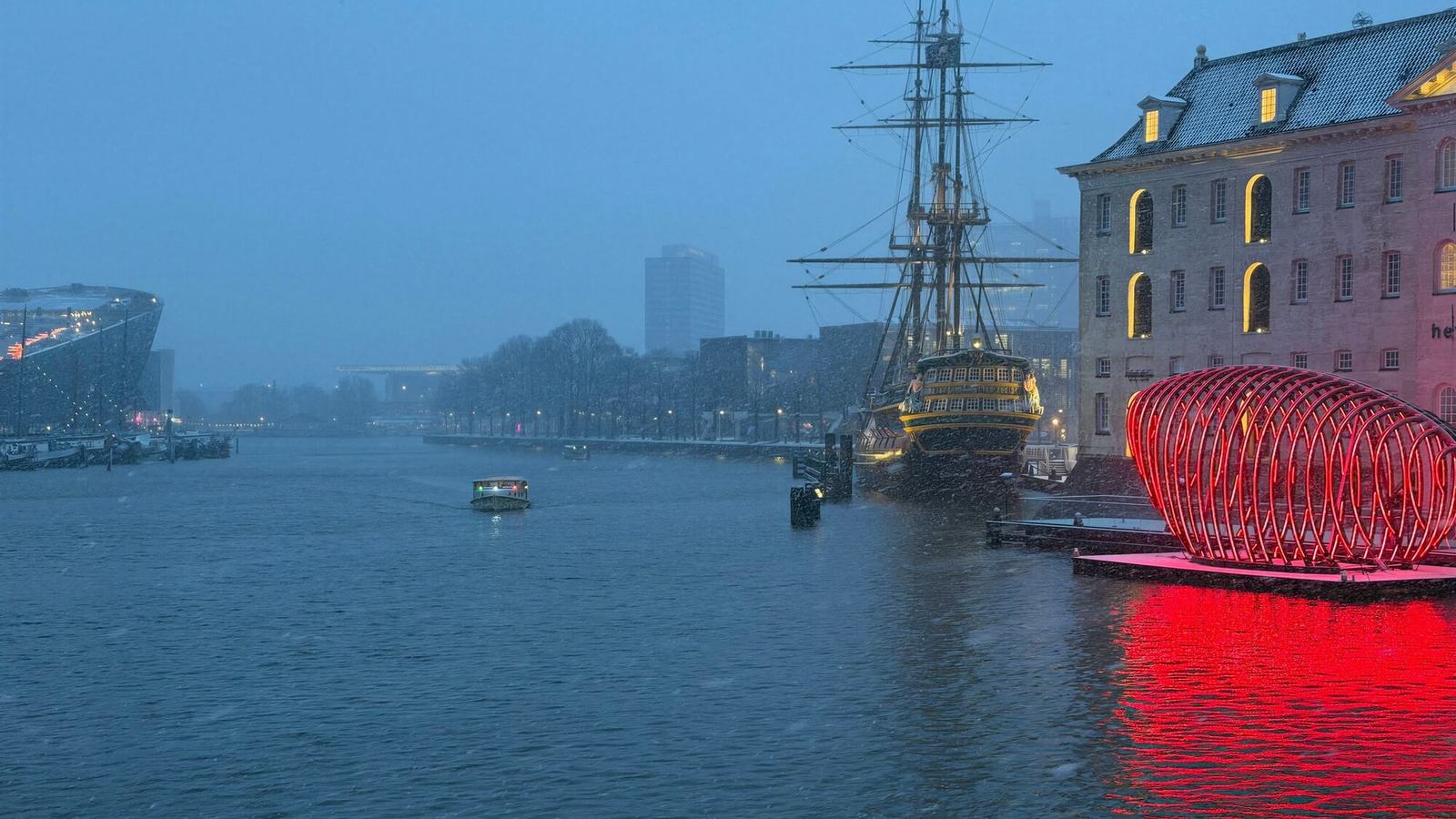
Award-recognised floating installation Whale Fall translates deep-sea ecology into an evocative public artwork of steel ribs and red light in Amsterdam's waterways.
A whale beneath the city lights
What becomes of a whale after its body reaches the ocean floor is usually hidden from view. The remains can support a complex procession of deep-sea life, turning an ending into a temporary habitat. Australian designer Xinyi Wang has brought that ecological idea into an unlikely setting: a floating illuminated sculpture presented in the canals of Amsterdam.
Called Whale Fall, the installation was realised with Amsterdam Light Festival and recognised in Australia's 2026 Good Design Awards. It used ribs of steel and restrained red illumination to suggest a vast submerged body. The result connected public art, waterfront engineering and an ecological story rarely encountered by the people who stroll or cruise through a busy city.
Turning biology into an urban experience
A natural whale fall is not an event most recreational boaters can witness. It occurs at depths where changing populations of scavengers and smaller organisms make use of the remains over time. As a design concept, that cycle gives the artwork an unusual emotional balance: mortality is present, yet the central message is about regeneration and interconnected life.
The installation did not set out to replicate a biological specimen or create a functioning artificial reef. Its purpose was interpretive. Long curving ribs, gaps and coloured light offered an abstract structure that viewers could read as both a skeleton and a shared space. Such ambiguity is part of what makes public art accessible to people arriving without specialist scientific knowledge.
A transcontinental commission
Wang, working through XYTOPIA in Sydney, developed the installation for the Amsterdam Light Festival's fourteenth edition in response to the theme of legacy. The project emerged from a two-stage international design competition and required coordination among the artist, Dutch festival organisers, structural engineers, fabricators and lighting specialists.
Distance made that collaboration more complicated. Drawings, engineering revisions and material choices had to move between teams in different time zones before the artist could attend final production in the Netherlands. The work also underwent two rounds of structural evaluation, showing that a striking shape on water must satisfy practical safety requirements before audiences can enjoy it.
What the water demanded
A floating installation behaves differently from a sculpture fixed in a square. Its structural frame and pontoon-based support must cope with movement, loading and a constrained urban setting while remaining stable for visitors to observe from bridges and waterside paths. The designers therefore refined the ribs and supporting system to meet both the artistic intention and the needs of the festival's technical team.
The design also had to be transported into its appointed location. According to the project's official award entry, the operation required the opening of a city railway bridge that had remained closed for decades. That unusual journey became another layer of the artwork's story: an object shaped by water moving through the city to reach its stage.
Colour, outline and reflection
The palette is deliberately limited. Red light traces the steel structure without turning it into a brightly illustrated animal, allowing reflections and surrounding darkness to complete the composition. From one viewpoint the repeated members resemble a body; from another they become an architectural procession of arcs.
Waterfront art can be especially powerful because the visitor's position is never fixed. Someone approaching by canal boat experiences a sequence of changing perspectives, while people on shore encounter the reflected form against the city beyond. Those conditions are different from looking at an object inside a gallery, and they invite designers to consider movement as part of the audience experience.
An ecological story without a simple solution
The connection to ocean science should be understood as storytelling, not a claim that the installation directly restores marine habitats. It draws attention to the overlooked ecology of the deep sea and asks viewers to consider what happens to material after apparent life has ended. Its designers also describe the structure's relevance to environmental awareness and later ocean-focused events.
That distinction is useful in an era when ecological vocabulary is applied to many creative projects. Art can prompt curiosity and conversation even where it cannot supply scientific monitoring or practical conservation outcomes. In the case of Whale Fall, a public encounter with an unfamiliar natural process is itself the project that can be assessed.
Designed for more than one festival
Temporary waterfront commissions often face a familiar challenge: what happens once the event closes? Whale Fall was planned with a reusable system of steel members and a transportable pontoon foundation. The design team describes potential future configurations as a public pavilion, gathering place or performance platform, whether on water or on land.
Those possible second lives have not all necessarily occurred. They illustrate the intent to avoid treating the first installation as the end of the object's useful service. Disassembly, storage, repair and adaptation become significant design questions when the footprint of an artwork extends from fabrication through transport to eventual reuse.
Where boating and cultural life meet
For leisure boaters, Amsterdam's canal culture offers a reminder that waterways are also civic spaces. They carry transport, frame architecture, host events and create memorable urban journeys. A piece such as Whale Fall can make a familiar passage feel newly considered, especially when an artwork changes the way viewers think about the water beneath them.
The 2026 award recognises an ambitious fusion of marine inspiration, art and engineering. Whale Fall's achievement lies in making the invisible accessible without pretending to reproduce it literally. It is a thoughtful example of how cultural design can deepen appreciation of the sea, even in a city whose relationship with water is shaped as much by bridges and canals as by the open coast.