
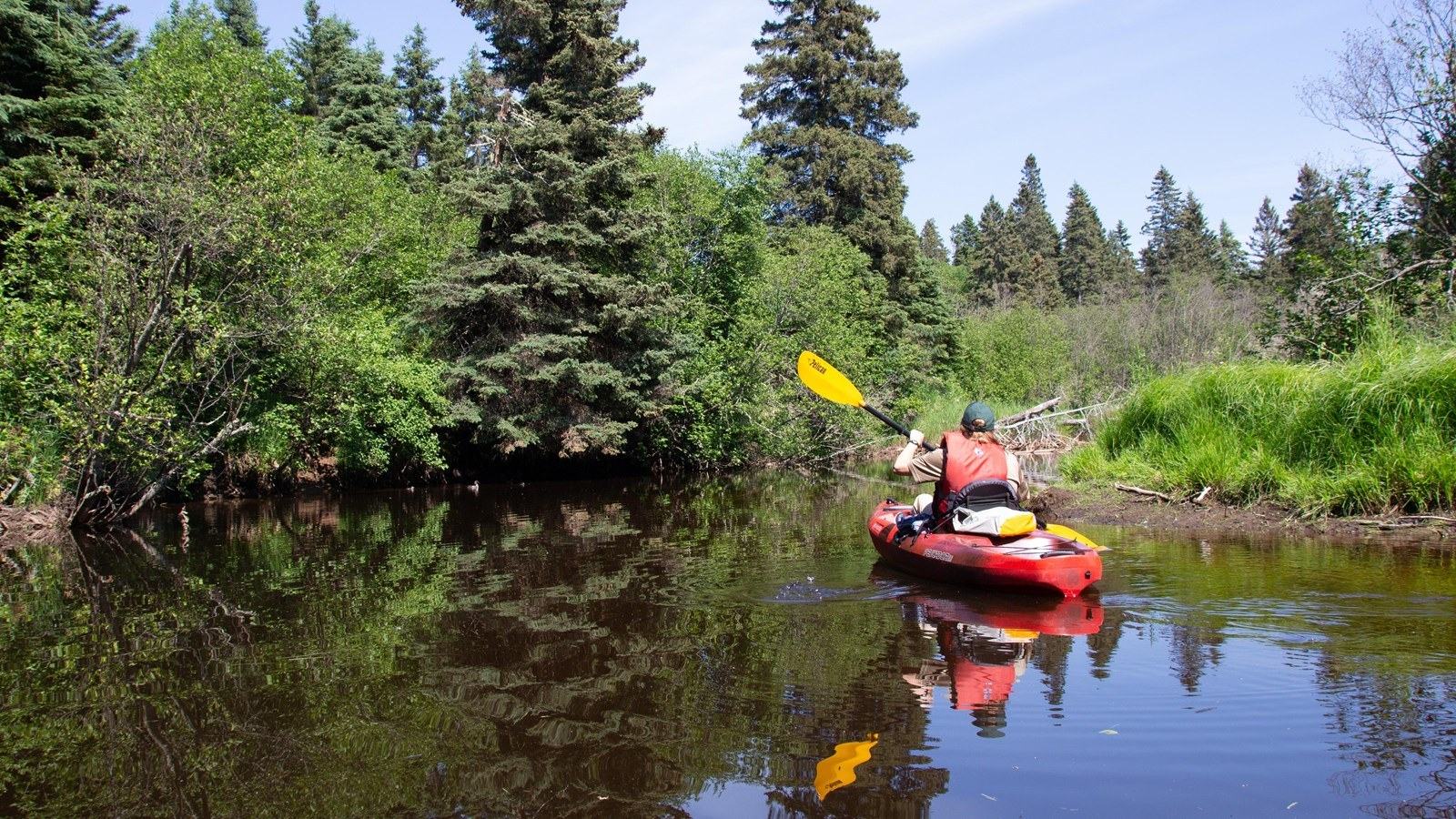
A quieter side of Isle Royale: kayak or canoe through forested Washington Creek from Windigo, with wildlife watching and cautious access planning.
A small canoe can offer a remarkably intimate view of Isle Royale National Park, where the forested island rises from Lake Superior and ordinary roads do not carry visitors between destinations. Washington Creek, near Windigo at the island's western end, provides a comparatively short, motor-free paddling opportunity that combines sheltered water, wildlife observation and the feeling of being somewhere genuinely remote. The National Park Service describes a one-to-three-hour out-and-back journey reached from Washington Harbor, with kayak and canoe rental opportunities through the Windigo Camp Store. That sounds approachable, but there are important qualifications: Isle Royale is reached by boat or seaplane, the creek becomes shallow inland and water levels in the harbour can change through seiche activity. The appeal is a peaceful small-boat experience, not a guarantee of easy access or calm conditions every day.
Reaching a park without public roads
The first decision in planning a Washington Creek paddle is how to reach Isle Royale at all. The island sits in the northwestern portion of Lake Superior, and the National Park Service explains that visitors arrive by passenger ferry, private vessel or seaplane. There is no normal road journey into the park's backcountry. This changes the economics and timing of a weekend afloat: a visitor must coordinate the island trip with transport schedules and whatever accommodation or camping arrangements are required. Missing a return connection can have greater consequences than at a mainland reservoir. Any day-trip plan should therefore start with reliable travel information, confirmation that the chosen service operates on the intended date and enough time to collect, paddle and return equipment before departure.
Windigo is the natural starting point
Windigo is the park's western visitor hub and is associated with the store, marina, visitor centre and nearby Washington Creek Campground. A canoe trip can become part of a broader visit that includes walking, a shoreline picnic or an interpretive stop. The NPS names daily kayak and canoe rentals through the Windigo Camp Store, although visitors need to confirm actual availability and seasonal opening rather than assume a rental will always be waiting. Travellers may also bring their own craft on an appropriate ferry or private boat, subject to transport rules and capacity. That flexibility is useful for people who want a proper small-boat experience without carrying a vessel across the entire mainland. It does not remove the need to consider the logistics of moving equipment on and off the island.
A creek entered from Washington Harbor
The Park Service describes Washington Creek as accessible from Washington Harbor. This is an important navigational distinction: a paddler is not setting out across the open expanse of Lake Superior in an ordinary recreational canoe. The intended outing follows the creek into its forested surroundings and returns along the same route. However, getting to the creek may still involve harbour conditions that deserve attention, and weather on a large inland sea should not be underestimated. The crew must know precisely where it may safely launch, where powered craft operate and where the creek begins. The existence of a protected waterway beyond the entrance does not make every section of the approach suitable for a novice.
Motors are prohibited in the creek
One rule central to the destination is the prohibition of motorised vessels within Washington Creek. The NPS specifically describes the route as a paddle destination, making it distinct from water that supports ordinary outboard-powered touring. Visitors with small tenders should not assume that an electric motor is allowed merely because it is quiet; a general motor prohibition requires checking against the current park rules. The absence of engines can make the creek an appealing place for slow wildlife observation, but the paddler remains responsible for steering carefully and avoiding unnecessary disturbance. Human-powered travel is not automatically harmless. Contact with the banks, careless landings and pressure on wildlife can still leave an impact, so low-noise boating should be accompanied by low-impact behaviour.
Wildlife and the possibility of moose
The official Washington Creek activity page identifies wildlife observation as one of the route's attractions and suggests that visitors may glimpse a moose in the water. That is a possibility, not a promise. Large wildlife can be unpredictable and should never be approached, followed or forced to change direction for a photograph. A paddler who sees an animal near the creek should maintain a substantial distance and be prepared to stop or retreat if necessary. The best encounter is one in which the animal continues undisturbed. Isle Royale's isolation is part of what makes such observations memorable, and it increases the responsibility to behave appropriately. A trip can be rewarding even when there is no dramatic animal sighting.
Shallow water changes the itinerary
Washington Creek becomes shallower as a paddler moves inland, according to the NPS. Because the recommended trip is out and back, the appropriate turnaround point may depend on depth, vegetation and the condition of the boat. There is no reason to push a hull into mud or sensitive shoreline vegetation to reach an arbitrary landmark. The route has no guaranteed end point at which every canoe or kayak can turn, so the person steering must be comfortable recognising when there is insufficient room or water to continue. A modest paddle can be a complete experience. Returning early because the channel is shallow or the crew is tired is sound judgement rather than a failed holiday.
Seiches and changing water levels
The park specifically warns that Washington Harbor and Washington Creek sometimes experience seiche activity. A seiche is an oscillation of water level in a basin that can create changes without the ordinary tidal pattern associated with the sea. On a large lake, these movements can alter conditions near a shoreline and affect shallow passages. A visitor should not rely only on a general forecast of wind and air temperature. The Windigo Visitor Center is an official place to obtain local weather guidance before paddling. For an inexperienced visitor, the need to understand changing water levels reinforces the value of selecting a short, conservative outing and returning with ample time to spare.
What one to three hours really means
The NPS estimates a duration of one to three hours for the out-and-back paddle. This is a planning range, not a promised completion time. Conditions, the direction of wind, water depth, the crew's experience and stops for wildlife observation may all influence progress. Anyone hiring a craft should establish the return or check-in time, because arriving late may disrupt operations or other visitors. The simplest plan is to decide on a realistic latest turnaround time before departing. A person who wants to spend a long time watching the forest may need to cover less distance. The aim is to enjoy the setting while keeping enough margin for a safe and unhurried return.
What to bring aboard
A small canoe or kayak has limited space, so personal equipment should be chosen carefully. A properly fitted lifejacket, suitable footwear, drinking water, warm layers and protection for essential belongings should be part of preparation. Cold-water exposure is a serious concern in the Lake Superior region, even when a sheltered creek looks inviting. The crew should be capable of managing the craft and know how to respond after a capsize. Equipment such as a whistle or another appropriate signalling device may be necessary under applicable rules. Before departure, tell someone where you plan to paddle and when you expect to return. A remote park is not the setting to test unfamiliar boat handling for the first time.
A wider Windigo itinerary
The creek can form a gentle centrepiece of a Windigo visit rather than a mission to cover as much water as possible. The NPS lists Washington Creek Campground, the visitor centre, marina and store among nearby places. Someone camping on the island may be able to choose the best suitable day for the paddle, while a person on a limited ferry schedule needs a more cautious time budget. Walks and interpretation can provide useful alternatives if conditions keep boats ashore. A well-paced itinerary combines the pleasure of being on the water with a realistic understanding of the island's limited services and transport options. It does not depend on seeing a moose or reaching the furthest possible bend.
Respect for protected shorelines
The wilderness character of Washington Creek depends on people staying within permitted areas and avoiding unnecessary disturbance. Do not land simply because a bank appears empty. Keep boats away from sensitive vegetation, and never feed or pursue wildlife. Clean and dry equipment before bringing it into the park to reduce the spread of aquatic invasive organisms. The rules for camping, food storage and pets must also be checked if the paddle is part of a longer visit. The official Washington Creek listing says pets are not allowed on the activity. Visitors should treat that restriction as a planning detail rather than something to discover after arriving at the island with a dog aboard.
A photograph that shows the real setting
The accompanying photograph comes from the National Park Service's official Washington Creek paddling page. It depicts a person in a kayak on a wooded creek and is credited to Uwe Konopka. The image provides a genuine view of the environment rather than an unrelated stock scene or a constructed wildlife encounter. It cannot establish that the same water depth, weather or wildlife conditions are present at the time of a future visit. The primary source also supplies the details about entry from Washington Harbor, motor restrictions, rental opportunities, seiches and the estimated paddling duration. These are useful verified foundations, while live transport arrangements and local alerts should be checked directly.
Why this small paddle feels exceptional
Washington Creek is not a destination where boat size determines the enjoyment. A suitable canoe, a little time and a well-considered plan can bring a visitor close to a landscape that is difficult to experience in any other way. The island's forest and wildlife provide the atmosphere, while the human-powered route encourages a slower pace than a motorboat passage. At the same time, the trip rewards competence and careful logistics: the park is remote, the creek becomes shallow and weather on Lake Superior should never be trivialised. For visitors prepared to respect those conditions, a brief Windigo paddle can become a memorable part of a wider Isle Royale holiday.
Sources and photograph attribution
Official destination and boating guidance: National Park Service — Isle Royale National Park. Current access, rules, weather and reservations must be checked independently before travel.
Photo: National Park Service / Uwe Konopka, Washington Creek kayaker, Isle Royale National Park. Source: https://www.nps.gov/thingstodo/paddle-washington-creek.htm. Original rights remain with the credited creator or as specified by the source and licence.