
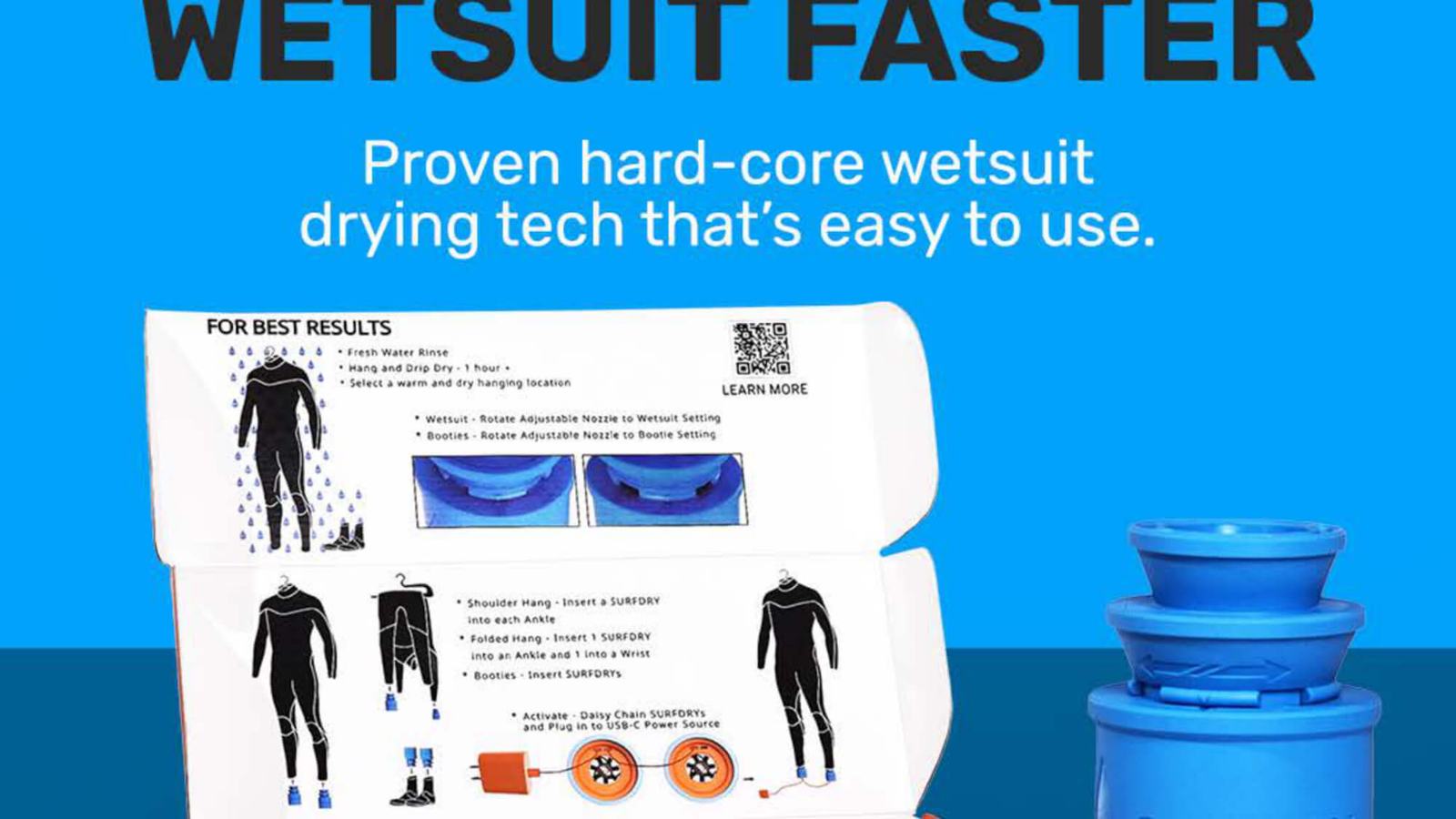
SURFDRY's 2026 Australian Good Design Award entry describes a portable, USB-C-powered system for drying wetsuits, dive booties and gloves using controlled ambient air instead of heat.
The problem of putting damp gear back on
For anyone using a wetsuit regularly, the least enjoyable part of a second session may begin before entering the water. Damp neoprene or natural-rubber material is uncomfortable to pull on, and booties and gloves can remain wet long after a suit has been hung up. SURFDRY, a 2026 Australian Good Design Award project, addresses that inconvenience with a compact dryer that moves ambient air through watersports gear instead of warming it.
The American-designed system was developed by SURFDRY LLC for commissioner Zachary Backlin and appears in the Product, Sport and Lifestyle category. The entry describes more than two years of prototyping and evaluation to produce an accessory that works with different equipment shapes. This is a product for everyday gear care, not an industrial dehumidifier or a guarantee that wet fabric will dry at a fixed speed in every climate.
Why heated drying is not always desirable
Wetsuits and technical accessories combine rubber, adhesives, fabric linings and coatings, and their performance depends on correct cleaning and storage. Excessive heat may be unsuitable for some materials, so gear makers often specify care conditions rather than recommend hot-air drying without qualification. SURFDRY uses controlled movement of room-temperature air instead of a heating element, which is the central idea behind its design.
Moving air can help moisture evaporate from narrow spaces where drying would otherwise be slow, but results still depend on room humidity, temperature and how much water the gear retains. Users should not interpret the absence of heat as proof that every seam or fabric is safe under every condition. The suit maker's washing, hanging and drying instructions are still the best starting point before adding an accessory.
A small device built for multiple openings
The published design incorporates three concentric, increasing diameters intended to fit wrist and ankle openings across youth and adult gear. Adaptability matters because a dryer that supports a broad wetsuit cuff may not hold a narrower glove or bootie securely. Rather than requiring separate machines for each accessory, the design team focused on one compact solution for several shapes.
A rotating shutter adjusts airflow depending on whether an item has a single opening, as with a glove or bootie, or multiple exits, as with a wetsuit. The mechanism is central to the entry's claim of broad suitability. Prospective buyers should still check compatibility with unusually shaped drysuits, footwear or tight cuffs; universal design is an intention to serve many users, not a guarantee of fit for every item.
Power options for boaters travelling light
SURFDRY is intended to draw power through a USB-C connection, giving it a different role from the heated drying cabinets sometimes found in dive centres. According to the design entry, it can be operated from a suitable wall supply, portable battery or compatible solar-powered setup. That flexibility is particularly relevant aboard leisure boats where dedicated drying appliances can demand more space and electricity than the owner wants to allocate. It does not, however, mean that every USB-C source delivers the same performance, and prospective buyers should confirm the manufacturer's electrical requirements before pairing it with a battery pack.
The reported weight is around 0.45 kilograms, or roughly one pound, and two units can nest together for storage. Those details could matter to cruising sailors, weekend motorboaters and divers who already carry substantial equipment. Still, the compact footprint should not be confused with complete independence from the surrounding environment. Damp gear needs somewhere for water to drain, and circulating air needs an escape route rather than being trapped in a sealed locker.
Making a practical drying station on board
A small boat's wet area is often a compromise between seating, equipment storage and a place to deal with spray-soaked clothing. The portable design suggests an alternative to leaving gloves hanging in a crowded cockpit or pushing wet boots into a locker until the next trip. An owner might set up a temporary drying space in a sheltered, ventilated location, with a drip tray or absorbent mat beneath the equipment. Any use should follow the product's instructions, particularly around electrical connections near water.
Placement matters as much as the dryer itself. A glove or boot exposed to moving air in a well-ventilated space will behave differently from an item in a humid cabin with little air exchange. Users should avoid directing water toward charging points, running cables across walkways or assuming a boat's electrical supply is appropriate without checking. The most credible benefit of a compact appliance is the ability to organise routine equipment care, not a guarantee that everything dries before departure.
A design informed by users of specialist gear
The award submission describes a development process lasting approximately two years and involving iterative design work. Its stated testing and feedback included people who regularly handle wetsuits and related equipment, among them professional surfers and industry participants. That user involvement is helpful context for a product aimed at awkward shapes rather than flat towels. The three concentric outlets and adjustable airflow arrangement speak to a specific everyday frustration: the openings of gloves and booties are difficult to prop open for drying.
Readers should nevertheless distinguish an official design-award description from an independently controlled laboratory assessment. The available entry outlines design objectives and features, but it does not establish a universally reproducible drying time across every thickness of neoprene, ambient temperature or humidity level. Nor does it demonstrate a precise comparison with every heated dryer or ordinary clothesline. Before buying, boat owners may reasonably want practical demonstrations involving the actual equipment they use.
Caring for neoprene and other technical materials
Anyone who spends several days on the water knows that drying is only one element of looking after specialist clothing. Salt, sunscreen, sand and residues can remain after a session, even when the surface no longer feels wet. Appropriate freshwater rinsing, washing according to the garment label and full drying before prolonged storage remain important habits. Some modern wetsuits use plant-derived natural-rubber alternatives such as Yulex rather than conventional neoprene, so material-specific manufacturer directions take priority over any general accessory claim.
Because SURFDRY uses ambient airflow rather than deliberate heating, its approach may appeal to people who want to avoid exposing sensitive gear to unnecessary temperature extremes. That is a plausible design rationale, not a claim that a device restores damaged fabric or disinfects equipment. Air movement alone is not a substitute for cleaning, and no portable dryer should be represented as sterilising borrowed or shared dive gear without evidence and a relevant validated procedure.
Who might benefit beyond individual leisure boaters
The obvious audience includes surfers and divers, yet the application can extend to boat crews who use flexible waterproof equipment, coastal sports instructors and sailing families juggling several pairs of gloves or shoes. On a charter boat, reducing the pile of wet personal gear between activities could improve the experience for passengers and crew alike. Diving and watersports operators might also appreciate equipment that can be rearranged when a permanent drying room is unavailable, provided it meets their operational and safety policies.
For an occasional summer cruiser, a thoroughly ventilated hanging area may already be sufficient. An additional gadget must justify its purchase price, charging needs and storage footprint. More frequent users have a different calculation: repeated sessions in cool weather can leave thick boots and gloves damp for longer than expected. The value proposition depends on how often equipment gets wet and how inconvenient the drying process currently is. That practical distinction is more informative than treating the accessory as an essential item for every boat.
Design recognition does not replace ownership checks
The SURFDRY project appears in the official 2026 Australian Good Design Awards project catalogue in the sport and lifestyle field. The listing names SURFDRY LLC and designer Zachary Backlin, and describes production in the United States. As a primary source for the product's stated design characteristics, the award catalogue is useful; its presence there should not be interpreted as independent certification of electrical safety for every environment or a guarantee of performance at sea.
Prospective buyers should verify the current commercial specification, waterproofing or splash-protection guidance, local electrical compatibility and warranty directly with the manufacturer. Diving operators should apply their own maintenance protocols rather than relying on a generic consumer description. Like many thoughtful marine-adjacent products, the design addresses a modest but persistent problem. A successful purchase comes from matching that solution to real equipment and working conditions.
A reminder that boating innovation can be small
Marine innovation is often associated with electric propulsion, advanced navigation displays or large investments in hull materials. Yet the practical comfort of a day afloat can hinge on less glamorous details, such as whether gloves and boots are ready for the next outing. This product's focus on airflow, power versatility and the geometry of awkward openings reflects that smaller scale of problem solving. Its appeal is not in adding another complex system but in simplifying a repetitive maintenance task.
SURFDRY's official 2026 design entry provides the clearest published description of its development and intended use. Owners interested in a portable heat-free drying solution can consult the Australian Good Design Awards project profile for that source material, then check current specifications with the maker. As with any electrical equipment brought aboard a boat, suitability ultimately depends on safe placement, proper ventilation and following the manufacturer's operating instructions.