
A low-impact small-boat visit to the St Johns River needs careful wildlife etiquette and a clear understanding of Blue Spring State Park’s seasonal and current access rules.
Florida at a river’s pace
The St Johns River presents a different kind of Florida boating day from the familiar image of an ocean inlet. Here the reward can be slow freshwater scenery, long views across broad bends and an exceptional chance to appreciate the landscapes that support the state's wildlife. Around Blue Spring State Park, that wildlife story includes the Florida manatee. Small boats make these waters accessible, but their size does not give them special permission to approach animals, enter protected runs or ignore posted speed zones. A successful visit begins with the understanding that the boat is a guest in a complex habitat. The ideal day is one of attentive river cruising and a properly arranged shore visit, not a search for the closest possible photograph of a manatee.
Why Blue Spring is special
Blue Spring is a warm-water refuge used by manatees when surrounding river temperatures fall. The clear spring water makes the site especially appealing to visitors, but that visibility has also created a need for strong protection at sensitive times. Florida State Parks explains that manatees gather in the spring run during the colder part of the year. It also restricts water recreation in that run seasonally, with the official park materials describing a closure beginning in mid-November and extending into March. Exact opening arrangements can be revised, so boaters must consult the current park guidance and on-site instructions before travelling. The attraction is best approached as an opportunity to observe wildlife responsibly from authorised viewing areas, not as an invitation to steer into the spring.
Do not plan to launch at French Landing
There is a particularly important practical warning for anyone searching online for Blue Spring access. The official Florida State Parks website currently states that the French Landing boat ramp and the park's canoe and kayak launch and rental operations are closed. That matters more than an old map symbol or an enthusiastic travel article recommending the ramp. Do not tow a boat there expecting to launch. Identify a currently operating, authorised public or commercial launch elsewhere on the St Johns River, confirm its availability directly and assess the intended distance to the cruising area. A ramp may also have limitations relating to draft, trailer parking or operating hours. Read fresh official information on the morning of departure when possible. Building a day around a closed facility is avoidable.
The protected spring is not the river channel
An enjoyable river trip does not depend on entering a sensitive spring run. The main St Johns River and the Blue Spring spring run are different navigational environments with distinct rules, signs and ecological purposes. Seasonal exclusions can prevent boating, paddling, swimming and other water activities in the protected spring area. Treat barriers and boundaries as absolute. If manatees are gathering in the run, the appropriate experience may be to secure the vessel at a lawful facility elsewhere and visit an authorised observation area by land. Do not assume that seeing another craft near a boundary grants permission to follow it. A small outboard is capable of causing serious injury to a manatee, and even a paddle craft can disturb animals if used improperly.
Slow zones require active attention
Manatee protection rules on Florida waterways can include posted idle-speed, slow-speed and other zones. They vary by location and sometimes season, so a general statement that the river is safe for fast running would be irresponsible. Look ahead for signs and adjust speed before entering a restricted area. A boat driven at a manageable speed gives the operator more time to notice a broad wake, a snout or another indication of an animal near the surface. Keep a proper lookout at all times and avoid abrupt movements towards wildlife. If a manatee appears in the boat's path, reduce power safely, allow space and follow official guidance. Deliberately pursuing a manatee or attempting to touch one is contrary to the basic purpose of visiting this refuge.
Make the river itself the destination
Away from the spring-run boundary, the St Johns offers the possibility of a quiet freshwater cruise through changing bankside scenery. The best route depends on where a legal launch is available, the vessel's range and prevailing conditions. Rather than recommending a fixed distance from a particular ramp, start with a section the skipper can confidently navigate both ways. Observe markers and shallow-water information carefully; a wide river still has underwater hazards and areas that demand local knowledge. Allow for other vessels, paddlers, wildlife and changing weather. A day that combines steady cruising with a short stop at an authorised facility can be satisfying without covering great distances. Enjoying a place through a boat is different from trying to occupy every part of it.
Understand what a wildlife photograph means
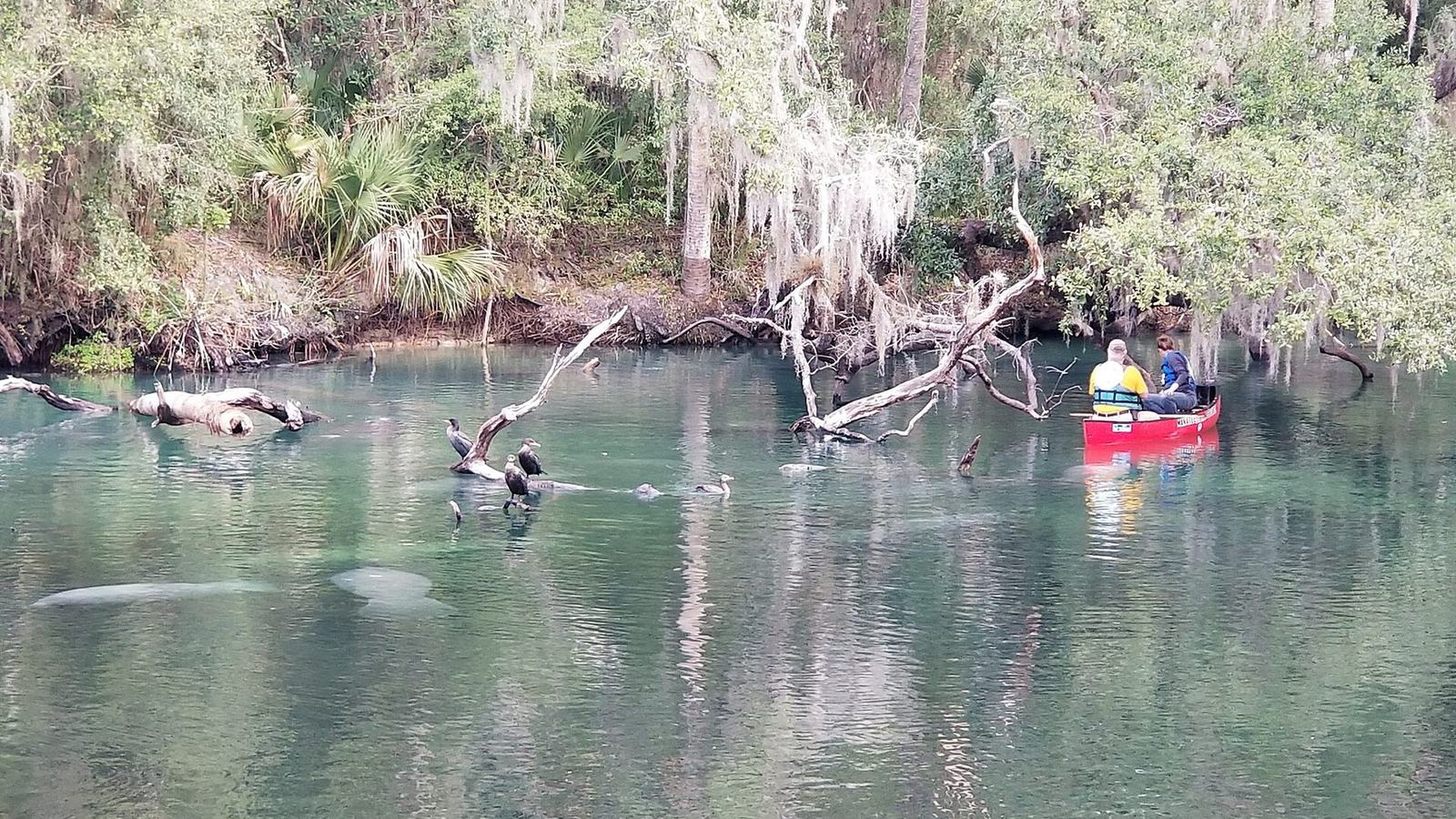
Blue Spring's manatees have been photographed extensively, and older pictures can convey the beauty of the setting. They do not show whether a particular area is currently open to boating. The image accompanying this feature was taken in December 2018 and is used as an archival illustration, not as evidence of present access. That distinction is important in travel journalism. A photo of a canoe near animals is not permission for today's visitor to repeat the scene, especially when seasonal wildlife restrictions and a current launch closure apply. The most respectful close-up may be taken from a park boardwalk or other designated land-based viewpoint with a suitable lens. Leave the animals undisturbed and keep public viewing spaces available for others.
Choose weather and water conditions carefully
Florida's generally mild climate can disguise the risks of a river outing. Thunderstorms, squalls, strong rain and changes in visibility can develop, while a cooler winter morning may expose an underdressed passenger to discomfort on an open boat. Check an appropriate forecast and the conditions for the planned reach. In freshwater, banks and trees can reduce the view ahead or make hazards difficult to identify. Keep a route and return time that leave ample daylight and an alternative sheltered place if the weather becomes unsuitable. If the outing involves children or less experienced passengers, prioritise comfort and short legs. A responsible skipper cancels or shortens the journey when the plan no longer matches conditions.
Small-boat equipment still matters
Every person needs the required and appropriate personal flotation equipment, and the boat must carry the safety gear demanded by the applicable rules. Check engine reliability, fuel reserve, steering, navigation lights when relevant and a means of calling for help. A charged phone may be useful on a populated reach but should not be the only method of communication if signal coverage is uncertain. Carry drinking water, sun protection and an accessible first-aid kit. Keep items secured so an unexpected manoeuvre does not send bags, cameras or tackle across the cockpit. Brief everyone on safe movement and on the special importance of keeping arms and feet inside the boat near docks. Wildlife watching should never distract the operator from the channel.
Shore access should be confirmed, not assumed
Florida State Parks lists amenities and activities, but access to a park on land and permission to land a private boat are not equivalent. Check the current park page, contact the operator if necessary and use only authorised docking or landing facilities. The closed French Landing infrastructure makes that especially important for this destination. A convenient bank may be private, environmentally sensitive or unsafe for a boat's hull. If a stop at Blue Spring is central to the visit, it may be simpler to make it as a separate land excursion and reserve the boat for an entirely different river section. Good planning separates experiences that are enjoyable together from operations that are not permitted to overlap.
Keep wildlife disturbance to a minimum
Give manatees, birds and other animals as much undisturbed room as possible. Avoid repeated passes for photographs or crowding a point where other people are watching wildlife. Do not feed animals or discharge food waste. Refuel carefully, remove litter and avoid excessive wash along vulnerable banks. Underwater vegetation is important in this ecosystem; running into shallow vegetation can damage habitat as well as the boat. Follow any aquatic-invasive-species and local waterway practices relevant to the launch. A small craft can have a small impact when its operator pays attention to how the boat is used. The aim is to leave the river just as inviting for wildlife and the next visitor.
A better way to plan the day
Begin by confirming an open launch and checking the latest Florida State Parks notice for Blue Spring. Mark seasonal restricted waters and relevant manatee protection zones on a suitable chart, then choose a conservative section of the main river that does not rely on entering the spring run. Check the weather, launch and return arrangements, fuel and safety kit. If seeing manatees is the priority, organise a lawful park visit on land, perhaps before or after the river cruise. Treat the day as a chance to appreciate why this habitat needs protection. The river gives small-boat owners a memorable connection with Florida's landscape; the best version of that experience grants manatees the right of way.
Sources and photograph credit
Current park facilities and seasonal restrictions: Florida State Parks, Blue Spring amenities and Manatees at Blue Spring. Archival photograph (December 2018): Ben1152000, Manatees and canoe at Blue Spring State Park, CC BY-SA 4.0; resized without cropping.

Source
Florida State Parks