
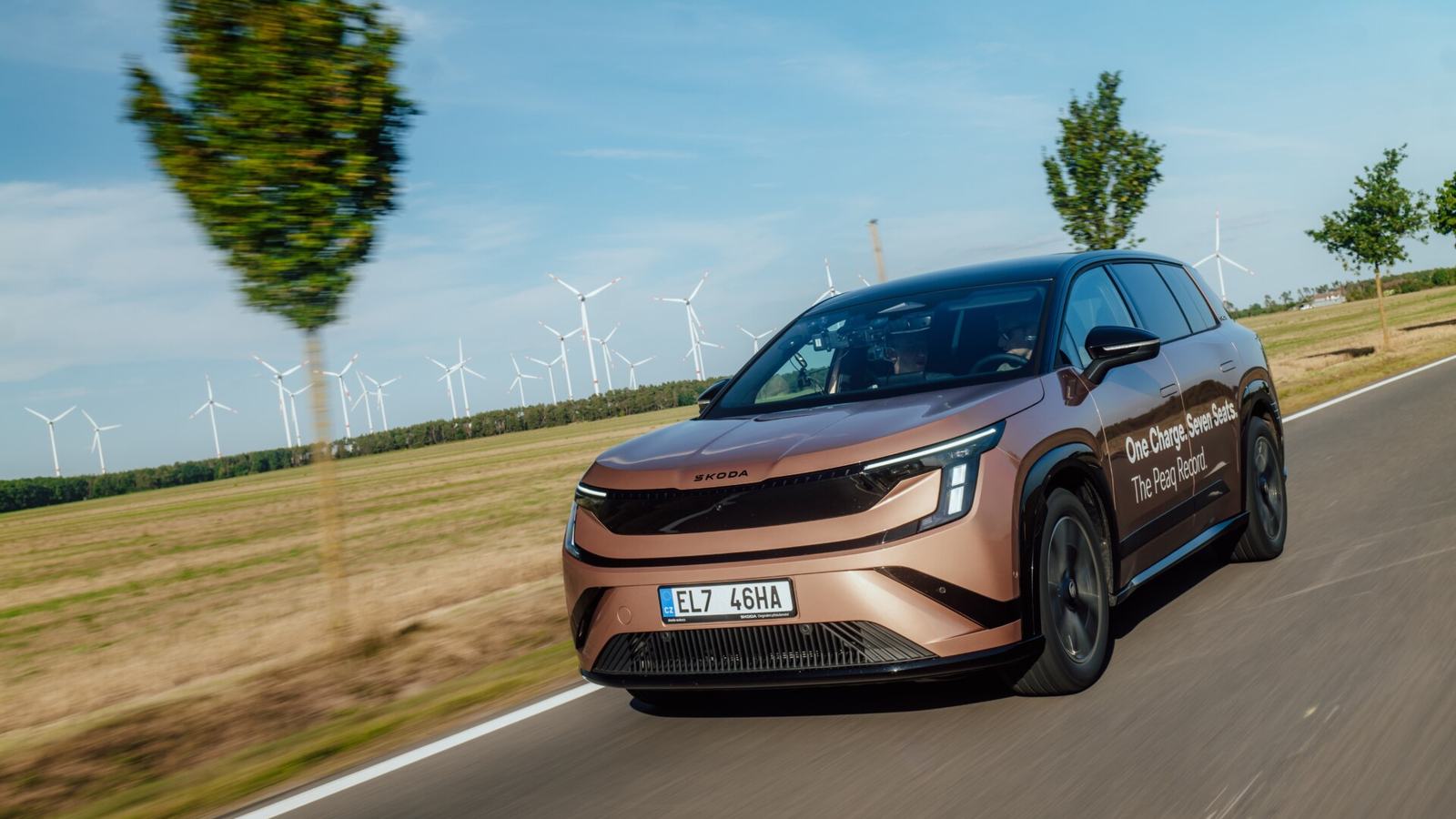
Škoda’s new seven-seat Peaq has completed a 936-kilometre single-charge drive from Mladá Boleslav to the Netherlands under TÜV SÜD supervision.
The new Škoda Peaq has covered 936 kilometres on a single charge in a supervised efficiency run from the Czech Republic to the Netherlands. The seven-seat electric SUV used a standard 91 kWh battery and averaged 9.2 kWh per 100 kilometres, demonstrating how far careful route choice and economical driving can extend real-world range.
A production Peaq travelled from Mladá Boleslav to Zandvoort
The record drive began at Škoda’s headquarters in Mladá Boleslav and continued through Germany before finishing at the Dutch seaside resort of Zandvoort. The journey was carried out in a series-production Peaq 90 rather than a specially built prototype.
Certification organisation TÜV SÜD supervised the attempt, giving the result a more formal basis than an informal economy run. Driver changes, rest stops and meals were included during the trip, but the traction battery was not recharged.
Energy use averaged 9.2kWh per 100km
The Peaq completed the 936-kilometre journey using an average of 9.2 kWh per 100 kilometres. Its 91 kWh battery provides 86 kWh of usable capacity, while the rear-wheel-drive test vehicle produced 210 kW and ran on standard 19-inch low-rolling-resistance tyres.
Škoda’s official WLTP figure for the Peaq 90 is up to 647 kilometres, so the record exceeded the homologated figure by 289 kilometres. The company stresses that normal owners are unlikely to drive in such an extreme efficiency-focused manner.
Seven-seat practicality remains the Peaq’s main appeal
The Peaq is the largest SUV in Škoda’s current range and provides three rows of seating for family and leisure use. That size makes its efficiency result particularly interesting because larger seven-seat electric vehicles carry more weight and present a greater aerodynamic challenge than compact crossovers.
For boating families, a spacious electric SUV can be useful for carrying luggage, watersports gear and passengers on marina or holiday trips. Towing suitability still depends on the approved trailer weight and individual boat package, so owners should check the model’s certified limits before specifying a trailer.
Aerodynamics and restrained driving made the difference
Škoda attributes part of the result to the Peaq’s aerodynamic design, which has a quoted drag coefficient of 0.249. The drivers also selected a favourable route and deliberately adopted an economical driving style to minimise energy consumption throughout the journey.
The result is therefore best viewed as a demonstration of technical potential rather than a normal range promise. Even so, it shows how vehicle efficiency, speed, route planning and driving behaviour can materially change the distance available from the same battery.
Official sources: www.skoda-storyboard.com.
Source
www.skoda-storyboard.com