
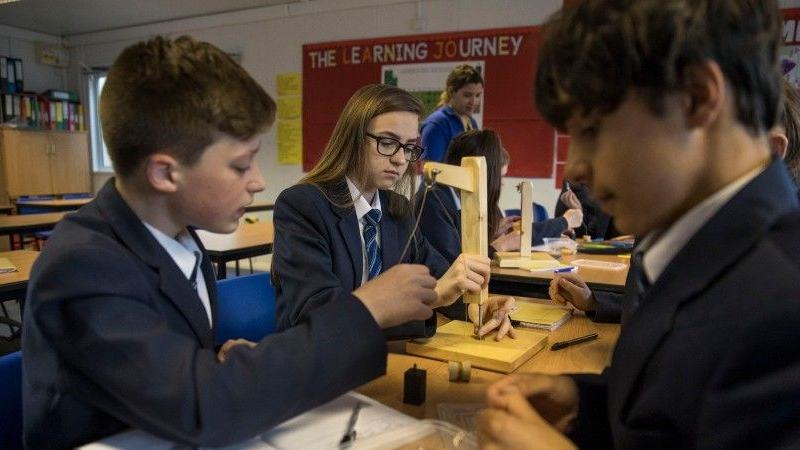
Canal & River Trust has secured £105,000 from the Royal Society's Science Community Grant programme to develop practical science, technology, engineering and mathematics projects linked to inland waterways. The three-year programme will involve twenty-five secondary schools, with students aged fourteen to sixteen investigating questions connected to local canals, water quality and the built environment.
Canals become outdoor science classrooms
Canal & River Trust has secured £105,000 from the Royal Society's Science Community Grant programme to develop practical science, technology, engineering and mathematics projects linked to inland waterways. The three-year programme will involve twenty-five secondary schools, with students aged fourteen to sixteen investigating questions connected to local canals, water quality and the built environment.
The organisation is one of ten UK STEM bodies selected for support, funded through a donation from the Julia Rausing Trust. The programme is intended to reach at least 750 young people annually, around 2,250 across three years. Its aim is sustained scientific experience rather than a single museum visit or occasional classroom demonstration.
Real waterways offer measurable problems
Students may examine water quality, ecology, structures and digital monitoring. These subjects become tangible beside a canal, where samples, measurements and observation can reveal how pollution, seasonal change and engineering decisions interact. A well-designed investigation can teach how to gather evidence and distinguish a hypothesis from a conclusion.
Practical work near water must always be supervised and planned safely. School projects can use suitable bankside locations and established safeguarding procedures, without requiring anyone to enter the canal. The value lies in meaningful scientific methods and careful interpretation of results, not risky access to infrastructure.
Teachers and specialists build lasting relationships
The Trust says a central objective is to connect schools with STEM professionals and help teachers feel confident delivering investigative learning after the grant period. This approach can offer students an understanding of careers that are not always visible in a traditional science syllabus, from environmental monitoring to engineering and digital systems.
Students who enjoy boats may discover a connection between navigation and mathematics, physics, mechanical systems or conservation. Those who prefer wildlife can investigate biodiversity and changing water conditions. A shared local waterway provides a common setting for very different scientific interests.
A spring 2027 start is planned
Applications from eligible secondary schools are scheduled to open in October 2026, ahead of a programme start in spring 2027. Places and the precise project activity will depend on the selection process and partner arrangements. Families and teachers interested in participating should consult the Trust's official education information for eligibility and updates.
For Leisure Boat Guide, this is a story about the wider culture around recreational waterways. The canals are places to cruise and walk, but also spaces where a young person can encounter practical science for the first time. The measure of success will include enduring school partnerships and confidence in carrying out evidence-based investigations. The work may also encourage young people to participate in sailing clubs, waterway volunteering or environmental projects after leaving school. That is a possibility rather than a stated outcome of the grant, and its real influence will take time to measure.
Source
Canal & River Trust