
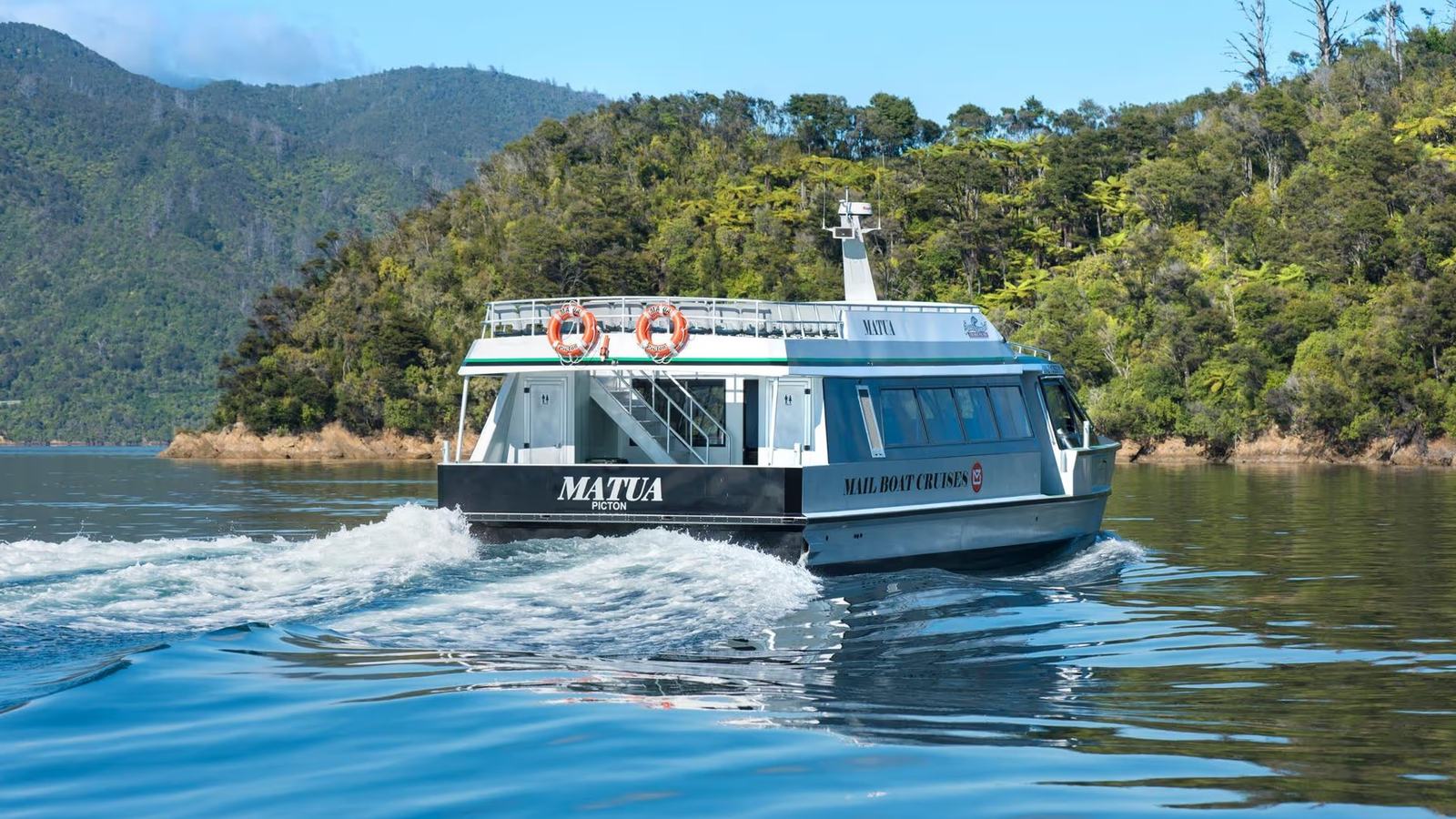
A mail boat in New Zealand's Queen Charlotte Sound serves residents whose homes are scattered around water-access communities. Beachcomber Cruises allows visitors to join this working journey from Picton, watching parcels arrive at remote jetties while forested hills slide past. It is a distinctive kind of leisure boat outing because the day's human connections are as memorable as the scenery.
A scenic cruise with a genuine purpose
Queen Charlotte Sound on New Zealand's South Island is a deeply indented waterway where steep, bush-covered slopes meet sheltered passages and scattered jetties. The shape of the coast means that not every home can be reached conveniently by road. For some residents, the arrival of a boat remains an everyday connection with the outside world.
Beachcomber Cruises operates a Mail Boat Cruise from Picton that combines passenger sightseeing with the delivery of mail and supplies. This is not simply a themed excursion in which a crew pretends to conduct local business. The route has a working purpose, and that gives the journey a relaxed human character.
Visitors watch the boat move between bays, stopping where deliveries or pickups are needed while the commentary brings the surrounding settlements into focus. The exact route can change with operational needs and conditions. That uncertainty is part of the experience rather than a failure to follow an inflexible sightseeing checklist.
The sound's long inlets allow the boat to reveal new views gradually. A secluded house, a patch of native forest or an isolated jetty can become the focus for a few minutes before the journey continues. People used to coastal dayboats may recognise how water rather than road infrastructure shapes life here.
Life around the jetties
A delivery stop is a small event, but it can tell visitors more about the area than a catalogue of landmarks. Parcels and letters help support households and businesses around the sound. The trip illustrates how a service that seems ordinary in town becomes a carefully organised waterborne connection in more remote surroundings.
Passengers should not expect a fixed series of staged encounters at every wharf. Some days require particular deliveries and others follow a slightly different pattern. The skipper's duties come first, while visitors are guests observing the work from an appropriate place on board.
Beachcomber describes the possibility of wildlife encounters during the voyage. Birdlife, dolphins or marine mammals may be seen in the region, but a working boat cannot promise a sighting or detour for every animal. A quiet view of the hills and shoreline remains rewarding when the wildlife stays out of sight.
The attraction extends to the vessels themselves. A boat designed to carry passengers efficiently through varied bays has different priorities from a private entertainment craft. Watching the crew work illustrates the value of dependable landing skills, local route knowledge and respect for the needs of people waiting ashore.
Planning an afternoon out of Picton
The official operator describes the experience as a half-day outing from Picton, running through much of the year. Current information lists an early-afternoon check-in and departure with a return later in the afternoon, but visitors must confirm their booked sailing. Working-route details and seasonal patterns can change.
Picton's waterfront is compact, yet it is wise to arrive well before the stated boarding time. Locate the correct departure point, allow for parking or local transport and check whether a printed or digital ticket is required. A relaxed start is especially valuable when travelling with children or older relatives.
A half-day on the water needs a different packing approach from a short harbour circuit. Carry layers against wind, sun protection, water and any medication normally required. The breeze experienced on a moving vessel can feel cooler than the temperature around Picton's cafés.
Families should discuss the length of the outing with children before departure, because the boat's schedule is driven by service obligations and cannot be shortened on request. Choose seats and activities that keep everybody comfortable without interfering with crew access. Simple observation of bays and vessels often proves sufficiently engaging.
What makes the scenery distinct
Queen Charlotte Sound belongs to the larger Marlborough Sounds landscape, where drowned valleys form long navigable arms edged by forest. The water creates a constantly changing foreground, sometimes glassy in sheltered reaches and more active where wind funnels between hills. That complexity makes even a routine route visually rich.
Photo opportunities include the wake receding behind the boat, distant layers of green hills and the occasional wharf apparently isolated among trees. Use a camera strap and avoid leaning beyond safe railings when taking pictures. The moments when the boat slows for a landing can be particularly revealing.
Some coastal settlements have little public access apart from their jetty, and the cruise should not be treated as permission to explore private property. Passengers should follow the skipper's directions about whether any disembarkation is possible. A working boat is not equivalent to a hop-on, hop-off island ferry.
Environmental care is important in a place that attracts both wildlife and growing visitor interest. Keep rubbish aboard, maintain respectful distances from animals and leave the crew to handle any necessary manoeuvres. The best contribution from passengers is curiosity that does not interfere with local life.
The pleasure of travelling at the working pace
The strongest feature of the Mail Boat Cruise is the lack of a single headline attraction. Instead, the pleasure is cumulative: a winding passage, a working landing, a conversation about a remote household and another turn into open water. The journey makes the sound feel inhabited rather than simply picturesque.
Leisure boaters may leave with a new appreciation for routine seamanship. Mooring at small jetties, accounting for wind and choosing an appropriate approach require skills that rarely appear in glossy travel photographs. Observing a professional crew from the passenger side can be quietly educational.
Travellers building a wider Marlborough holiday should avoid assuming that the mail boat will visit every famous track, cove or island. The operator's published route is the authority, and the service's primary commitments determine what happens on a particular day. Combine it with separate walking or water-taxi plans if particular landings are essential.
With a confirmed booking and sensible clothing, this excursion offers something rarer than another generic sightseeing loop. It allows visitors to experience Queen Charlotte Sound as a community connected by boats, with the beauty of the water woven naturally into the day's practical work.