
The North Cascades offer a distinctive mountain-lake canoe holiday, from Diablo and Ross waters to boat-in campsites, with portages and cold-water precautions.
North Cascades National Park offers a different kind of Washington State boating holiday: mountain lakes bordered by steep forested slopes, with small craft providing access to campsites and views that can be difficult to appreciate from the road. The National Park Service describes paddling opportunities on Gorge, Diablo and Ross lakes, as well as Lake Chelan, but the distinctions between them are substantial. Some have conventional launch access; others require a portage or water taxi. Diablo and Ross lakes also demand respect for very cold water, wind and backcountry permit requirements. A kayak or canoe can bring a traveller closer to the landscape, but a successful trip depends on more than selecting a photograph of a blue lake. It requires an itinerary whose access points, transport arrangements and conditions have been checked with the park.
Four lakes with different access arrangements
The NPS lists Gorge, Diablo, Ross and Chelan among its major paddling waters. Although all belong to the broader North Cascades park complex, they are not interchangeable. Ramps and launches are identified at Gorge Lake, Diablo Lake, the northern end of Ross Lake at Hozomeen and Lake Chelan. The southern end of Ross Lake, by contrast, has no drive-up boat launch and cannot be reached by car directly from State Route 20. This matters for visitors who bring a canoe on a roof rack or trailer. A journey that looks short on a map may require carrying the craft, arranging a boat shuttle or changing the start point. The right access plan should be agreed before booking accommodation or packing for a backcountry outing.
The visual attraction of Diablo Lake
Diablo Lake is celebrated for the way its water and surrounding mountains create dramatic contrasts. From a canoe, the height of forested slopes and the changing light across the water can make a relatively modest paddle feel extraordinary. That attraction should be balanced with the realities of a reservoir exposed to wind. A calm-looking cove may offer welcome shelter while another stretch develops swells that are uncomfortable for small craft. The NPS warns that gusty afternoon wind can occur, and that conditions may shift at other times as well. An enjoyable outing is often the one that stays comfortably within the capabilities of the crew. There is no need to attempt a long crossing in order to appreciate the scenery.
Ross Lake requires a different plan
The official park guidance describes Ross Lake as a destination with equipment rental and water-taxi services through Ross Lake Resort. It does not describe the southern lake as accessible to private cars for launching. Travellers should therefore treat a Ross Lake paddle as a logistical project: confirm the resort's service availability, check how equipment will be moved and determine where the party is allowed to begin and end. This distinction is particularly important for visitors with a rigid schedule. A hired canoe does not eliminate the need for skill, and a water taxi is not an unrestricted public shuttle operating continuously to suit every departure. Successful planning requires current information from the park and authorised operators.
A real portage between Diablo and Ross
The NPS explains that paddlers travelling between Diablo and Ross lakes must use the proper portage arrangements. It directs canoe and kayak users arriving from Diablo Lake to the portage dock rather than the ferry dock. The portage over a gravel road is approximately 1.2 miles, with 525 feet of ascent and 100 feet of descent. That is a physically significant undertaking with a boat and equipment. The alternative Ross Dam Trail descends about 900 feet over roughly a mile on a rocky, switchbacking path, and is not an effortless route for carrying a heavy craft. The park also notes that the resort may offer portage assistance. Anyone considering the crossing should verify exactly what service is operating and whether their craft is suitable to move.
Why large powerboats are a different proposition
The official guidance cautions that the portage cannot accommodate larger powerboats or craft that cannot be carried between the two lakes. That is an important warning for owners who see an attractive destination and assume any trailerable vessel can make the transition. Even a relatively small motorboat may be inappropriate if it cannot safely be transported over the terrain. Canoes, light touring kayaks and other suitable paddlecraft are more natural candidates for these arrangements, but the loading and physical abilities of the party still matter. An owner should not attempt to solve the problem by hauling a boat over an unapproved route. Park regulations and designated access infrastructure exist for both visitor safety and the protection of the landscape.
A boat-in camping opportunity
One of the most appealing possibilities is reaching a campsite by water. The NPS says boat-in camping is available on Ross and Diablo lakes and on Lake Chelan. For Ross and Diablo, the park requires a backcountry permit issued through the Wilderness Information Center. Campers using a dock on Lake Chelan may need a federal dock permit. These are separate requirements from simply being permitted to paddle on the water. Visitors should confirm current campsite availability, any rules governing landing and the equipment needed for overnight travel. A canoe makes it possible to carry camping gear, but that should not encourage overloading or reliance on the boat for storage in unsuitable conditions. A measured route and appropriate permit are essential.
Camping changes the safety calculation
A day trip can often be shortened when conditions deteriorate, provided the crew is near a safe return. An overnight journey introduces more complex responsibilities. Food, sleeping equipment, dry clothing and emergency supplies must be protected from water, while the group should understand where it can land legally. A sudden wind change may prevent a planned crossing or delay a return. The party must therefore leave enough flexibility in its itinerary and have a plan for remaining safely ashore if necessary. The NPS advice should be supplemented by current forecasts and information from the permit office. A beautiful campsite is not worth reaching if doing so places an inexperienced crew in conditions they cannot manage.
Cold water is the central hazard
The North Cascades guide states that water temperatures in the park complex seldom exceed 50°F, approximately 10°C. That is cold enough for an unexpected immersion to become dangerous quickly. A sunny afternoon does not make the water warm, and a lifejacket alone cannot prevent the effects of cold-water shock or loss of physical function. Dress for the possibility of immersion, not just the air temperature, and know how to return to a boat or reach safety. Paddlers should practise self-rescue in suitable, supervised settings before attempting remote water. The park explicitly warns that small hand-powered craft may overturn and that reaching shore can be difficult. Those facts are more important than the apparent calm of an attractive photograph.
Wind, waves and the return crossing
A narrow mountain valley can expose paddlers to changing wind patterns. The NPS describes sudden gusty winds and swells as a risk, especially in the afternoon but not exclusively then. It is sensible to choose a conservative turnaround time and avoid committing to a long crossing simply because conditions are pleasant at the launch. A group should remain aware of where sheltered landing might be available, while respecting restrictions on where landing is allowed. A large lake is not an ideal place to learn how a canoe behaves in waves. The best trip is matched to both the boat and the weakest or least experienced member of the crew.
Rental choices are limited by location
The park distinguishes among the lakes in the availability of equipment. It says there are no boat-rental options at Gorge or Diablo lakes through the arrangements described in its official guidance. Ross Lake Resort offers rentals and transport services for Ross Lake, while limited paddlecraft rentals may be available at Stehekin on Lake Chelan. These details can prevent a wasted journey. A visitor who arrives at Diablo Lake expecting to rent a canoe directly from the shore may be disappointed. The official source is a useful foundation, but providers, seasons and operating hours can change. Anyone depending on a rental should verify its availability and the specific conditions of use before travelling.
Protecting the shoreline
Lakes in a national park are part of a protected landscape, not simply recreational basins. Vegetation along the shore can be vulnerable to repeated trampling or improvised landings. Paddlers should use designated access and permitted campsites, take rubbish away and avoid approaching wildlife closely. Washing and drying equipment between bodies of water helps reduce the risk of spreading invasive organisms. The comfort of exploring by canoe should not lead to the assumption that any small beach is available for overnight use. Good stewardship includes understanding where the park has created facilities and why some areas may be restricted. A quiet visitor can enjoy the scenery without leaving a visible mark.
Planning around the actual route
The most useful first question is not how many kilometres one hopes to paddle, but which lake and launch are realistic for the party. A visitor seeking a short outing may prefer an accessible section of Gorge or Diablo Lake with suitable weather and equipment already available. Someone considering Ross Lake should examine the portage and transport logistics first. A camper needs the relevant backcountry permits, a reliable way to reach the site and a plan for changing conditions. Every option offers its own rewards, but their operating arrangements differ. A single general itinerary for all four lakes would obscure important access and safety facts.
Photograph and source context
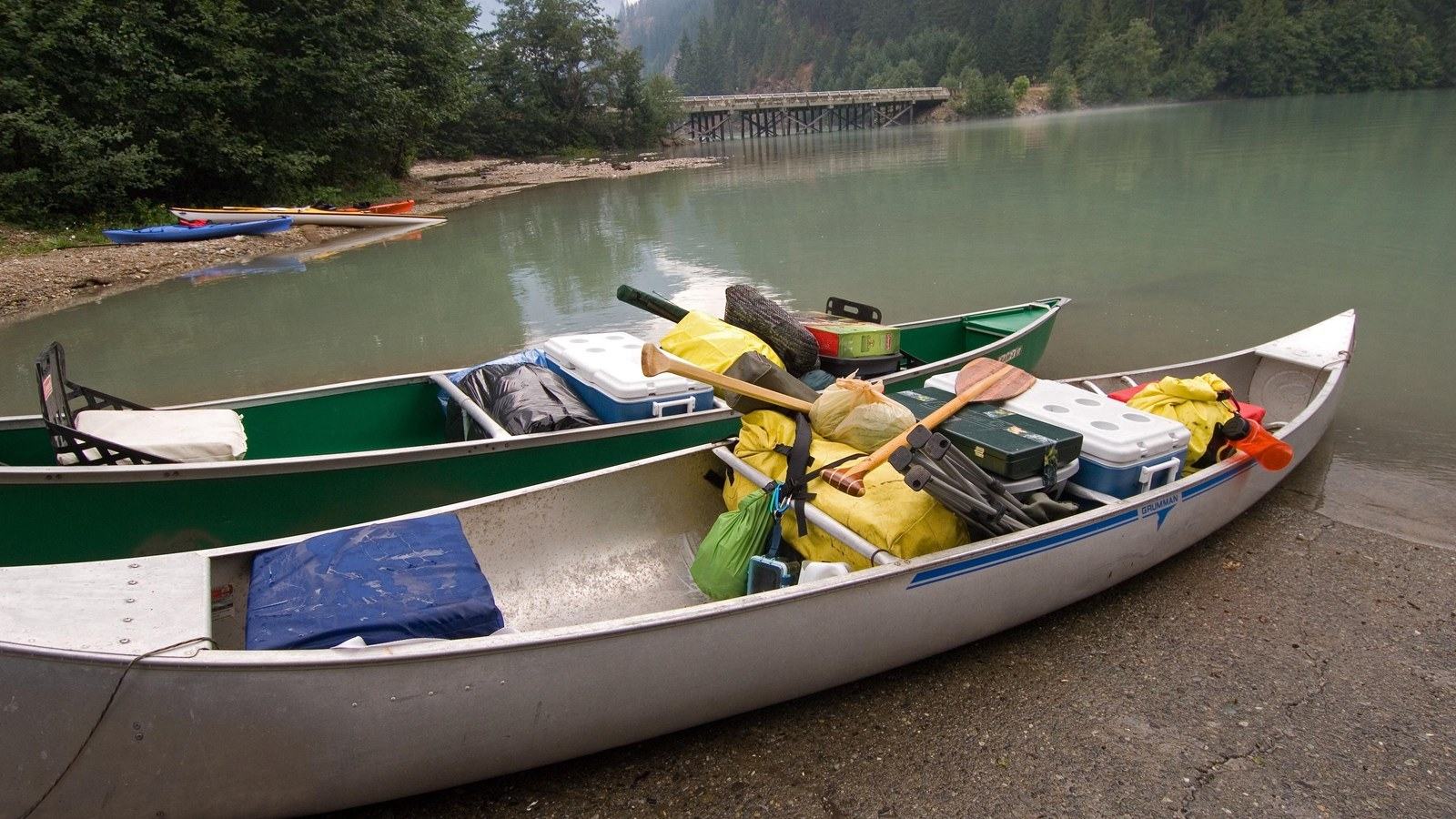
The accompanying image is an authentic National Park Service photograph of canoes with camping gear at Colonial Creek Campground, published on the park's official paddling guidance page. It illustrates actual small-craft recreation in the North Cascades rather than a fabricated wilderness scene or a guarantee of conditions on the reader's chosen date. The primary NPS source explains the separate lake launches, Ross Lake portage, rental limitations, boat-in camping permits and the serious cold-water risks. Readers should consult current access notices and approved operator information when arranging a real trip. The image and article together identify an opportunity while clearly distinguishing inspiration from live operational guidance.
An appealing adventure when the details fit
Canoeing in the North Cascades can be an extraordinary way to experience mountain water, especially for travellers prepared to move slowly and respect the limitations of a small craft. The attractive scenery is real, but so are the challenges posed by cold water, uncertain weather and complex access between lakes. A short day trip and an overnight boat-in camping expedition are both valid choices, provided they are properly planned. For Leisure Boat Guide readers, the region illustrates the enduring appeal of simple boats: the ability to enter a landscape without noise or hurry, carrying only what is needed and taking responsibility for the route. The strongest memories begin with the right preparation.
Sources and photograph attribution
Official destination and boating guidance: National Park Service — North Cascades National Park. Current access, rules, weather and reservations must be checked independently before travel.
Photo: National Park Service, canoes and camping gear at Colonial Creek Campground, North Cascades. Source: https://www.nps.gov/thingstodo/paddling-the-north-cascades.htm. Original rights remain with the credited creator or as specified by the source and licence.