
Explore Everglades National Park at water level on Noble Hammock’s narrow, two-mile mangrove canoe trail, with careful manoeuvring and seasonal planning.
Everglades National Park is often imagined as an enormous landscape best seen from an aircraft or an open-water boat, but one of its more intimate paddling experiences is contained within a two-mile loop. The Noble Hammock Canoe Trail winds through narrow mangrove-lined creeks and small ponds, taking visitors into a world where vegetation, water and the need for precise boat handling are closely connected. The National Park Service describes it as a route with sharp turns and restricted passages requiring good manoeuvring skills. Motors are prohibited. This is not a simple straight-line paddle across open water, and a visitor should not assume it is suitable for every recreational kayak or first-time paddler. For a capable crew in appropriate conditions, its appeal lies in experiencing the subtropical landscape at close range without the noise or speed of a powered craft.
Two miles that require attention
A two-mile trail can sound modest compared with an all-day river journey, yet distance alone is a poor measure of difficulty. The official NPS description emphasises the twists, turns and tight passages of Noble Hammock's mangrove creeks. A small canoe must be steered accurately, sometimes within a limited space where turning around may not be straightforward. A short loop may therefore demand more control than a longer paddle on a sheltered lake. Visitors should be comfortable manoeuvring their craft before beginning and should remain prepared to stop or return if conditions are not suitable. The trail's compact scale encourages deliberate travel, but it should never be described as effortless merely because the distance can be written in one number.
The mangrove habitat at water level
Mangroves create a distinctive environment where roots, trunks and branches shape the edges of the waterway. From a canoe, the tangle can look almost like a natural corridor, with the surface reflecting small openings in the canopy. These trees are part of an important coastal and wetland ecosystem, and their roots should not be used as convenient handholds for pulling a boat through a channel unless safety absolutely requires it. A paddler should aim to remain in navigable water without damaging vegetation. The best observations often come from slowing down and listening, allowing the subtle movements of water and wildlife to emerge. The experience is compelling precisely because the landscape feels so close to the boat.
Locating Noble Hammock
The official NPS listing places the Noble Hammock Canoe Trail within Everglades National Park, providing coordinates near 25.234799 north and 80.818283 west. The page identifies a canoe and small-boat launch, car parking and a scenic viewing opportunity. Those coordinates are useful for orientation but not sufficient as a complete navigation guide. Visitors should use the current park map, check approach roads and confirm the status of the launch before making the journey. Road access, water conditions and temporary closures may affect what is possible. A paddler should never substitute an approximate pin on a phone for the practical information needed to reach the authorised launch and navigate a trail safely.
No motors on the loop
One defining rule in the NPS description is that motors are prohibited. This protects the character of the narrow waterway and helps keep it suited to human-powered travel. A visitor with a small outboard tender should not assume the boat is permitted simply because the trail is described as a small-boat access location. The craft and equipment need to comply with the relevant restrictions. Even an electric motor should not be treated as automatically exempt from a general motor prohibition. Confirm current rules with the National Park Service before departure. The limitation is part of the route's identity: a setting where progress depends on paddle strokes and controlled steering rather than engine power.
Why the narrow turns matter
Tight bends and mangrove-lined passages demand the ability to turn a canoe or kayak without striking vegetation or becoming wedged. A double-bladed kayak paddle may be useful in open reaches but can be awkward where overhanging branches and narrow channels reduce the space for a full stroke. An experienced paddler may use short, controlled strokes and careful positioning to pass through. That does not mean a novice should attempt the loop as an informal training exercise without guidance. The park's emphasis on manoeuvring skills deserves to be taken seriously. A well-matched boat and crew can enjoy the challenge, while a poorly chosen craft may make the same route frustrating or unsafe.
Water levels change the experience
The National Park Service specifically advises paddlers to check for low water levels during the dry season. A narrow channel that is navigable in one period may become difficult or impassable when water is lower. Attempting to force a craft through mud or vegetation can damage both equipment and habitat. Conversely, higher water does not eliminate every challenge, because wind, storms and changing conditions may affect the trip in different ways. A visit should be planned around current park advice and local water information. The image of a clear paddling corridor on an official page does not establish that the entire loop can be completed on a future date without encountering a changed condition.
Wildlife watching in a close landscape
Everglades waterways support a rich range of animals, although sightings on a particular trip depend on time, season and conditions. A small craft can allow a visitor to notice details that are easily missed from a road, but that closeness creates responsibilities. Give wildlife space and never attempt to approach or feed an animal. If a passage appears occupied by wildlife, the best response may be to wait or change direction rather than force a route through. Keep hands and feet inside the craft where practical and avoid leaning toward animals or vegetation. The goal is to observe an ecosystem while leaving its normal behaviour as undisturbed as possible.
The value of travelling without an engine
A motor-free trail can offer a distinct soundscape. Paddle strokes, moving water and the noises of insects or birds become more noticeable without machinery. This is one reason paddling has a special place in protected landscapes. The lack of a motor does not make the trip impact-free, however. A canoe can still disturb nesting birds, damage roots or leave rubbish behind if handled carelessly. The quality of the experience depends on deliberate, responsible behaviour. Visitors should remain on the authorised route and avoid entering narrow side passages simply because they are curious. A quiet trip is most successful when the people aboard behave as temporary guests in an environment that is not theirs to alter.
Choosing the correct type of boat
A short, manoeuvrable canoe or kayak may be more suitable for tight waterways than a long touring craft designed primarily for open-water speed. But no single boat type can be recommended for all conditions or paddler abilities without further information. A canoe can provide space for a companion and equipment, while a kayak may appeal to someone comfortable with a lower seat and different paddle technique. Loading matters too: excess equipment can reduce control and create obstacles during turns. The NPS page confirms canoe and kayak access, but it does not publish a universal list of approved hull dimensions. The right choice involves current guidance, local experience and the ability of the particular crew.
Preparing before leaving the launch
A paddler should inspect the boat, paddle and personal flotation device, confirm current conditions and carry enough water for the outing. Sun, humidity and insects can make the Everglades demanding even on a short trail. Suitable clothing, sun protection and insect precautions may improve comfort. A protected communication device and a simple emergency plan are sensible, but mobile coverage should not be assumed throughout remote park areas. The group should know how to stay together and what to do if a boat becomes difficult to control or the route is blocked. A party that cannot comfortably manoeuvre its craft in confined water should seek instruction or choose a more suitable outing.
A two-mile loop as part of a wider visit
Noble Hammock can be included in a larger Everglades holiday without becoming the only reason to visit the park. A traveller might choose one morning for the canoe loop and another for walking, observing birds from an authorised viewpoint or learning about the wetlands through official interpretation. This flexibility is useful because paddling conditions may not suit the intended day. There is no need to force the outing simply to keep an itinerary on schedule. The short distance makes the trail appealing, but the unusual nature of the route gives it enough interest to occupy a thoughtful visit. It is a good example of how a small-boat experience can complement other forms of low-impact travel.
Photography among the roots
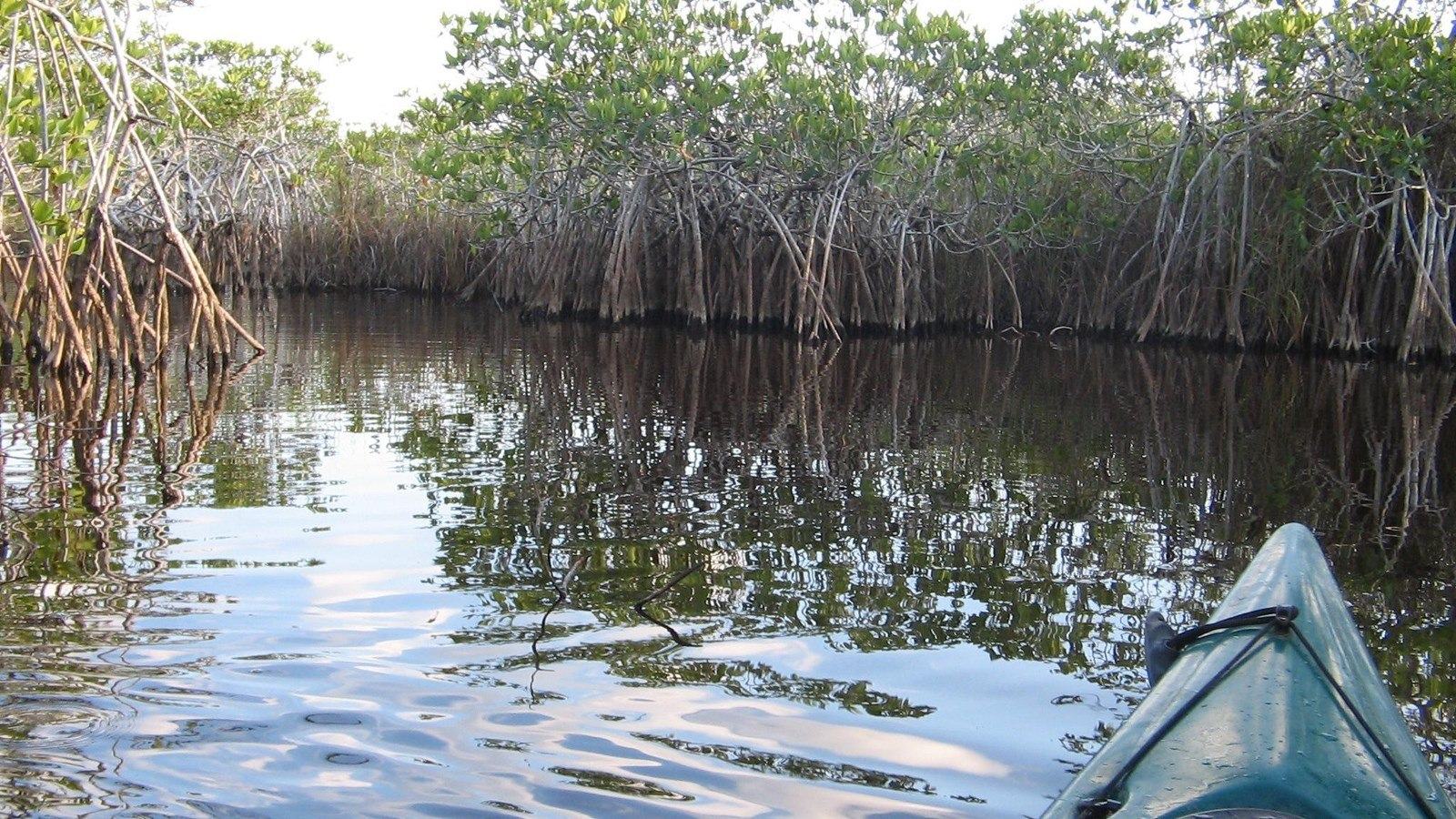
The official NPS photograph for this trail shows the view from the bow of a kayak toward red mangrove prop roots. It captures the sense of being enclosed within the ecosystem rather than looking at it from a distant observation platform. The best images may come from a stable position and careful attention to reflections, textures and changing light. Avoid shifting weight or reaching out with a camera where doing so may compromise the boat's balance or steering. Waterproof storage can help protect equipment, but no photograph is worth getting stranded or disturbing wildlife. Taking fewer, more considered pictures may leave more time to enjoy the quiet character of the waterway.
Avoiding the assumption that short means safe
Some of the most important risks on a short paddle arise from the environment rather than the distance. The trail has narrow passages, sharp bends and water levels that can affect access. Weather and personal competence also matter. An inexperienced paddler might be tempted to use Noble Hammock as a beginner's first outing because the route is only two miles long. The NPS warning about manoeuvring suggests caution instead. A guided experience or additional instruction elsewhere could be a better first step, depending on what services are available and the visitor's circumstances. The fact that the trail is publicly described does not mean the park guarantees a safe passage under all conditions.
Leaving the trail intact
Mangrove habitats can be damaged by repeated contact with boats and careless landings. Paddlers should avoid breaking branches, pulling out vegetation or digging a hull into shallow areas to maintain forward movement. Carry all rubbish away, clean equipment appropriately between waterways and follow current restrictions on access and wildlife disturbance. The National Park Service's rules exist to protect the habitat and the experience of future visitors. A person who finishes the loop without leaving a visible trace has achieved something important. Responsible recreation is not separate from the enjoyment of the trail; it is what allows people to continue entering such places while preserving their ecological value.
What the official source establishes
The Noble Hammock Canoe Trail page identifies a two-mile mangrove loop, a launch and parking area, sharp turns, narrow passages and a prohibition on motors. It also warns about low-water conditions in the dry season. Those facts provide a reliable basis for describing the outing, but not the live water depth, weather or opening status on the reader's planned date. A visitor should check the current park alerts and any further operational guidance before travelling. The lead image is a genuine National Park Service photograph taken from a kayak among the mangroves and supplied on the official place page. No generated picture or unrelated location photo is used.
Why Noble Hammock stays in the memory
The trail's attraction is not speed or distance. It is the unusual intimacy of paddling through an environment in which roots, narrow water and subtle wildlife activity surround the boat. A capable crew may complete the loop within a modest part of the day yet leave with a strong sense of having encountered the Everglades in a distinctive way. That experience comes with responsibilities: respect the motor prohibition, check water levels and choose a boat that can handle confined turns. For people prepared to travel thoughtfully, Noble Hammock shows how a short paddling route can offer a substantial adventure without a large vessel or a long passage.
Sources and photograph attribution
Official destination and boating guidance: National Park Service — Everglades National Park. Current access, rules, weather and reservations must be checked independently before travel.
Photo: National Park Service, documentary kayak-bow perspective in the Noble Hammock mangrove paddling trail. Source: https://www.nps.gov/places/noble-hammock-canoe-trail.htm. Original rights remain with the credited creator or as specified by the source and licence.