
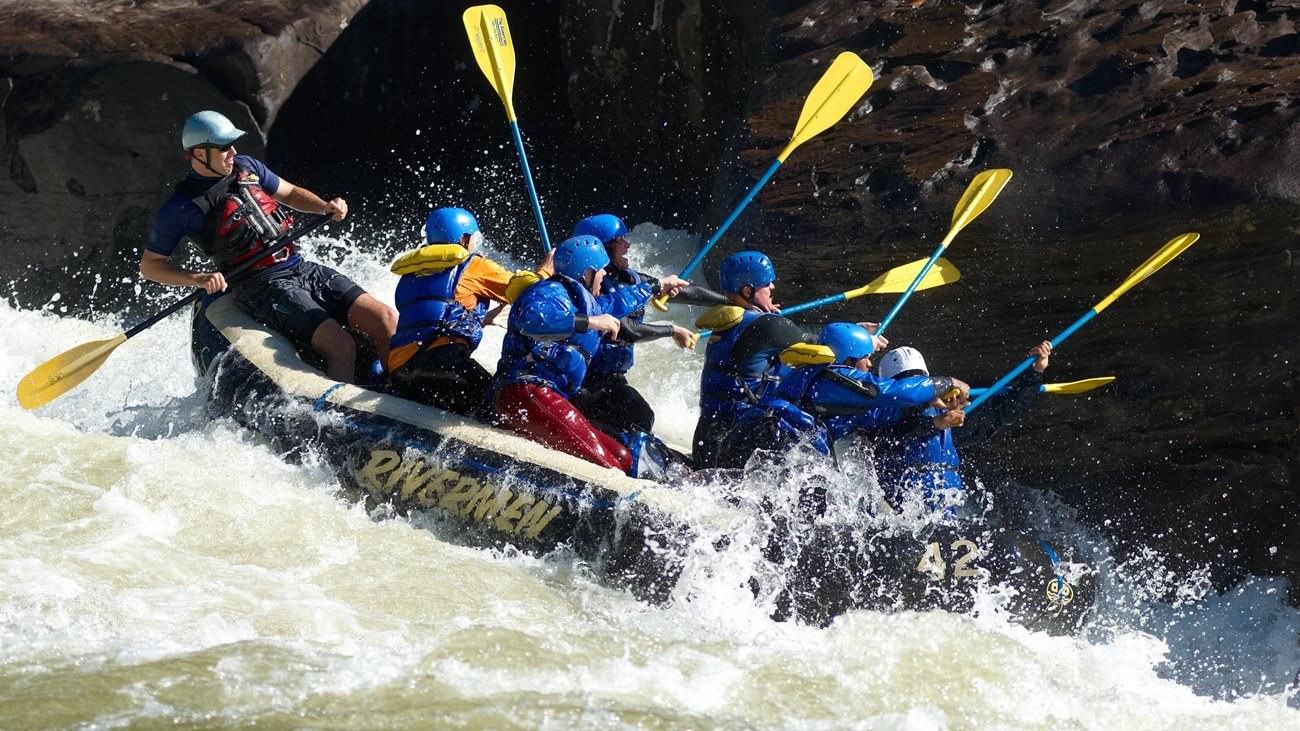
New River Gorge offers thrilling guided small-raft experiences through West Virginia's river landscape, where route choice and skilled supervision are essential.
A national park experienced from the river
New River Gorge National Park and Preserve in West Virginia offers an energetic contrast to the quieter lakes and sheltered bays associated with many paddling holidays. A guided inflatable raft can take visitors through a landscape of steep wooded slopes, rock formations and fast-flowing water, with the character of the journey determined by the chosen river section and current conditions. The National Park Service treats whitewater as a major recreational activity here, while emphasising that this is a sport requiring preparation and judgement.
The appeal comes from the combination of scenery, teamwork and the feeling of moving with a powerful natural system. Unlike a motorboat cruise, a rafting party may need to paddle together on the guide's instruction and remain alert as the channel changes. A good trip allows participants to enjoy that involvement without assuming that a dramatic rapid is necessarily the most suitable objective.
Understanding the different river sections
The New River contains stretches with different challenges, meaning that a trip marketed as rafting the gorge can vary substantially in intensity. Some commercial routes are intended for newcomers in appropriate conditions, while more demanding sections feature rapids that require experienced handling and suitable passenger ability. Travellers should ask an authorised operator which section is planned and why it fits the group.
A family with younger participants or people who have never rafted should not simply book the most challenging trip advertised. Age and physical requirements differ among commercial operators and routes, and those restrictions may change with water levels. A clear discussion before paying helps align the outing with realistic expectations rather than forcing a group to decide at the launch.
Water flow changes the entire experience
Whitewater difficulty is not fixed across the year. River levels influence current speed, the size and character of rapids, available landing places and the consequences of a mistake. A route that is manageable during one flow period may become more demanding following rain or a different seasonal pattern. Professional guides therefore assess the day's actual water conditions and may modify or cancel an outing.
Visitors should understand that cancelling for safety is part of competent rafting operations, not evidence that an operator is unreliable. A flexible itinerary makes room for a scenic hike or another activity if the river is unsuitable. West Virginia offers plenty of landscapes to enjoy without requiring an unwise commitment to a particular rapid.
A raft depends on crew coordination
Guided inflatable rafts carry several passengers, with the guide providing instructions about paddling, weight distribution and how to respond to obstacles. The small craft's shape and buoyancy help it handle turbulent water, but they do not remove the risk of capsize or a person falling overboard. Participants must listen carefully and be willing to follow instructions promptly.
A short safety demonstration before departure should explain how to hold a paddle, where to sit and what to do if separated from the raft. Guests need to know when to keep feet up and how to respond when the guide calls for a manoeuvre. These skills are important even when the first stretch of the river appears calm.
Protective equipment is not optional
A rafting operator should provide suitable personal flotation equipment and other protective items required for the specific section and conditions, commonly including a helmet for appropriate whitewater activities. Each item must be correctly fitted and worn as directed. A life jacket is not a substitute for sound judgement, but it plays a central role if a participant enters moving water unexpectedly.
Cold water and exposure also influence clothing choices. Depending on season and conditions, suitable thermal or protective layers may be recommended. Passengers should follow the operator's advice rather than bring footwear or loose accessories that can snag or be lost. Cameras should be secured only in ways that are permitted and safe for the chosen route.
Selecting an experienced local operator
Professional outfitters offer an easier starting point than trying to navigate whitewater in privately owned equipment without substantial training. A reputable provider should explain its guide qualifications, route selection, safety briefing, insurance arrangements and policies for changing weather. Travellers should also check what transport is included between the put-in and take-out points.
An organised rafting holiday can be combined with accommodation and other activities around the national park. That makes the trip especially suitable for groups who want a memorable day on the river but do not own technical rafting equipment. The quality of the experience often depends as much on the briefing and organisation as on the rapids themselves.
The wider landscape rewards another day
The New River Gorge is more than a whitewater corridor. Forested slopes, historic transport routes and scenic viewpoints offer opportunities to understand why the river has shaped the surrounding region. Visitors who allow a second day for a hike or a slower exploration may appreciate the geology and history more deeply than those who arrive only for a rapid and leave immediately afterward.
A good rafting guide often adds to this understanding by explaining features visible from the water. An observer on a raft encounters the gorge from below, where the cliffs and vegetation appear different from a roadside lookout. That perspective is part of the value of using a small craft rather than seeing the park only from land.
A dramatic day that should remain a controlled one
The official National Park Service photograph shows rafters paddling through real whitewater at New River Gorge, matching the experience described rather than using a generated rendering. The scene captures the excitement of shared paddling, but a still image cannot communicate the technical assessment needed to move through the rapid safely. Travellers should never assume they can reproduce a photographed route on their own.
For anyone planning a visit, the park's current whitewater guidance and an experienced operator are the appropriate starting points. The most satisfying journey is not necessarily the most difficult but the one in which everyone participates, enjoys the scenery and returns safely. Whitewater rafting can be a memorable small-boat holiday when the river, the crew and the chosen trip genuinely suit one another.