
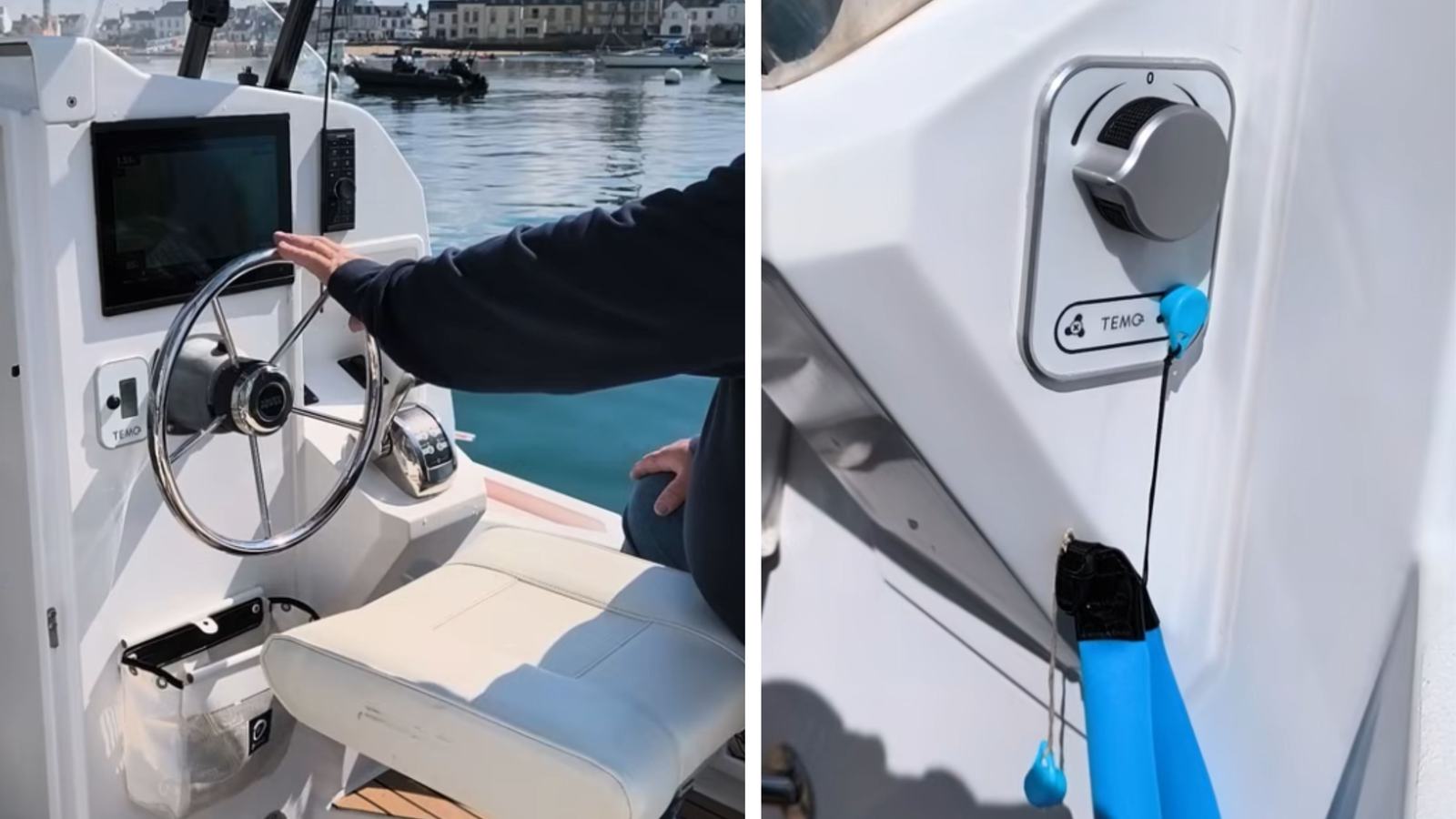
A French Loxo 32 owner added a stowable electric auxiliary propulsion system. The installation highlights the possibilities and limitations of compact emergency power for leisure boaters.
A backup drive is a different boating problem
A reliable main engine is the centre of a motorboat's cruising plan, yet owners also need to think through what they would do if propulsion stopped unexpectedly. A practical example has emerged from France, where a Loxo 32 owner fitted a compact electric auxiliary motor that stays stored until it is needed. Rather than treating the installation as a way to make an ordinary cruising trip under electric power, the owner asked for something that might help retain some manoeuvrability and reduce drift after a breakdown.
The boat is a Loxo 32 by Pogo Structures, about 32 feet long and described by the equipment supplier as displacing approximately 1.8 tonnes in light condition. That makes it an interesting test case because a small electric motor is a very modest source of thrust relative to the hull. The project, carried out by CN Diffusion in Loctudy with TEMO, illustrates the trade-off between a permanently mounted auxiliary engine and a compact system that is kept out of the way for nearly every passage.
An auxiliary motor should never be sold to an owner as a guarantee of safety in offshore weather. Its usefulness will depend on the weather, current, hull, loading, available electrical energy and whether it can be deployed safely from aboard. Even a successful bespoke installation does not remove the need for sound maintenance, a passage plan, communications equipment and a clear procedure for asking for assistance when propulsion is lost.
How the Loxo 32 installation works
TEMO identifies the auxiliary unit as an OUTPOD 1000 in its October 2026 account of the project. Although the product name contains 1000, the particular installation is specified with 1,300 watts of motor output, a nominal 48-volt electrical system and one 2.3-kilowatt-hour battery. Those are useful details because the actual installed configuration matters more than a model name when estimating likely electrical demands or deciding whether a concept can be adapted to another boat.
The system is arranged so the battery and rack remain fixed inside the boat while the motor is stored separately. Wiring is already fitted, and a sliding mounting arrangement lets the crew retrieve the unit, place it on its dedicated support and connect it when required. This separation preserves stern space in everyday use and avoids leaving a small auxiliary permanently hanging in the water, but it also means the crew must be able to reach and handle the unit safely in less-than-perfect conditions.
CN Diffusion was responsible for integrating the equipment, with TEMO providing technical input. The supplier describes a plug-and-play installation and says the boat did not need major alterations, but that is a report about this specific hull and its custom fittings, not a promise that any owner can add the same system with a few simple tools. The strength of the mount, cable protection, electrical isolation and safe access deserve professional assessment on every different boat.
What low-power emergency thrust can and cannot do
TEMO explicitly says the system is intended to help a disabled Loxo 32 keep some control, limit drift and move at low speed. It was not designed to replicate the normal propulsion system or to deliver the boat's customary cruising performance. That distinction is vital when thinking about whether a small auxiliary will help in flat harbour water, in a strong tidal stream or in a rising wind offshore.
Power and usable thrust are not interchangeable with the ability to make progress over the ground. A vessel can be moving through still water while being carried backwards relative to land by a current stronger than its own speed. Owners therefore need to judge whether a planned backup installation is merely helpful for position control or strong enough to reach a chosen refuge under credible local conditions, ideally on the basis of supervised trials rather than assumptions.
The 2.3-kilowatt-hour battery figure also needs careful interpretation. Dividing storage capacity by a nominal motor figure is not a reliable promise of duration because electrical losses, accessory loads, battery management and the operator's throttle setting affect the result. A prudent owner will have an agreed reserve threshold, know the charge state before departure and understand the remaining options if an auxiliary system's battery or connectors also fail.
Stowage, electrical integration and preparation
The project has a practical virtue that deserves attention: the motor is not permanently fitted at the transom. On many compact motorboats, stern space is used for boarding, swimming, tenders or servicing the main propulsion, so a continuously mounted secondary engine can obstruct the normal layout. A securely stowed auxiliary arrangement avoids much of that inconvenience, provided it does not create a new heavy object that can move dangerously in rough weather.
Preparation determines whether a system kept in storage is genuinely useful in a failure. The correct fixings, connectors, lifting method and deployment sequence must be familiar before an emergency; a crew should not have to discover how a bracket fits while the boat is drifting toward danger. Periodic inspection of exposed fittings, a dry rehearsal alongside and a controlled on-water test are sensible practical measures, with the final frequency guided by the installer and manufacturer.
Battery installation is equally important. The Loxo arrangement includes TEMO's AutoConnect rack, an 8-amp domestic charger and an onboard charger rated at 7.5 amps and 350 watts in the manufacturer's case study. These are specifications of the documented installation, not a universal package, and any retrofit should be assessed for suitable protection, ventilation, routing, corrosion resistance and the safety rules applying to its electrical system.
A sensible hierarchy when propulsion is lost
The existence of a backup motor should not delay action when the boat is in immediate danger. A crew should first stabilise the situation, keep people in safe positions, establish the vessel's location and communicate promptly with the appropriate coastguard or rescue service. Depending on conditions, safe anchoring, a tow or other assistance may be preferable to attempting to make headway with a small electric drive, especially near rocks, traffic or strong currents.
An owner can build a simple breakdown exercise around the exact Loxo idea without pretending every boat needs the same hardware. During a calm-weather trial, check where the unit is stowed, who retrieves it, how power is isolated during fitting, how long deployment actually takes and whether steering is effective at the lowest usable power. Confirm that the system can be stopped rapidly and that the main engine, if faulty, does not create an unexpected obstruction or handling complication.
Even with an auxiliary, fundamental safety preparations still matter. Fuel or energy reserves, properly maintained navigation lights, working distress communications, flotation equipment and knowledge of local waters provide layers of protection that a single device cannot replace. The value of the extra motor is its potential to offer one more controlled option, not a reason to extend passage limits or postpone requesting help.
What other owners can learn from the installation
The Loxo 32 case is valuable because it focuses on a defined need instead of a broad claim about electrification. A buyer considering a similar solution can begin with a clear question: what exactly should the auxiliary achieve, for how long and in which waters? Only then is it sensible to discuss available mounting space, motor size, installed battery capacity, safe cable runs and the ability of all regular crew members to deploy the equipment.
The motor's manageable stowed footprint, the existing battery rack and the collaborative installation appear well aligned with the owner's wish to preserve normal use of the boat. But a different motorboat with greater windage, deeper draft or heavier displacement may not respond in the same way to roughly one kilowatt of auxiliary electrical power. A professional propulsion assessment and real-world verification remain more important than copying a photograph or product list.
The broader lesson for leisure boaters is that electric propulsion has worthwhile applications beyond replacing a main diesel or petrol engine. It can potentially serve as a limited-use contingency system where compactness and readiness matter more than speed. The French installation demonstrates one credible approach; whether it is a good fit for another boat depends on engineering, operating conditions and a crew that understands both its benefits and its very real limits.