
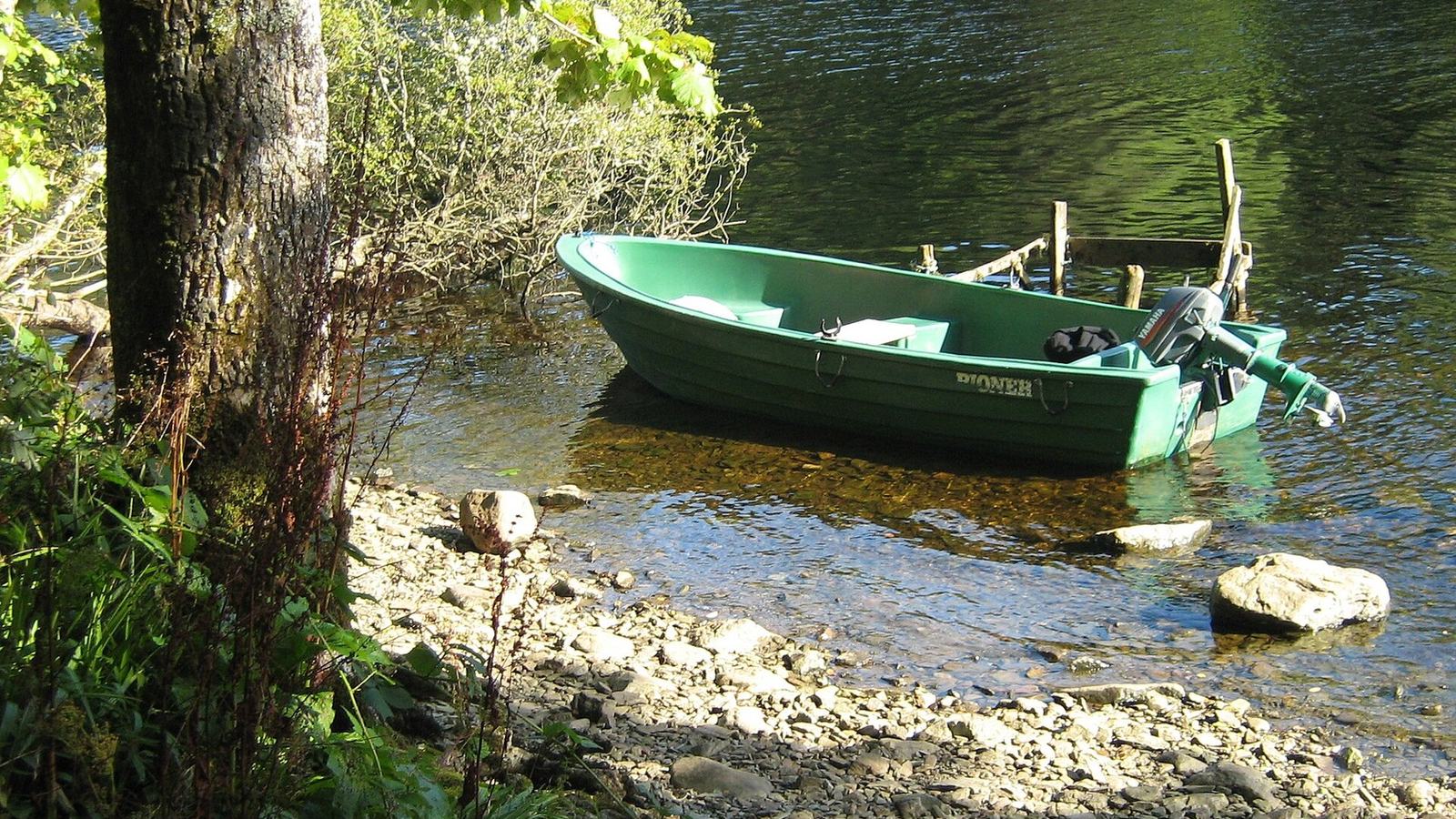
A small-boat holiday guide to Loch Awe in Argyll, covering hire boats, island heritage, crannogs, ruined castles, wildlife and safe navigation.
Loch Awe in Argyll offers a distinctive Scottish small-boat holiday, combining wooded shores, islands, historic ruins and mountain scenery under broad skies. The area's visitor organisation promotes hiring rowing boats, motorboats, cabin boats, kayaks and canoes, with the possibility of exploring a shoreline that is especially rewarding when approached slowly. Yet the loch's length and exposed sections mean that a leisurely photograph should never be mistaken for proof of easy conditions. Visitors need to choose a route suited to their vessel, check current launch and hire arrangements and consider where landing is actually permitted. A short outing near a recognised base can reveal more of Argyll's character than an ambitious passage planned without local knowledge.
A long loch in a Highland landscape
Loch Awe stretches through a landscape of low hills, woodland and mountain views, with water that can appear almost mirror-like in settled weather. Its changing shoreline makes the loch appealing for kayaking and rowing because small details become visible from water level: an old wall, a small island, a stand of trees or the reflection of a distant ridge. It is also substantial enough for wind to build uncomfortable waves when conditions change. A route that looks sheltered in a village bay may be very different in a more exposed reach. The safest plan is to select a modest destination and allow the scenery, rather than distance, to be the purpose of the trip.
Hiring locally rather than bringing a boat
Visit Lochawe's outdoor-adventure guide recommends hired rowboats, motorboats, cabin boats, kayaks and canoes as ways to enjoy the loch. Choosing a local provider can be especially useful to a visitor who does not know the access points or current conditions. Ask exactly which vessel is being offered, whether a licence or previous experience is required, and what safety equipment is supplied. A short motorboat rental and a cabin boat holiday involve very different expectations for fuel, mooring, weather and onboard facilities. Beginners may prefer a guided outing or a small rowing boat close to the base rather than taking responsibility for a much longer expedition.
Lochawe village as a practical base
The visitor organisation highlights Lochawe village as a point from which travellers can arrange activities, meals and accommodation. Its advice suggests beginning a boating day from the village end, where there can be attractive views and opportunities for calmer early conditions. The word 'can' matters: an early departure is not a guarantee that the loch will be safe. The launch location and use of the jetty must be confirmed through the responsible operator. A public-looking pier is not necessarily open for any privately owned craft. Visitors should plan where to park, how to move the boat and how to recover it before taking to the water.
Kilchurn Castle and the landscape
Kilchurn Castle is among the best-known historic landmarks of Loch Awe, with a dramatic position near the water. Its ruined stonework creates memorable views from the surrounding landscape, and the changing light can make it an appealing photographic subject. Viewing from the water may help place the castle in the context of the loch, but access to its grounds and landing areas should never be assumed. Visitors who want to explore the castle should check its current visitor arrangements and approach by an authorised route. A kayak is not a shortcut to any picturesque bank. Heritage conservation and safe boat handling are part of respecting the site.
Islands, crannogs and the past
The loch is also associated with islands and crannogs, the artificial or modified island sites connected with long periods of Scottish settlement. Visit Lochawe specifically draws attention to crannogs and ruins as part of the waterside experience. Such places can be fascinating to observe, but they may be archaeologically sensitive or have restricted access. A shallow-draft canoe should not be used to land on an island merely because the water is navigable around it. The best approach is to research the history beforehand, observe from an appropriate distance and avoid disturbing masonry or vegetation. The interest lies in understanding the landscape, not collecting a physical souvenir.
Choosing a compact motorboat
A small motorboat can make it easier to see several sections of the loch during a limited visit, but the responsibility for navigation remains with the operator. The hire provider should explain the engine, fuel reserve, steering, emergency stopping and the boundaries of the permitted cruising area. A compact open craft can be uncomfortable in rough water, and passenger loading affects its handling. A family should choose a boat with enough space for everyone to remain safely seated and secured. The ability to travel quickly is not a reason to make a distant destination compulsory. Returning early when wind begins to strengthen is good seamanship, not a failed outing.
Canoeing and kayaking at a quiet pace
A canoe or kayak offers closer contact with the water and the possibility of observing the shoreline without engine noise. For experienced paddlers, a sheltered short route may be especially satisfying near woodland or islands. Yet a small kayak can be hard to see from a passing motorboat, and the crew must remain aware of other traffic. Bright clothing, properly fitted buoyancy aids and suitable communication equipment are practical precautions. The route should be chosen for the actual wind, available landing options and paddlers' ability to recover if something goes wrong. A novice should consider a guide rather than entering an unfamiliar Scottish loch independently.
Wind can change the return journey
Loch Awe's elongated shape means that wind direction can matter as much as a forecast's headline strength. A following breeze can make the outward trip seem effortless, then become a headwind that exhausts a canoe crew on the return. A motorboat may be better able to make progress but could encounter uncomfortable waves or reduced visibility. Assess conditions before launching and set a conservative turnaround time. If storms or stronger wind threaten, return to the correct base rather than hoping to reach a more distant sheltered cove. A beautiful view should never become a reason to continue beyond what the crew or craft can manage safely.
Cold freshwater requires respect
Scottish lochs can be very cold, including during otherwise pleasant spring or summer weather. An unexpected fall into the water can affect breathing and physical control, making a suitable lifejacket or buoyancy aid vital. Paddlers should dress for immersion as well as for the air temperature, and a small motorboat crew should know how to help someone back aboard without capsizing the vessel. Keep a communication device protected from water and tell a reliable person ashore about the planned route and return time. No amount of equipment eliminates risk, but sensible preparation creates more options if the day changes unexpectedly.
Wildlife along the shore
Visit Lochawe highlights opportunities to see ospreys, deer, otters and eagles around the wider area. A quiet kayak may provide an appealing platform for observing the shoreline, but it must not be used to pursue an animal or move deliberately close to a nest. Binoculars are often more useful than trying to approach with a camera. If a bird repeatedly moves away or shows signs of alarm, the boat should maintain greater separation. Wildlife encounters are never guaranteed, and the beauty of an outing does not depend on a close sighting. A respectful visitor values the chance to observe animals behaving naturally in their habitat.
Fishing from an appropriate craft
The loch attracts anglers, and a small motorboat or rowing boat can provide an enjoyable fishing platform where the regulations and access arrangements permit. An angler should verify the appropriate local permissions and any restrictions on the species, season and tackle before setting out. Fishing gear needs to be secured so that loose hooks and rods do not obstruct the operator or endanger other passengers. Anchoring must be done with regard to depth, wind and other boats. The fact that another boat is fishing near an island does not mean the location is safe for every hull or authorised for all activities. Local advice remains valuable.
Choosing a place to stop ashore
The shoreline includes villages, private land, natural vegetation and areas associated with heritage sites. A group planning a picnic should establish where it may land rather than assume that any quiet bank is available. Boat rental agreements may define approved stopping places and forbid leaving the vessel unattended. A canoeist who drags the hull through sensitive vegetation can cause damage even without intending to. Take all rubbish away, avoid lighting fires without permission and treat archaeological features with care. The best stop is one where the entire crew can rest without creating problems for residents, wildlife or the next visitor.
Photography without compromising safety
The combination of ruined castles, islands and mountain reflections makes Loch Awe especially photogenic. From a small boat, a wide view may capture the relationship between a landmark and its surroundings in a way that a photograph taken from the road cannot. Yet the person steering should not also be trying to compose a shot while the craft drifts. A passenger may take photographs from a safe position, with cameras secured against water damage. Keep clear of other vessels and avoid moving close to a castle shore merely for a more dramatic angle. The experience is often better when the crew pauses to look around instead of concentrating on a screen.
Time ashore in Argyll
A day at Loch Awe can include more than a boat trip. The wider area offers walks, historic places and hospitality, making it suitable for a holiday with family members who have different interests. Someone may choose a short morning paddle while other members of the group visit a local attraction, with everyone meeting again for lunch. A flexible schedule is especially useful when weather changes the boating plan. Check current access to historic sites rather than rely on a promotional photograph taken when a path or building was open. Enjoying the place on foot does not make a day less successful than a longer voyage.
Seasonal hire and practical arrangements
A listing on a visitor website does not guarantee a particular boat is available every day of the year. Operators may reduce hours in the cooler months or cancel outings when conditions are unsafe. This article is being published in November, when daylight and weather can make small-boat travel especially demanding. Visitors should confirm booking dates, equipment, insurance terms, local launching access and what happens in the event of cancellation. Owners bringing their own craft should check whether the intended ramp can be used and where vehicle and trailer parking is permitted. Simple questions answered before departure prevent the most avoidable problems on arrival.
A loch best enjoyed slowly
Loch Awe rewards a patient approach. Its islands, crannogs, wooded banks and historic ruins offer plenty of interest without requiring a long passage or a high-powered vessel. A local hire company or experienced guide can help select a comfortable route, while the skipper must still respect the weather, cold water and other users. The most meaningful trip may be a short paddle from a recognised access point, with time to see a castle in the distance and enjoy a meal ashore afterward. For small-boat travellers, the pleasure lies in the relationship between the water and Argyll's landscape, preserved through careful and considerate exploration.
Sources and photograph attribution
Official destination and boating guidance: Visit Lochawe — Official Outdoor Adventures Guide. Current access, rules, weather and reservations must be checked independently before travel.
Photograph: JK Gillon — “Boat beside small island in Loch Awe, Argyll - geograph.org.uk - 1963012.jpg” (CC BY-SA 2.0), via Wikimedia Commons. Resized and converted to JPEG for editorial display. Source: https://commons.wikimedia.org/wiki/File:Boat_beside_small_island_in_Loch_Awe,_Argyll_-_geograph.org.uk_-_1963012.jpg. Licence: https://creativecommons.org/licenses/by-sa/2.0. Original rights remain with the credited creator or as specified by the source and licence.
