
Take a considered canoe trip on North Wales’s Llangollen Canal, with Welsh scenery, heritage, aqueduct safety rules and a choice of suitable routes.
North Wales offers a canal experience in which the pleasure of being afloat comes from the landscape, historic engineering and the manageable pace of a small craft rather than the number of miles travelled. The Llangollen Canal passes through the Dee Valley, links traditional waterside communities and forms part of a UNESCO World Heritage Site associated with the Pontcysyllte Aqueduct. The Canal & River Trust identifies it as a promising location for people beginning to explore canoeing, with published guides explaining how to use the canal responsibly. That description should not be mistaken for blanket permission to paddle through every tunnel or across a high aqueduct without preparation. Certain features demand particular care, and the Trust has specific restrictions affecting stand-up paddleboards. Planned well, a canoe trip here combines gentle rural travel with an extraordinary piece of British waterway heritage.
A canal holiday on a small scale
A canal invites a different style of travel from a river with a noticeable current. On a suitable stretch, paddlers can make progress at a conversational pace, observing stone bridges, fields, narrowboats and trees beside the towpath. The relative shelter can appeal to beginners who have already received basic instruction, but narrow waterways introduce their own hazards. A bend may conceal another vessel; a bridgehole can reduce the space available; and towpath users may be close to the water's edge. The Llangollen Canal is popular for more than one form of boating, so choosing a comfortable, less congested stretch can be more rewarding than chasing famous landmarks. A shorter out-and-back trip may be a useful first introduction, while longer journeys should be planned around known access points and the conditions expected.
Why Pontcysyllte is such a draw
The Pontcysyllte Aqueduct carries the Llangollen Canal high over the River Dee valley. The Canal & River Trust describes the structure as approximately 1,007 feet long and 127 feet high, making it the country's longest and highest navigable aqueduct. Its engineering and the surrounding eleven-mile World Heritage landscape have made the canal internationally recognisable. For someone in a canoe, the site can be both inspiring and intimidating. The drop beside an exposed water trough is not comparable to paddling across a small pond. Travellers should not decide to cross solely because they have seen striking photographs. The Trust's current paddling guidance and the requirements of any authorised operator should determine what is appropriate for the craft and experience involved.
A rule that matters to paddleboarders
The canal's appeal to several kinds of small craft does not mean their permissions are identical. Canal & River Trust safety guidance says stand-up paddleboards are not permitted on aqueducts that lack a protective railing at the side, giving Pontcysyllte as an example. Anyone planning a mixed group of canoeists, kayakers and paddleboarders needs to account for that distinction before arrival. It would be misleading to describe a high-aqueduct SUP crossing as an ordinary holiday activity. For a visitor who wants to experience the aqueduct without undertaking a paddle crossing, walking along permitted public routes or arranging an authorised guided experience may be a better choice. Restrictions should be checked again immediately before travel because access arrangements can change.
Beginning around Llangollen and Llantysilio
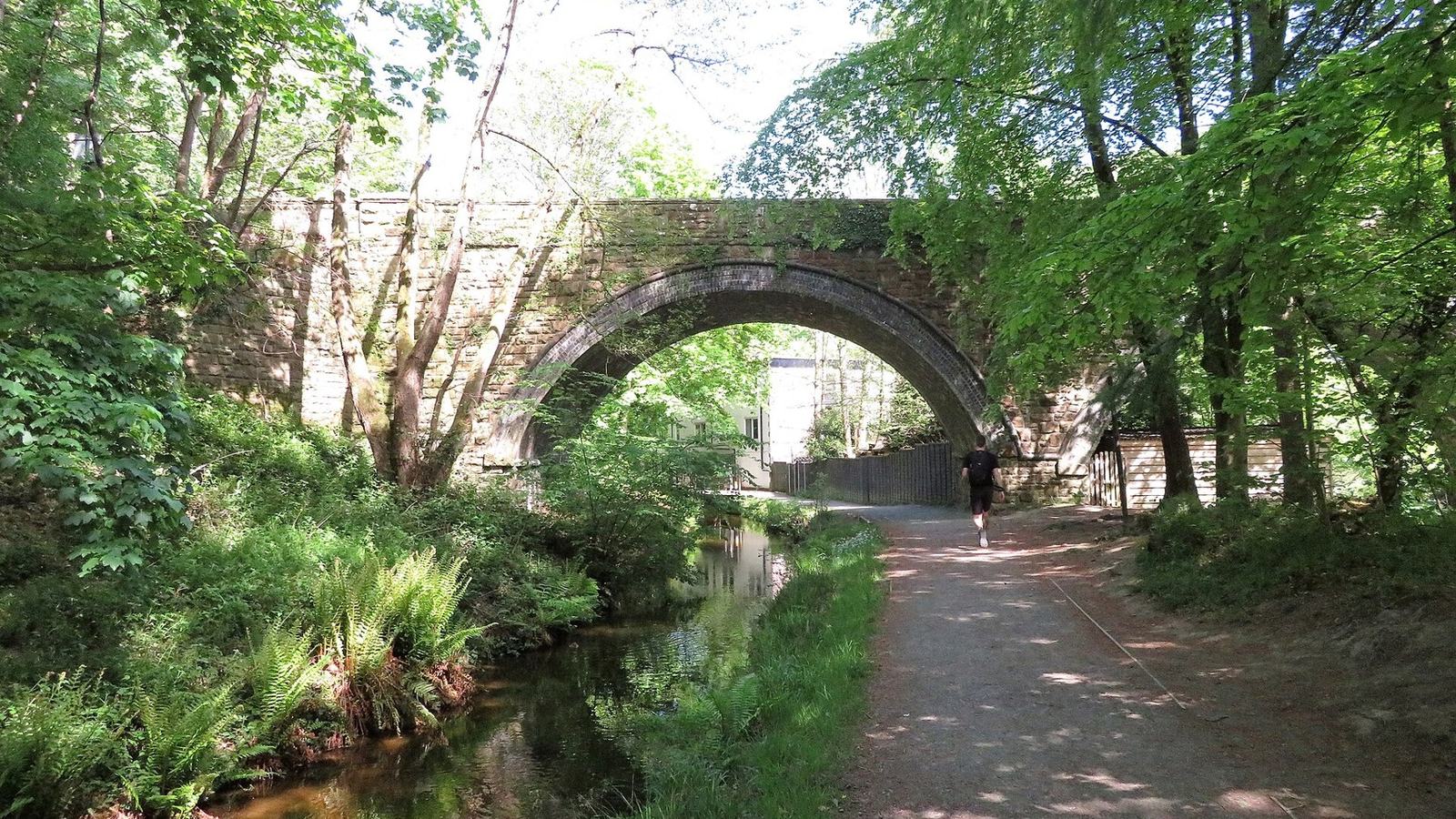
The upper sections of the canal near Llangollen and the Horseshoe Falls offer an opportunity to understand how the waterway relates to the River Dee. The photograph accompanying this feature depicts the canal near its source in this area rather than the aqueduct itself. That distinction is useful: the canal is not just one famous crossing. It comprises quieter stretches, carefully engineered channels and access points that call for separate planning. Some areas may be narrow or subject to local restrictions, so a visitor should use the official route guidance rather than assume that every place visible from a path is suitable for launching. A successful outing begins at a permitted, practical entry point with a confirmed place to finish.
Boats and towpaths share the space
Narrowboats and other powered craft use the canal as a navigation, not as an obstacle course. The Canal & River Trust advises paddlers to keep right where possible, allow powered boats room and take care around bridges and blind bends. A canoe sits low in the water and may be difficult to spot from a larger boat's steering position. The right approach is to remain alert, avoid hovering at bridgeholes and move into a safe position when another vessel needs more space. Courtesy also extends to the towpath: do not obstruct walkers or cyclists with a boat left across the path, and use authorised launching areas without damaging the bank. A shared waterway can remain pleasant only when visitors recognise that they are not its sole users.
Tunnels change the safety requirements
The Llangollen route includes historic tunnels, and the Trust's published guidance treats tunnel paddling as a separate safety question rather than an ordinary continuation of open canal. Passage may be restricted according to the particular tunnel. Visitors should follow current rules and not enter simply because the water appears open. Appropriate buoyancy equipment, lighting and an alternative way of attracting attention may be required where paddling through a tunnel is permitted. The limited visibility and narrow space can make it difficult to deal with another vessel approaching. A group should know the rules and local arrangements before setting off, and beginners may be better served by a stretch that avoids tunnels entirely. A scenic holiday is not improved by unnecessary uncertainty in confined waterways.
The licence question
Using a canoe or kayak on a managed canal may require an appropriate waterways licence or other permission. Paddle UK offers options that cover many Canal & River Trust navigations, while the Trust also provides guidance for people using small unpowered craft. A visitor hiring a kayak should ask whether the operator's arrangements include the necessary permission; an owner bringing a boat should verify their own status. The general principle is not to treat a public towpath as proof that the adjoining water is open for unrestricted use. Fees and membership arrangements can change, so current official information should take precedence over a figure remembered from an older guide. Getting the paperwork right is a straightforward part of planning.
Choosing a suitable stretch for a first trip
Although the Trust characterises Llangollen as beginner-friendly, a sensible route still depends on the individual paddler. A short section with straightforward launching, predictable navigation and no need to cross an exposed aqueduct may provide a calmer introduction. An experienced visitor may choose a more ambitious journey, but should identify any tunnels, locks or other structures before departure. Allow time to turn around and return without pressure. Canoes can be affected by wind and passing-boat wash even on canal water, and someone who has never used a paddle should receive instruction first. A positive initial outing is more likely to encourage another boating day than an exhausting trip selected because its photographs looked dramatic.
Waterway heritage beyond the aqueduct
The canal was constructed through an era when inland navigation transformed the movement of goods and people. Today its bridges, embankments and water-control arrangements help visitors understand a history that remains visible in the landscape. The Pontcysyllte section is recognised for its engineering significance, but smaller structures along the waterway contribute to the story too. Paddling can be an unusually effective way to see how those features fit together. The pace is slow enough to notice masonry, curves in the banks and the relationship between canal and valley. Respect for the heritage includes staying clear of structures where access is prohibited and avoiding damage to banks, walls or fixtures when launching or landing.
The appeal of a guided canoe outing
Guided experiences can be useful around a demanding landmark such as Pontcysyllte because the operator may provide route knowledge, equipment and local safety procedures. The Trust's visitor information refers to canoe tours in the aqueduct area, but the existence of a listing is not proof that a particular tour will be operating on the reader's chosen date. Book through a legitimate provider, confirm the age and experience requirements and ask exactly where the trip begins and ends. The relevant permission and equipment arrangements should be clear before payment. A guided trip should never be represented as removing all risk; its value lies in appropriate planning, a structured experience and advice specific to the conditions and route.
Bringing children or new paddlers
A family canoe day can be a rewarding way to introduce younger people to boating, but it requires well-fitted buoyancy aids, suitable supervision and a route within the group's capabilities. Allow time for breaks and avoid making the entire experience depend on reaching a distant landmark. The novelty of controlling a boat, seeing ducks from water level or passing under a low bridge can be enough to keep a young visitor engaged. Adults should also understand how to return safely if the weather changes or someone becomes tired. A trip that remains cheerful and comfortable can support a lasting interest in small craft. The objective is enjoyment and confidence, not proving that every member can handle the most exposed section of the canal.
Planning for the changing seasons
A canal can look inviting throughout the year, yet temperature, wind and daylight influence the best time to paddle. Cold water is a concern even when the air feels pleasant. Clothing should be selected with the possibility of immersion in mind, and a dry change of clothes can make returning ashore more comfortable. Busy holiday periods may bring heavier narrowboat traffic, while some services or towpath sections may be affected by maintenance. Check current Trust notices and local forecasts before travelling. If a route contains a tunnel or demanding aqueduct passage, the day's conditions and the participants' ability should be assessed conservatively. The option to walk beside the canal instead of paddling is a useful part of a flexible holiday.
Photography without losing control
The Llangollen landscape lends itself to photographs of reflections, wooded banks and historic structures. The camera should not interfere with steering or lookout, especially near other craft. Keep equipment secured and take pictures when the boat is in a safe position. The lead image is an authentic photograph of the Llangollen Canal near Horseshoe Falls by Llywelyn2000, shared through Wikimedia Commons under a Creative Commons Attribution-ShareAlike 4.0 licence. It documents the canal landscape, not an organised canoe tour or a current permission to navigate a particular structure. The image has been resized for the article, with the creator and licensing information retained.
The official basis for a memorable visit
The Canal & River Trust's official Llangollen canoeing page and its specific aqueduct and tunnel safety guidance provide the factual foundation for this feature. They establish the canal as a paddling destination while making clear that route choices and certain craft restrictions matter. The best day afloat combines that knowledge with an appropriate launch, properly fitted safety equipment and realistic expectations. For people seeking an unhurried boating holiday in Wales, the Llangollen Canal offers more than a celebrated engineering landmark. It provides a long, changing waterside landscape that rewards patient observation, respect for other users and an understanding that small-boat travel is most enjoyable when matched to the place.
Sources and photograph attribution
Official destination and boating guidance: Canal & River Trust — Llangollen Canal. Current access, rules, weather and reservations must be checked independently before travel.
Photo: Llywelyn2000, “Llangollen Canal, near the Horseshoe Falls, Llangollen, Cymru (Wales) 09.jpg”, CC BY-SA 4.0, via Wikimedia Commons. Cropped/resized as needed for editorial use. Source: https://commons.wikimedia.org/wiki/File:Llangollen_Canal,_near_the_Horseshoe_Falls,_Llangollen,_Cymru_(Wales)_09.jpg. Licence: https://creativecommons.org/licenses/by-sa/4.0. Original rights remain with the credited creator or as specified by the source and licence.
