
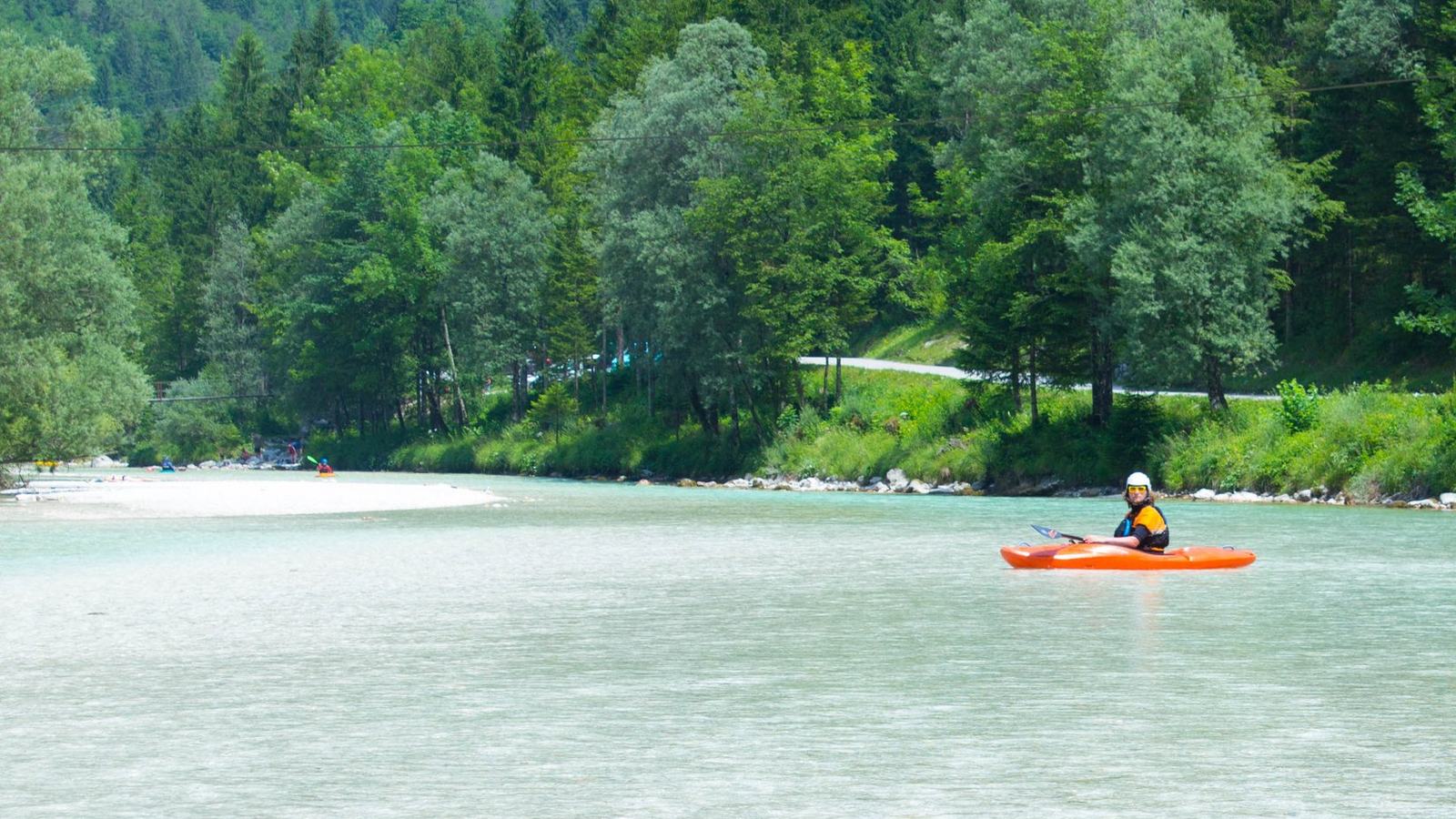
Original Soča Valley paddling feature about guided kayaking, variable river flow, whitewater safety, wildlife, conservation and visitor logistics.
A river that demands both admiration and respect
Slovenia's Soča Valley is celebrated for water of striking colour and a mountain setting that makes a journey along the river visually memorable. The country's official tourism organisation identifies whitewater kayaking, rafting and other activities as important parts of visiting the valley. Those activities should never be described as uniformly gentle. A river can change rapidly after rain or as flows vary, and the skill needed for one section may be quite different from another. For a visitor seeking a boating experience, the most rewarding starting point is an honest conversation with a professional operator about ability, water levels and the kind of trip that is appropriate.
Understanding the geography of the valley
The Soča runs through an Alpine environment of steep slopes, forest, villages and changing river channels. The official Slovenian tourism information places Bovec and the wider valley at the centre of outdoor adventures. From the bank, calm-looking pools and luminous water can create an impression of easy travel, but they do not describe what lies downstream. A route may include faster currents, obstacles and sections where stopping is difficult. Study the exact reach selected by the guide rather than assuming that every photograph depicts the planned departure. The valley can be enjoyed on foot even when water conditions prevent a safe paddle.
Why the river looks so distinctive
The apparent colour of the Soča comes through in photographs as turquoise or emerald, with shades changing according to light, depth and weather. Kayakers see those differences close to the water surface, where movement and reflections are more noticeable than from a bridge. Such beauty can be distracting, particularly for first-time paddlers who need to watch the next stretch of current. Take time to appreciate the river at a safe stopping point instead of looking sideways while negotiating a demanding line. A good guide knows when the group can pause for observation and when everyone must concentrate on steering and maintaining a safe distance between craft.
Kayaking is not the same as rafting
An organised raft can accommodate a group under the direction of an experienced guide, whereas a kayak generally requires each paddler to control a smaller craft. Some programmes use specially selected boats and easier sections for instruction, but others require established whitewater skills. Ask which activity is being sold and do not interpret the word 'kayaking' as proof that a novice can participate. A family considering the valley may find a suitable guided rafting or shore-based excursion more practical than independent kayaking. The right choice is the one that respects the least experienced participant and the conditions on that stretch of the river.
Choosing an appropriate operator
Before booking, ask about instructor qualifications, local knowledge, safety procedures, group size and minimum experience requirements. The provider should explain whether the session involves a sheltered training area, moving-water instruction or a downstream run. Confirm which equipment is supplied, including helmet, buoyancy aid and appropriate thermal protection. A responsible guide should be willing to say no when the river is unsuitable or when a participant lacks the necessary skills. Avoid providers who imply that a spectacular landscape removes all risk. Clear safety explanations and transparent cancellation conditions are far more valuable than claims about being the most exciting trip in the valley.
Water levels set the itinerary
River flow is one of the main variables in whitewater boating. Rain or upstream conditions can alter currents, obstacles and the difficulty of a given section. Check official warnings and listen to local operators with current river knowledge immediately before departure. A route enjoyed by a visitor during one season cannot be assumed safe at the same time the following year. The group may need to change its starting point, use a shorter section or cancel entirely. Flexibility is a sign of competent planning. The most important decision can be to remain on land until conditions suit the experience and the planned equipment.
The equipment that matters most
Whitewater kayaking requires more than a paddle and an attractive boat. Participants need a suitable helmet, correctly fitted flotation equipment, clothing chosen for water temperature and a craft designed for the river conditions. A spray deck, where appropriate, introduces additional skills and should not be used without proper instruction. Footwear needs to remain secure when wet and not trap the paddler. The guide should explain how equipment fits, how to leave a capsized craft and what commands the group will use. Visitors should report discomfort or uncertainty before launching. No item of equipment replaces training, but the correct combination gives training a meaningful chance to work.
Learning to read moving water
A river's surface communicates its flow through waves, smooth patches, eddies and disturbances around rocks. Understanding those patterns takes experience. Beginners should not treat an apparently straight channel as proof that it is free of hazards. A guide may demonstrate how to angle a kayak, cross gentle flow and rest in slower water, but these techniques are not an invitation to improvise on a whitewater section. The group should rehearse the communication signals and planned sequence of manoeuvres. Taking the time to understand basic current behaviour can make an introductory session genuinely educational rather than merely an attempt to reach the finish.
Cold water in a sunny landscape
An Alpine river can remain cold even when the air is warm and the sun is bright. Immersion risks include shock, reduced dexterity and fatigue, especially for someone who is not accustomed to moving water. Ask the operator whether a wetsuit, thermal layer or other protective equipment is supplied for the conditions. Carry dry clothing for after the session and avoid heavy cotton layers that become uncomfortable when soaked. A well-run programme will also account for time spent standing near the water during instruction. Warm weather is an opportunity to enjoy the scenery, not a reason to neglect the consequences of an unexpected capsize.
Rescue planning is a shared responsibility
Visitors should understand what happens if someone falls out of the boat, loses a paddle or becomes separated. Guides need a plan that fits the location and group capability, and each participant must know the essential instructions. Do not attempt a risky rescue without training; follow the established signals and protect yourself as well as the person in difficulty. Communications and first aid equipment should be appropriate for the route. An individual paddle beyond an authorised beginner programme calls for a substantially higher level of knowledge and self-rescue ability. Being clear about those limits makes a guided experience safer for everyone involved.
Bridges, villages and views from land
The Soča Valley offers more than water sports. A visitor can appreciate the river's changing colour from paths, bridges and designated viewpoints, often gaining a better understanding of the landscape before booking. Shore-based time can also make the day rewarding if the river is too high or conditions are otherwise unsuitable for kayaking. Follow signed trails and respect protected or privately managed areas. Avoid crossing barriers to reach a more dramatic photograph of the water. Looking down from a safe viewpoint helps reveal why river conditions vary along the valley and why a guide chooses one section rather than another.
Respecting river habitats
The river and its banks support wildlife, plants and sensitive places. Slovenia's official tourism information notes the Soča trout as a distinctive part of the river's natural character. Whether paddling or walking, avoid damaging banks, disturbing animals or leaving food packaging behind. A group should use designated access and exit points rather than creating a new trail wherever a boat can be dragged onto shore. Clean equipment as required to reduce the transfer of unwanted organisms between waterways. The best outing leaves no visible mark beyond temporary ripples. Responsible access helps ensure the river remains a living landscape, not just an outdoor sports venue.
Photography during a fast-water trip
It is tempting to capture the Soča's remarkable colour from the middle of a rapid. That can be dangerous. Do not use a phone or camera when steering requires full attention, and never remove a hand from the paddle unless the guide confirms that conditions are safe. An action camera should be fitted according to the operator's rules and should not create an entanglement hazard. Photographs from designated shore stops may be more satisfying and certainly easier to compose. A licensed historical image illustrating a story should be identified as such, not presented as proof of today's flow or of a particular commercial operator.
Planning a day around Bovec
Bovec is a useful base for visitors interested in the valley's outdoor activities, but the meeting place for a kayaking trip may be elsewhere. Confirm transport, equipment pickup, the actual river access and the time needed to change clothing. Allow for a safety briefing and possible alterations to the plan. Do not schedule a demanding hike immediately after a tiring session without considering the group's energy and weather. If several participants have different abilities, select an activity everyone can complete comfortably rather than expecting the weakest person to keep pace with experienced paddlers. A carefully paced day leaves space for the surrounding scenery.
The questions to settle before paying
Ask whether a booking is an introductory lesson, a guided downstream excursion or a specialist whitewater trip. Clarify the expected skill level, age restrictions, inclusions, transport and the policy for river-based cancellation. Request details on protective clothing and whether participants need to swim confidently. The provider should be able to discuss what happens if conditions change after arrival. Prices and seasonal dates should be checked directly; a generic guide cannot reliably describe future availability. A transparent operator will provide practical answers instead of relying on claims of adventure. That conversation is part of the safety assessment.
A realistic first experience
An appropriate beginner day might start with a meeting and equipment fit, followed by instruction at a suitably selected location. The guide can evaluate paddling control before deciding whether to proceed, and the group can practise clear signals and basic manoeuvres. Time on moving water should remain within the participants' ability, with a planned exit that does not depend on exhaustion or last-minute improvisation. After returning, visitors can explore a viewpoint or village at a relaxed pace. This is an illustrative pattern, not a published route or guaranteed itinerary. The specific water and the guide's judgement must determine what actually happens.
More than a colour on a map
The Soča Valley's reputation rests partly on the extraordinary appearance of its river, but a fulfilling visit is about more than turquoise photographs. Kayaking can reveal the power and texture of moving water while encouraging respect for a mountain environment. Professional supervision, realistic preparation and the willingness to change plans are what make that experience appropriate. Slovenia's official tourism information confirms the setting and the established water activities; current river conditions define the possibilities. Visitors who combine curiosity with restraint are more likely to remember the river as a remarkable living place rather than simply an obstacle course.
Sources and photograph attribution
Official destination and boating guidance: Official Slovenia Tourism — Soča Valley. Current access, rules, weather and reservations must be checked independently before travel.
Photograph: Jernej Furman from Maribor, Slovenia — Kayaking on Soca river (42197319524).jpg (CC BY 2.0) via Wikimedia Commons. Original image resized as JPEG. Historical location-specific photograph of kayaking on Slovenia’s Soča River; not a current river-flow report, operator itinerary or safety assessment. Source: https://commons.wikimedia.org/wiki/File:Kayaking_on_Soca_river_(42197319524).jpg. Licence: https://creativecommons.org/licenses/by/2.0. Original rights remain with the credited creator or as specified by the source and licence.
