
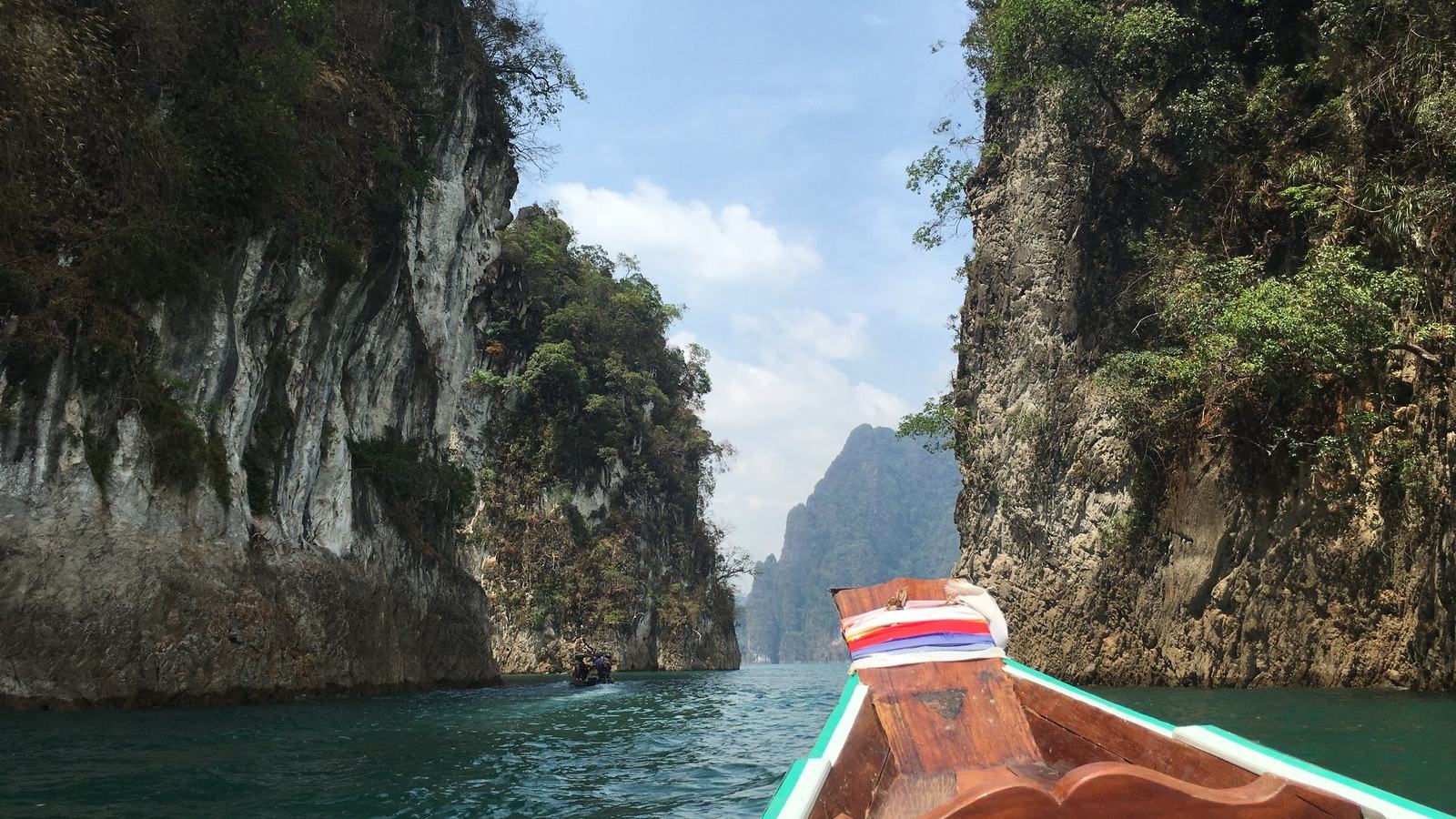
A Cheow Lan and Ratchaprapha reservoir lifestyle guide covering longtail boat travel, limestone scenery, floating lodges, kayaking and safety planning.
An inland water journey unlike a beach holiday
Cheow Lan Lake, also written Chiao Lan Lake, presents a side of southern Thailand that is easy to miss when the itinerary concentrates on islands and beaches. The reservoir lies among abrupt limestone hills and forested shorelines in Surat Thani province. Its setting makes a small-boat journey a landscape experience rather than simply transport across a body of water. Thailand's official government tourism guidance describes Ratchaprapha Dam and its reservoir, boat sightseeing, characteristic limestone formations and opportunities to paddle kayaks or canoes. Those are grounded attractions; water levels, access and excursion timetables need checking separately. The pleasure is the changing arrangement of rock, water and forest as the boat passes.
Understanding the lake's identity
The names Ratchaprapha Dam, Rajjaprabha Dam and Cheow Lan or Chiao Lan Lake are used in travel material for the dam and its associated reservoir. That can confuse visitors who find different spellings in booking descriptions. Before paying, check that an excursion actually operates on the reservoir associated with the Khao Sok region rather than somewhere else in Surat Thani. The lake is not a natural coastal lagoon, and its channels, steep shores and water operations differ from a typical island longtail outing. Knowing the setting makes practical questions easier: where does the boat depart, how much time is spent travelling and what land or floating stops are included?
How a longtail changes the perspective
A traditional longtail excursion offers the opportunity to move through a landscape of narrow horizons that repeatedly open into broad water. The engine and propeller are part of the experience, yet the striking moments may come when the operator slows to allow passengers to look toward the cliffs. Visitors should remain seated where the crew directs and avoid leaning across the gunwale for photographs. A longtail boat is neither a kayak nor a passive viewing platform: passenger movement affects balance, and the operator must manage wakes, turning and changing weather. Choose a boat and operator that provide suitable flotation equipment, clear instructions and a realistic passenger load.
The limestone scenery
Rock formations rise directly from the reservoir in places, creating the impression of islands, walls and freestanding towers. The official Thailand government tourism description points to Khao Sam Kler, a group of three limestone peaks, as a characteristic sight. The best viewing angle will vary with the route, light and conditions; a photograph in a brochure does not guarantee the same appearance on arrival. Look also at vegetation clinging to exposed rock, changing shadows and the contrast between sheltered water and the open reaches. Good sightseeing should keep the boat at a sensible clearance from rock faces and any restricted or shallow area identified by local operators.
Choosing between a short cruise and an overnight stay
A short boat trip can deliver the principal spectacle without committing to accommodation in a remote setting. An overnight programme may offer extended time among forest and water, but it comes with different expectations about transfers, facilities and weather disruption. Floating accommodation is frequently promoted in the wider lake area, yet individual properties vary enormously. Ask whether accommodation is on a floating raft structure, whether meals and transfers are included, and whether electricity, toilets, communications or mobility access meet the party's needs. An appealing photograph should never substitute for written details. Visitors who value comfort should verify services rather than assuming that every floating stay operates like a conventional hotel.
Paddling as the quieter alternative
Thailand's official government guidance identifies kayaking and canoeing among recreational possibilities on the reservoir. A paddle can make a valuable contrast to the powered boat: slower movement allows attention to small ripples, tree shapes and the shifting scale of the limestone walls. But a calm-looking surface may still be affected by wind and boat traffic, and not every stretch is suitable for inexperienced paddlers. Rent equipment only from an operator that specifies permitted areas and current conditions. Wear a correctly fitted flotation device, stay together, understand how to return and leave sufficient daylight. A supervised, protected-area paddle is preferable to improvising a long route toward an alluring distant cliff.
Rain, cloud and the meaning of visibility
The lake's dramatic appearance is partly a product of atmospheric conditions. Haze, rain clouds and breaks of sunlight can alter the contrast between water and cliffs within minutes. That creates photographic interest but also a reason to take weather seriously. Heavy rain may reduce visibility, and thunderstorms are not an occasion to remain exposed on the reservoir for a better view. Check the local forecast and follow the crew's guidance about alterations or cancellation. Keep cameras and spare clothing in genuinely waterproof protection. Visitors should not assume that a covered boat eliminates the effects of severe weather, especially when transferring between a jetty and a smaller craft.
Matching the journey to your travel day
Cheow Lan outings are often combined with wider travel in Surat Thani province, but the excursion itself deserves breathing room. Verify the road transfer, exact boarding point and expected return rather than fitting a lake tour between tightly scheduled onward connections. Allow for changing road conditions, boarding delays and a slower return if the boat must proceed cautiously. If travelling with children, older companions or people who find steps difficult, ask about boarding arrangements and toilet access before booking. A route that looks short on a map may involve multiple transfers. A comfortable day starts with sensible logistics rather than an unusually ambitious series of stops.
Wildlife watching without promises
Forest and water are part of the lake's appeal, and visitors may notice birds, insects and other signs of life during a trip. The correct expectation is an opportunity to observe habitat, not a guarantee that a particular animal will appear. Avoid operators who encourage feeding wildlife or pressing close to shore to provoke an encounter. Keep noise and movement considerate, particularly when another boat has paused to observe. Binoculars can be more useful than a long camera lens in a moving craft, provided they are used while seated safely. A respectful distance helps preserve both the visitor's experience and the behaviour of animals that depend on this environment.
Choosing an operator carefully
Ask a prospective excursion provider for the full itinerary, passenger capacity, equipment, guide language, pickup arrangements and cancellation terms. Confirm that the operator can respond to weather changes and has a plan for a disabled engine or other interruption. A clear explanation should distinguish what is included from optional charges for accommodation, meals or separate activities. Inspect flotation devices before departure; they must fit all members of the party, not merely exist somewhere on board. If the advertised activity includes kayaking, request details about supervision and which part of the reservoir is used. Reliable arrangements matter more than claims about being the most adventurous or most exclusive tour.
Packing for boat and shore
Light clothes may be comfortable in humid conditions, but sun, rain and wet boarding can arrive on the same excursion. Bring sun protection, secure footwear suitable for a jetty, drinking water and a dry bag for important items. A light rain layer can make a difference when spray or weather changes the temperature. Pack medication, any required travel documents and a spare battery or power bank without depending entirely on mobile coverage. Keep luggage compact enough for the boat's storage instructions. Valuable electronics should not be balanced near the edge to capture photographs. A reusable bottle and minimal packaging reduce waste on a trip where disposal options may be limited.
Respecting a working reservoir
A dam reservoir is a managed environment, not an open playground without boundaries. Water levels, operating rules, shoreline access and boat activity can change. Follow the guidance of the managing authority and licensed local providers, and do not land on cliffs, floating structures or private facilities without permission. Swimming should be considered only in designated, approved circumstances with suitable supervision, and not inferred to be safe simply because photographs show clear water. Avoid collecting plants or damaging shore vegetation. The most useful visitor habit is to ask what is permitted today rather than treating a past travel account as a statement of current operating policy.
A thoughtful photography approach
The famous wide view is only one visual story. Photograph the repetition of layered hills, the shape of a boat moving against the cliffs, gentle reflections and the working details of the longtail itself, while avoiding identifiable people without consent. Bright midday light may flatten distant scenery; softer conditions can reveal subtle greens and greys. Never stand, lean or move abruptly because an angle appears irresistible. If carrying a large camera, agree a safe place for it before boarding. Remember that a licensed editorial image showing the reservoir represents its geography, not a promise that a particular commercial operator will use the same boat or visit the same exact viewpoint.
How to build a balanced itinerary
One possible pattern is a morning transfer to the lake, a safety briefing at the jetty, a deliberately paced longtail circuit and a pause for food or a permitted stop before returning. A kayak session can be added only if suitable equipment, time and conditions are confirmed. The itinerary should remain flexible: a shorter circuit in poor visibility can be preferable to forcing a distant stop. Leave unscheduled space for changes to the route and for the ordinary pleasures of watching the landscape. Visitors staying overnight can distribute activities over more than one period rather than trying to fit every advertised highlight into a single day.
Questions worth settling before payment
Confirm which place name appears on the booking, whether transport is shared or private, the exact departure jetty, the number of passengers, the price basis and the conditions for refunds when safety concerns prevent boating. Ask whether a park or entry fee is separate and whether accommodation is provided by the same operator. Clarify the policy for children and non-swimmers. Check how far ahead travellers must arrive and what happens if weather interrupts the excursion after departure. Clear written answers protect the visitor and help the crew plan properly. Never rely solely on an attractive social-media reel for essential safety or logistical information.
The appeal of a slow passage
What makes Cheow Lan memorable is not the number of activities completed. It is the feeling of travelling through a changing natural amphitheatre, where broad water narrows between dark limestone and forested slopes. The contrast between an engine-powered longtail and a quieter paddle gives visitors two ways to appreciate the same setting. Official tourism information establishes the reservoir's attractions, while reliable local planning determines what is possible on the day. A measured visit, with appropriate equipment, respectful conduct and generous time, can be more rewarding than a hurried circuit designed only to reproduce familiar photographs.
Sources and photograph attribution
Official destination and boating guidance: Government of Thailand — Ratchaprapha Dam and reservoir. Current access, rules, weather and reservations must be checked independently before travel.
Photograph: Avenlarosa — Rajjaprabha Dam Reservoir 02.jpg (CC BY-SA 4.0) via Wikimedia Commons. Original image resized as JPEG. Historical reservoir landscape photograph in Surat Thani, Thailand; not a specific tour boat, current accommodation or water-level forecast. Source: https://commons.wikimedia.org/wiki/File:Rajjaprabha_Dam_Reservoir_02.jpg. Licence: https://creativecommons.org/licenses/by-sa/4.0. Original rights remain with the credited creator or as specified by the source and licence.
