
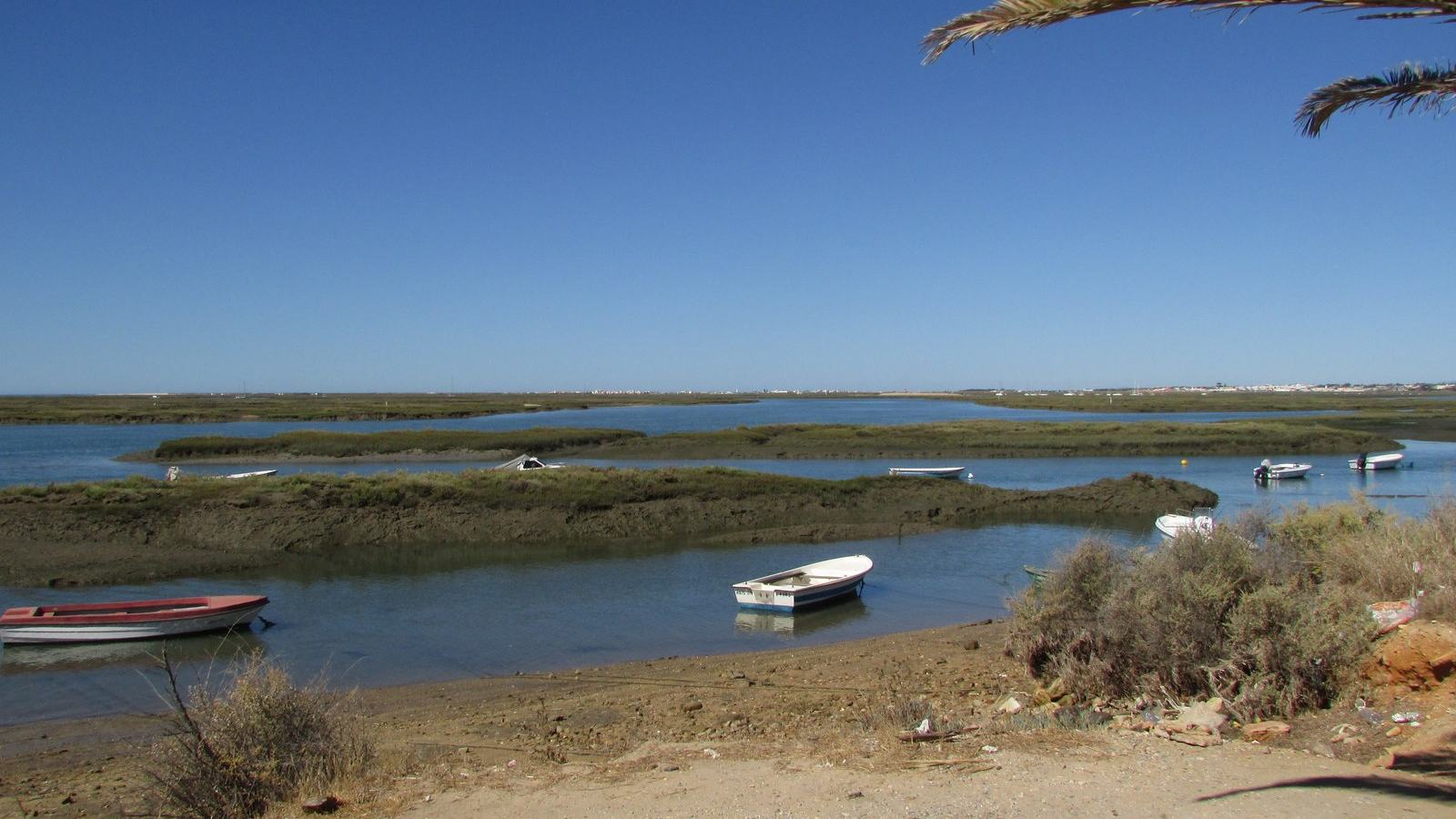
An original boating guide to Ria Formosa, covering Faro barrier-island tours, tidal navigation, island communities, salt-marsh birds and visitor safety.
The Ria Formosa lagoon on Portugal's Algarve coast presents an unusually rich setting for a modest passenger boat. Between Faro, Olhão and the open Atlantic, tidal channels pass salt marshes, fishing communities and barrier islands that remain distinct from the resort beaches farther west. Visitors can reach places such as Ilha Deserta, Farol and Culatra by scheduled transport or through guided excursions, but the exact routes and landings require careful local knowledge. Faro-based operator Formosamar advertises a specific Ria Formosa Barrier Islands Boat Tour, providing a useful first-party account of what a licensed boat outing can include. The attraction is not speed: it is understanding how water, working communities and wildlife coexist in a landscape that changes with every tide.
A lagoon rather than an open-sea cruise
Ria Formosa is sheltered by a chain of barrier islands and sandy peninsulas, but its water is not uniformly deep or calm. Tidal channels wind among mudflats and sandbanks, and the boundary between a navigable passage and a shallow area can be difficult to identify without local experience. A sightseeing boat follows established routes for good reasons. Its crew must understand tides, current, charted hazards and the positions of other craft. Visitors should not see a wide expanse of water and assume they can hire any small boat and travel directly across it. A guided departure can reveal the complexity of this landscape while avoiding disturbance to sensitive habitats.
Faro offers a practical departure
Formosamar operates excursions from the Faro area and describes routes through the lagoon to barrier islands and coastal viewpoints. For someone arriving by rail or road, this makes the experience more accessible than an offshore charter. However, an operator's advertised itinerary is not a permanent guarantee of the exact island visited, the landing place or the length of a stop. Water levels and weather can influence the route. Before booking, check the precise departure pier, meeting time, included services and return arrangements. Visitors unfamiliar with Faro's waterfront should allow enough time to find the operator rather than arriving just as the vessel is scheduled to leave.
The barrier islands are individual places
It is tempting to describe all the islands simply as beaches, but each has its own settlements, natural features and visitor arrangements. Culatra is associated with fishing and island community life. Farol offers a different atmosphere around its lighthouse area, while the Ilha Deserta setting is valued for relative remoteness and open sandy coast. Some tours combine several islands; others focus on one or include only a short landing. The correct choice depends on whether visitors want a cultural stop, swimming time or an ecological explanation of the lagoon. Avoid promising every destination in one outing unless the actual operator confirms it.
Tidal range shapes what is visible
At low water, mudflats and marsh edges become prominent, exposing feeding grounds for birds and making the lagoon's geography clearer. At high water, some shallow areas may be submerged and the channels can look wider. These changes are part of Ria Formosa's appeal, but they also affect navigation. The skipper, not a passenger's preference for a shortcut, determines the safe route. A visitor may find the outward and return journeys visually different even when the boat covers similar ground. Rather than expecting permanent turquoise water at every location, enjoy the changing colours and patterns of a working tidal estuary.
Birdwatching belongs to the experience
The lagoon is an important habitat for waders, waterfowl and other birds that use its salt marshes and mudflats. Observations vary by season, tide and the disturbance level around a particular location. Binoculars are useful because they allow passengers to watch wildlife without demanding that a skipper approach closely. Formosamar advertises boat activities in the natural park, while conservation guidance emphasises responsible behaviour around protected birds. A boat trip should not be judged solely by the number of species seen. Watching how birds feed or rest around tidal channels can reveal more about the ecosystem than a single dramatic close-up.
A small passenger boat suits the channels
A vessel designed for shallow coastal touring can move through the lagoon at a pace suited to observation. From an open or partially sheltered deck, passengers can see fishing boats, islands and wildlife without the elevated viewpoint of a large sightseeing ship. Craft differ in seating, access and protection from spray, so it is worth asking what type of boat will operate the chosen tour. Families may value shade and stable boarding, while photographers may prefer clear sightlines. Whatever the design, everyone should remain seated when instructed and avoid shifting to one side when birds or a scenic bank appear.
Working fishing communities deserve respect
The Algarve's barrier islands are not empty nature exhibits. Fishing, shellfish gathering and other maritime activities have shaped the area's identity, and local residents continue to use the waterways. A tour guide may explain fishing traditions or the history of particular settlements. Visitors should not obstruct working quays or assume that every moored boat is a public attraction. Ask permission before photographing people at close range or walking into private spaces. Supporting local food businesses can be an enjoyable part of a stop, but respect for the community matters more than consuming an idealised image of island life.
How a guided tour differs from a ferry
A ferry primarily transports people between designated points, often on a published schedule. A sightseeing excursion usually includes interpretation or a route selected for scenery and ecology. The distinction matters because a ferry passenger may plan a lengthy independent visit ashore, while an excursion guest must return to the boat after a specified interval. Formosamar's barrier-island tour is a guided product, not a blanket promise of unlimited time on the islands. Travellers should decide which experience they want before paying. If independent walking time is the priority, ask about scheduled transport and the actual return service rather than relying on a short tour.
Weather matters even inside the lagoon
The presence of barrier islands does not make conditions entirely predictable. Wind can create chop in exposed channels, and a change in weather may affect crossings or planned landings. A small boat that appears comfortable beside the quay can move more sharply in open passages. Check the forecast and listen to the operator's instructions about clothing, shelter and possible cancellations. Offshore swell may be relevant near entrances connecting the lagoon with the Atlantic. A flexible itinerary allows visitors to rearrange a cruise rather than press a crew to travel when conditions are unsuitable.
Flotation and boarding arrangements
Passengers should receive a clear safety briefing and have access to suitable flotation equipment under the applicable rules. Families should confirm that child sizes are provided and that boarding arrangements can accommodate their party. The gap between a pier and a small excursion boat can move with wash or tide, so everyone should wait for an instruction before stepping aboard. Bags should be compact, with cameras protected from spray. Once under way, stay within the passenger spaces and leave the skipper free to manage navigation. A relaxed estuary excursion still requires the same basic responsibility as any other journey afloat.
Photography rewards a wider view
Ria Formosa is particularly photogenic when the sinuous channels and pale sandbanks appear in the same frame. A wide composition showing boats and habitat together can tell a more accurate story than a close-up of a bird or beach. Photographers must not ask the skipper to approach a nesting area or enter shallow water for a better angle. Secure equipment against sudden movement and avoid standing on seats. Light changes quickly as clouds and tides move, so patience is more useful than constant repositioning. The lagoon's geometry often provides memorable photographs without any unusual manoeuvre from the boat.
Swimming needs an appropriate location
Some excursions include time on an island beach, but the conditions for swimming should never be inferred solely from inviting photographs. Tidal currents, beach exposure and the presence of designated swimming areas all matter. Ask the guide where it is safe and permitted to enter the water, and supervise children closely. A shallow-looking passage can carry a current that is difficult to judge from shore. The boat operator's responsibilities and an individual's swimming ability are separate issues. The best island stop is one where leisure time takes place within clear local guidance rather than a spontaneous plunge from an unsuitable landing.
Wildlife protection also means leaving no trace
A day trip creates opportunities for waste, lost plastic packaging and trampling of sensitive dunes. Visitors should carry rubbish back to collection points and remain on designated paths where present. Shells, plants and other natural objects should be left in place. The barrier islands protect the lagoon and support habitats that can be damaged by repeated informal crossings through vegetation. Even a small group can contribute to cumulative impact. Choosing an established operator, respecting island access and keeping a low environmental footprint are practical ways to preserve the setting for future visits.
Planning around the season
Some island transport and tourist services operate more frequently in warm months, while off-season schedules can be limited. A visitor planning for a future year should confirm the precise service date rather than assume a summer itinerary is available in November. Weather also affects comfort: an exposed boat can feel cool despite bright Algarve sunshine. Check restaurant and facility availability for any planned island stop. The aim is to avoid a day in which the group reaches a remote beach expecting food or an onward ferry that is not operating. Reliable information close to departure is better than an outdated travel article.
A satisfying day from Faro
A well-paced outing can begin with the boat journey through the tidal channels, continue with a short permitted walk on an island and finish with time to explore Faro's waterfront. Visitors need not attempt every lagoon settlement in a single afternoon. If nature is the priority, choose a tour with a guide prepared to explain birds and salt marsh ecology. If island life is more important, seek an itinerary with genuine time ashore. A family may prefer a shorter loop. The flexibility of the experience is one of its strengths, provided the operator and passengers agree on the plan before leaving.
The lesson for small-boat travellers
Ria Formosa shows that a place described as sheltered water can still demand expertise because of tides, channels, protected habitats and working maritime traffic. A capable local skipper does more than steer; the crew interprets the geography and helps visitors appreciate what they are seeing. A well-managed barrier-island tour connects leisure boating with conservation and the people whose lives depend on the lagoon. By respecting the route, protecting wildlife and choosing arrangements suited to the season, travellers can experience one of Portugal's most distinctive small-boat landscapes without treating it as an unrestricted playground.
Sources and photograph attribution
Official destination and boating guidance: Formosamar — Ria Formosa Barrier Islands Boat Tour from Faro. Current access, rules, weather and reservations must be checked independently before travel.
Photograph: Kolforn — 12-09-2017 Ria Formosa, Faro (1).JPG (CC BY-SA 4.0), via Wikimedia Commons. Editorial JPEG resizing; original creator credited. Source: https://commons.wikimedia.org/wiki/File:12-09-2017_Ria_Formosa%2C_Faro_(1).JPG. Licence: https://creativecommons.org/licenses/by-sa/4.0. Original rights remain with the credited creator or as specified by the source and licence.
