
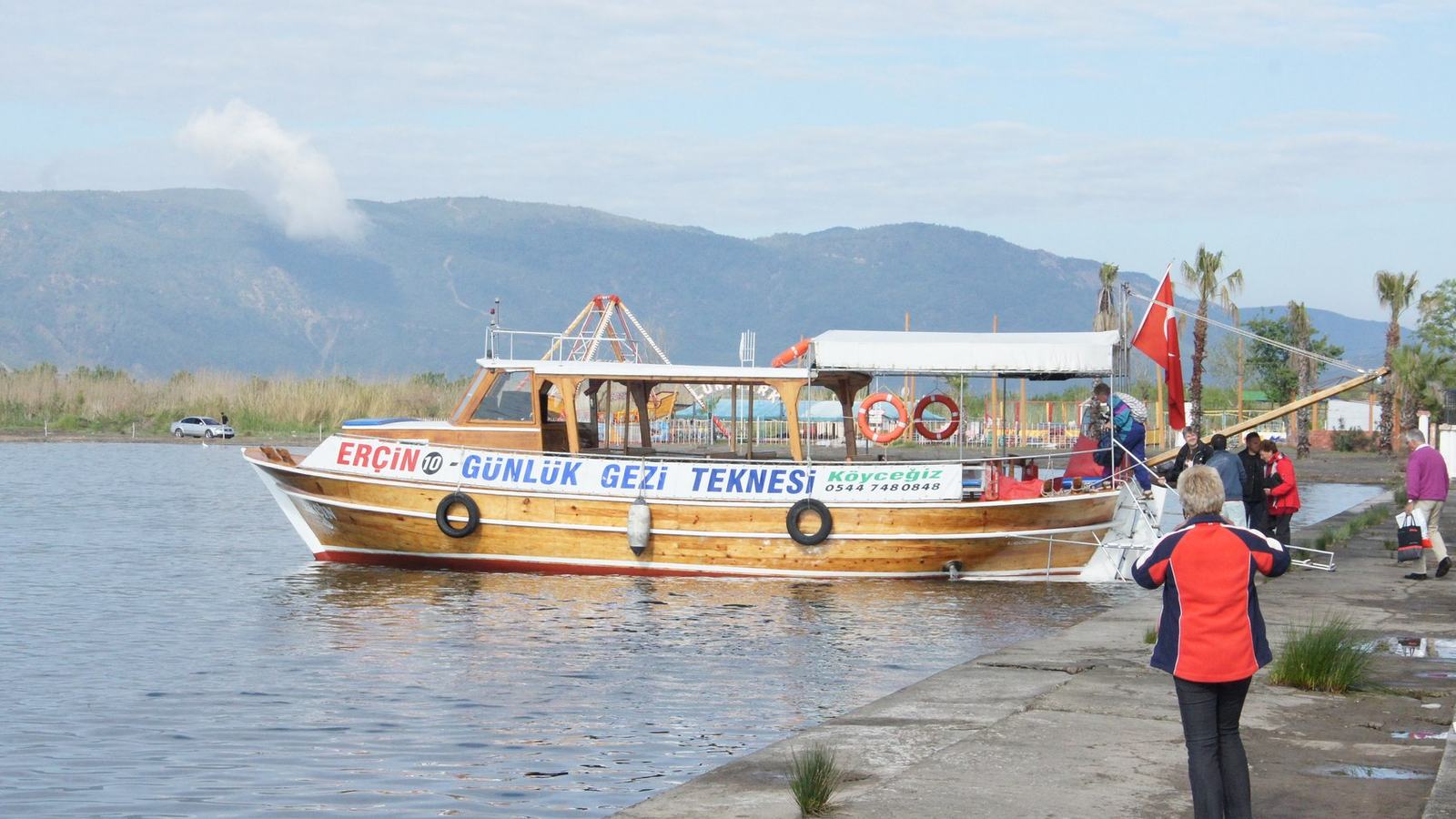
A practical guide to Dalyan River boat excursions, Kaunos cliff tombs, İztuzu loggerhead nesting protection, wetland scenery and responsible visitors.
The Dalyan River in southwestern Türkiye connects a quiet inland landscape of reeds and ancient ruins with the Mediterranean coast at İztuzu Beach. Visitors often make the journey on a locally operated excursion boat, passing the celebrated rock-cut tombs associated with ancient Kaunos before following the river channels towards the sandspit. Türkiye's official GoTürkiye destination material explains that İztuzu is important for nesting loggerhead sea turtles and that boat access and speed are subject to conservation restrictions. This makes Dalyan an unusually instructive small-boat destination: a journey can bring together archaeology, wetland scenery and a protected beach, but only when skippers and passengers treat the environment as more than a scenic backdrop.
A river linking inland water and the sea
Dalyan lies between Köyceğiz Lake and the coast, in a landscape where river channels, reeds and marshes create a transition between freshwater influences and the Mediterranean. A tourist boat may follow part of this corridor from the town towards İztuzu, while other excursions focus on the archaeological surroundings or lake-side destinations. The exact route depends on the operator and the state of the waterway. A visitor should not assume that the river behaves like an open coastal anchorage. Narrow bends, shallow areas, other passenger boats and wildlife habitats all require careful handling and the guidance of someone familiar with the locality.
The rock-cut tombs are a defining landmark
Above the river are ancient tombs carved into a cliff face near the ruins of Kaunos. Their striking façades are often photographed from the water because the boat provides an unobstructed view of the rock. They are cultural remains, not structures designed for climbing or informal visits from the riverbank. An excursion guide may explain their ancient context, but travellers should distinguish interpretation from established archaeological fact. A boat moving slowly past the tombs gives passengers time to understand how geography influenced settlement and ceremonial architecture. There is no need to demand an unusually close approach for a photograph when a safe view from the channel already captures the setting.
Kaunos adds depth to the trip
The ancient city of Kaunos, close to Dalyan, contains archaeological remains that can be explored through appropriate land access. GoTürkiye identifies Kaunos as a significant cultural attraction associated with the region. A river cruise and a visit to the ruins can complement each other, but an itinerary that includes both should allow realistic walking and boat-transfer time. Do not assume that every tour ticket includes entry to an archaeological site. Ask where the vessel stops, how long passengers have ashore and what footwear is appropriate. The experience is more rewarding when the history is approached with time and respect rather than a sequence of hurried photo stops.
İztuzu is a nesting beach
GoTürkiye highlights İztuzu as a nesting area for loggerhead sea turtles, known locally by the name caretta caretta. The wide sandy beach is attractive to visitors, but its ecological role changes what responsible tourism requires. Turtle nesting and hatching are sensitive to disturbance, and beach access or permitted activities may vary seasonally. Visitors should obey marked boundaries and instructions from conservation staff rather than treat the beach as an unrestricted stretch of sand. A boat excursion is compatible with enjoying the coast only when the operator and passengers preserve the conditions that nesting animals need.
Boat speed restrictions are important
The official GoTürkiye description notes restrictions on high-speed boats near İztuzu, including an exclusion for speedboats within one kilometre of the beach. A visitor should confirm the current regulation with local authorities or the operator before travelling, as enforcement details can change. The principle is clear: wildlife protection may require boats to slow down, avoid certain water or choose another route. A private owner who sees excursion craft in the area should not conclude that every vessel can enter in the same way. The responsible response is to check specific permissions and accept that protected habitat takes priority over a convenient short passage.
Traditional excursion boats suit a gentle pace
Local passenger boats are an established way to experience the river scenery, and a slow cruise allows passengers to observe reeds, rock formations and birdlife. The skipper must still account for traffic, changing conditions and the needs of other water users. A group seeking a quiet nature excursion should ask about shared versus private departures, passenger capacity and the intended stops. Some boats are designed for larger groups or include food and refreshments, while others provide a simpler trip. Choosing a vessel suited to the party is more sensible than selecting the cheapest advertised price without knowing what the booking includes.
Reeds make the landscape distinctive
The reed-lined channels create a visual rhythm quite different from a journey along an open beach. From the low deck of a passenger boat, the vegetation can appear tall and enclosing, and small openings may reveal waterbirds or views of the surrounding hills. Reeds also provide habitat, so they should not be pulled aside or entered by a tourist boat in pursuit of a photograph. A guide may explain how the wetland changes through the year and why certain passages are used. The apparent simplicity of the landscape conceals an ecosystem that depends on functioning water flows and limited human disturbance.
Birdwatching works best with patience
The Dalyan wetland supports birds that feed and rest around the water, but the species visible vary by season and the conditions of the excursion. Carry binoculars if birdwatching is a priority, and choose a tour that allows quiet observation rather than a high-speed transfer. The skipper may need to keep a practical distance from a feeding or nesting area even when a bird appears clearly visible. Avoid using food to attract animals or asking the crew to follow them through vegetation. A natural sighting, experienced without interference, adds more to a boating holiday than a photograph obtained by disturbing habitat.
The beach deserves its own time
A stop at İztuzu can offer a different experience from the river passage, with views of the Mediterranean and the unusual geography of the sandspit. Passengers should confirm whether their tour includes time on the beach or only views from the boat. If a landing is planned, ask where to disembark and when the return service operates. Protected-area guidance may govern umbrellas, food, pets, noise or access after particular hours. A traveller should not infer all of these rules from an old brochure. Respecting the locally posted information is an essential part of visiting a nesting beach.
A river journey is still a boating operation
The water may look calm, but safety begins with proper boarding, passenger loading and a clear briefing. People should know where suitable flotation equipment is located and use it as directed. A broad passenger boat can still become unstable if guests crowd one side to photograph a tomb. Small children need supervision near open rails and boarding gaps. Keep walkways clear so crew can work safely. A shared boat trip can be relaxing when passengers follow instructions, while careless standing or movement can create unnecessary risk even during an apparently gentle sightseeing passage.
Avoid confusing a guided trip with private navigation
The sight of local boats operating regularly on the river does not prove that every private tender is welcome in every channel. There may be separate rules for commercial excursions, chartered vessels and privately operated craft. Water depth, seasonal wildlife restrictions and authorised landing points all matter. If arriving in the region on a yacht, obtain specific navigation and local regulation advice instead of planning a direct tender run based on photographs. A guided river trip offers the benefit of a skipper familiar with both boating practice and the cultural and conservation context of the route.
Photography from a moving deck
The Kaunos tombs, reed channels and coastal dunes provide a variety of photographic subjects. A low viewpoint from the boat can emphasise the scale of the cliff and the changing light on its carved surfaces. Cameras should be kept secure, particularly when the vessel passes other boats or turns into a narrower reach. Do not climb onto seating or lean over the edge for a better angle. A wide image that shows the tombs in relation to the river tells a richer story than an isolated architectural detail. For wildlife, a longer lens is preferable to asking the skipper to approach closely.
Sun, wind and water comfort
Dalyan can be warm in the main holiday season, and exposed parts of the river or beach may offer little shade. Passengers should bring water, sun protection and suitable clothing for the forecast. The presence of a canopy on a photograph does not guarantee that the specific booked boat has one. Weather can change the comfort of a planned trip, particularly when the route reaches more exposed water near the coast. Ask how the operator manages changes or cancellations. A relaxed experience depends on being comfortable enough to enjoy the scenery rather than endure hours of heat or wind without preparation.
Choosing an operator and route
Some Dalyan excursions combine the river, rock tombs and İztuzu Beach, while others include lake-side stops or additional activities. Ask for the actual itinerary, total duration, number of passengers and services included. A group interested in archaeology may prefer a route with time for a guided visit to Kaunos, while families may favour a shorter river-and-beach trip. The existence of a destination on a promotional list is not confirmation that it can be visited on a particular date. Current weather, conservation restrictions and operational schedules should determine what is promised to guests.
Working communities and local knowledge
Dalyan is a community as well as a visitor destination, and its waterways are used by local boat operators and other residents. Travellers should be respectful at jetties, restaurants and public spaces, avoiding obstruction of boats arriving to collect passengers. A knowledgeable local guide can explain how the river supports tourism and why the nesting beach attracts conservation attention. The relationship between livelihood and habitat protection is more complex than a simple choice between development and nature. Responsible tourism supports people who can make a living while protecting the landscapes that visitors come to see.
Planning a full day without rushing
A good day might begin with a river cruise, continue with views of the tombs and include a controlled stop near İztuzu, followed by time to explore Dalyan on land. The precise order depends on the operator, water and weather conditions. Leave room for boarding, return transfers and independent entry tickets if archaeological sites are involved. Avoid an inflexible onward journey immediately after the cruise, particularly if the group includes young children. A small-boat excursion is best experienced at the pace of the river rather than as a race through several unrelated attractions.
A lesson in balancing access and protection
Dalyan demonstrates that a boat can connect remarkable places without giving passengers unlimited access to them. The river invites slow observation, the rock tombs reveal historical depth, and İztuzu requires respect for nesting turtles and the regulations designed to protect them. The role of the local skipper is therefore central: navigation and conservation judgement are inseparable. Travellers who ask the right questions before booking, remain considerate on board and accept restrictions at the beach can enjoy an outstanding journey while helping preserve the qualities that make it worth visiting.
Sources and photograph attribution
Official destination and boating guidance: GoTürkiye — İztuzu Beach, Dalyan River and Sea Turtle Conservation. Current access, rules, weather and reservations must be checked independently before travel.
Photograph: rob Stoeltje from loenen, netherlands — Boat in Dalyan (5665184871).jpg (CC BY 2.0), via Wikimedia Commons. Resized and converted to JPEG for editorial presentation. Source: https://commons.wikimedia.org/wiki/File:Boat_in_Dalyan_(5665184871).jpg. Licence: https://creativecommons.org/licenses/by/2.0. Original rights remain with the credited creator or as specified by the source and licence.
