
Explore Lake Titicaca’s floating Uros islands, traditional totora boats, community-led tourism, high-altitude lake travel and responsible visitor practice.
A journey onto Lake Titicaca from Puno, Peru, can take visitors to an extraordinary community landscape: floating islands made from totora reeds. The islands of the Uros are not simply a novelty visible from a sightseeing boat. They are places where families maintain a distinctive relationship with the lake, its plants and boatbuilding traditions. Peru's official tourism authority describes how totora is used to construct the islands, boats and everyday objects, while Peru's protected-area service explains the wider ecological value of the Titicaca National Reserve. A responsible visit begins with understanding that this is a living community and an important wetland, not a stage built for tourists.
The water defines everyday life
On much of Lake Titicaca, water separates settlements and determines how people move from place to place. The Uros floating islands make that relationship particularly visible because the islands themselves are constructed from a lake plant rather than ordinary mineral soil. Peru Travel explains that the Uro-Aymara families have used totora reeds for centuries and continue to work with the material. Visitors arriving by passenger boat see homes and other structures set on floating platforms, but the visual spectacle only hints at the expertise required to maintain them. A visit is more rewarding when the guide explains the work and decisions behind that environment.
Totora is a building material
Totora reeds grow in the lake's shallower areas and have long supplied material for floating islands and traditional craft. The official Peru Travel page emphasises the connection between these reeds and local life, including boats and handicrafts. The structures are maintained rather than built once and forgotten, and their condition depends on continued care. A visitor should avoid standing on fragile or restricted sections simply to test how the islands float. Ask hosts where to walk and what may be touched or photographed. Understanding the maintenance involved prevents the islands from being reduced to a misleading tourist curiosity.
A reed boat is more than decoration
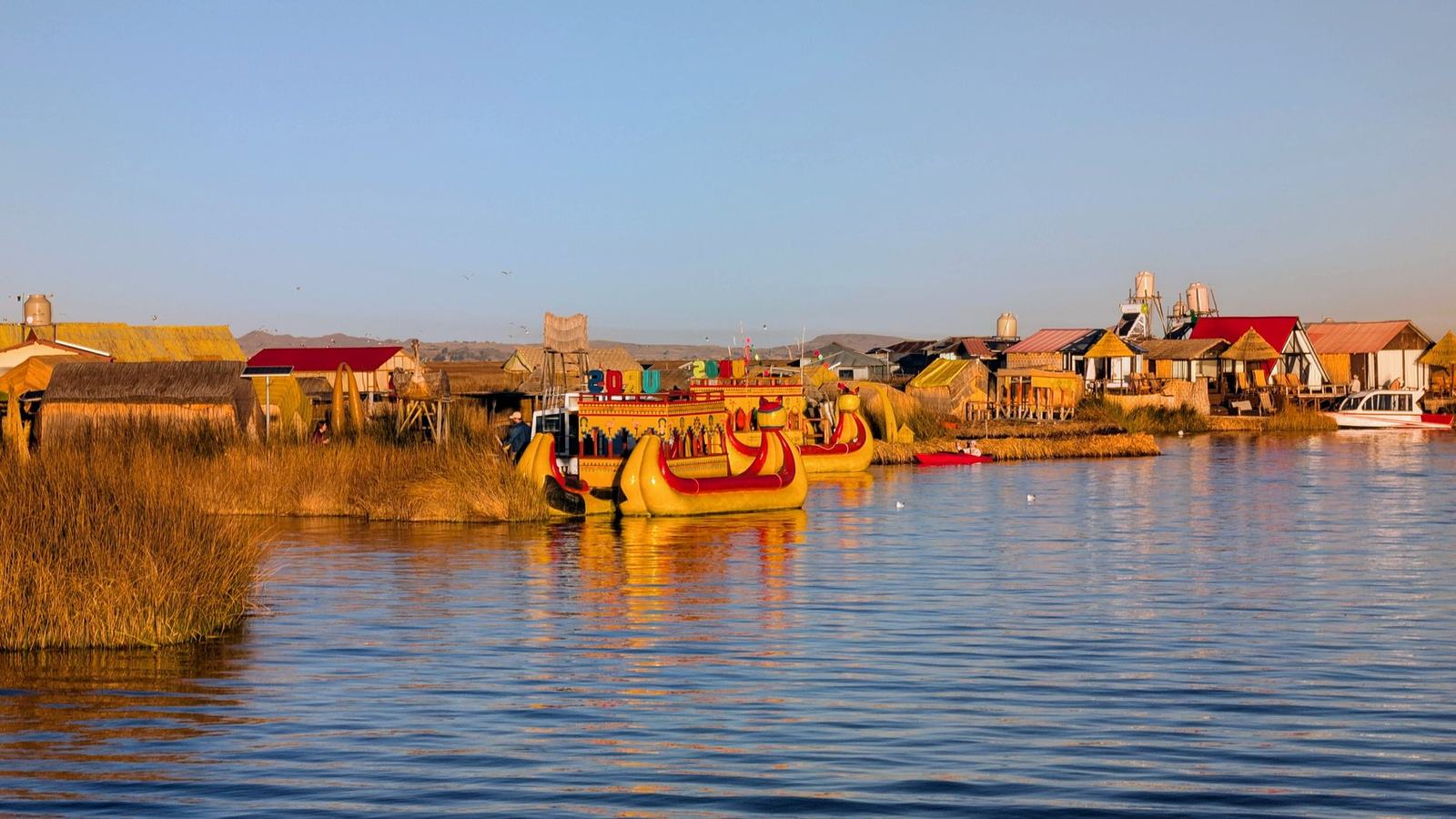
Traditional totora vessels are one of the most recognisable symbols of the Uros islands, with their curved forms and bundled construction. They demonstrate a long history of using local plant material for water transport. Some journeys for visitors may include an optional ride on a reed boat, but that is not automatically part of every island tour. The modern motorboat carrying passengers from Puno is a different craft, with different costs, purposes and safety arrangements. Clarify whether an optional ride is available, whether it is charged separately and how passenger capacity is managed. The cultural importance of the craft should be acknowledged rather than treating it as a disposable photo prop.
Starting at Puno
Puno is a common gateway for authorised excursions onto the Peruvian part of Lake Titicaca. Peru Travel identifies the lake as a major cultural and nature destination and describes visits to the floating islands as part of local community tourism. A boat departure should be arranged through a reputable provider with clear information about the embarkation point, route, duration and included services. Visitors should not assume that any vessel waiting at a pier operates under the same conditions. Ask who is responsible for the boat and whether there will be a community guide on arrival. The quality of an experience is often shaped by the relationship between the operator and the families hosting guests.
The difference between sightseeing and community tourism
A fast excursion focused on photographs can leave a traveller with little understanding of the people who live on the islands. Peru Travel also promotes community-based tourism, which can include learning about reed construction, everyday practices and local handicrafts. These experiences should be chosen with respect for hosts' time and the arrangements made by the community. Some visitors may prefer a shorter introductory trip; others may want a guided discussion or cultural exchange. Neither approach justifies entering private areas or treating residents as performers available on demand. The best tour is one in which hosts remain partners rather than anonymous objects of curiosity.
Lake Titicaca's elevation changes the experience
The lake lies at a high altitude of approximately 3,810 metres above sea level according to Peru's protected-area service. Even a physically gentle boat excursion can feel demanding for travellers who have only just arrived from low elevations. Cold air, intense sunlight and reduced oxygen can affect comfort. A visitor should allow time to acclimatise and follow appropriate medical advice for altitude-related concerns. Walking across an island or boarding a boat may require more effort than expected, particularly for older passengers or families with small children. Plan a modest first outing and avoid combining travel fatigue with a long itinerary on the same day.
Water and weather are not always gentle
Photographs of calm blue water can create the impression that Lake Titicaca is permanently sheltered. In reality it is a substantial high-altitude lake where wind and changes of weather matter. The skipper of a passenger vessel must assess conditions, and visitors should accept altered schedules or cancellations without pressure. Ask about flotation equipment and know where it is located before leaving the pier. People should remain seated when requested and avoid leaning over the gunwale to photograph reeds or other vessels. A short crossing is still a boating operation, with the usual responsibilities of passenger safety and consideration for other lake users.
How the visit connects to conservation
The Titicaca National Reserve protects important wetland habitats, including areas associated with totora reeds and water birds. Peru's protected-area service describes its biodiversity and cultural attractions as linked parts of the destination. Collecting reeds, disturbing birds or dropping rubbish into the water undermines both. A community-led visit can help tourists learn why healthy wetland vegetation matters for the people who use it, but tourism itself must be managed carefully. Visitors should follow conservation guidance rather than assuming that a traditional use of reeds gives everyone permission to cut or gather them. The lake is a shared ecological and cultural resource.
Birdwatching from a passenger boat
A boat on the lake can create opportunities to observe aquatic birds, particularly when passing wetland edges. Binoculars and a patient approach are better than trying to turn a motorboat towards every distant bird. Avoid asking a skipper to enter protected vegetation or chase an animal for a photograph. Birds depend on uninterrupted resting and feeding areas, and a vessel can create disturbance even without direct contact. An interesting sighting is never guaranteed. Visitors who appreciate the wider setting—reeds, water, mountains and the movement of local craft—can enjoy the excursion regardless of which species appear.
Photography should involve consent
The distinctive appearance of the islands naturally attracts cameras, but their residents should not be photographed at close range without permission. A home is a private place, even when it stands on a floating platform regularly visited by tourists. Ask before recording conversations or taking portraits of children, and respect any request not to photograph a particular activity. A landscape picture showing a reed boat with the host's consent may be more appropriate than an intrusive close-up. Tour operators should explain local expectations, but the responsibility remains with the traveller to exercise good judgement and courtesy.
Paying fairly for local experiences
A visit to the islands may involve an operator's boat fare, an entrance or community fee and optional purchases or activities. These should be explained clearly before departure or before accepting an additional experience. Handmade goods can be a meaningful way to support the community when purchased without bargaining tactics that undervalue labour. At the same time, visitors should not feel obliged to buy objects they do not need. Ask how the tour works with local hosts and choose arrangements that make the community's role transparent. Fair tourism depends on honest exchange rather than an assumption that every interaction is included in the transport ticket.
Do not confuse the islands with all of Titicaca
Lake Titicaca includes many communities and islands, each with its own traditions and visiting arrangements. Peru Travel's wider coverage describes places such as Taquile and Amantaní in addition to the Uros floating islands. A trip to one place does not represent the entire lake, nor should cultural practices be assumed to be identical across communities. Visitors with more time can learn about other areas through separate, appropriately arranged excursions. However, a family with only a few hours should not feel compelled to rush through multiple destinations. A thoughtfully guided visit to one community can be more informative than a long itinerary with little time for conversation.
Choosing a suitable boat operator
Passengers should look for clear information about the vessel, crew, route, payment and return arrangements. Ask what kind of boat will carry the group, the expected travel time and how delays are handled. A very low ticket price is not necessarily an advantage if safety equipment, community fees or interpretation are not adequately explained. Families need to verify flotation equipment in child sizes and the safety of boarding from the pier and island platforms. If travelling with someone who has limited mobility, inquire about steps, boat stability and the possibility of assistance before booking. Honest answers at this stage are more useful than promises made after departure.
What to bring to the water
Sun protection is important at high altitude, and temperatures on the lake can feel cooler than those in town. Layers suitable for wind, drinking water and a secure bag for cameras can improve comfort. Footwear should allow safe movement onto a boat and around the permitted visitor areas without causing damage. Carry small amounts of appropriate local currency if the operator recommends it for community fees or optional purchases. Avoid taking more luggage than can be safely stowed on the vessel. Essential medication should remain accessible, and people concerned about altitude should make their plans accordingly.
Respecting the work behind a reed island
The most memorable part of an informed visit is often understanding the skill involved in turning a plant into an island, a boat or a household object. Reed structures require knowledge of buoyancy, material condition and maintenance that has been developed locally. An outsider may find the technique surprising, but it deserves the same respect accorded to other traditional forms of engineering. Listen to explanations, ask sensible questions and do not interrupt demonstrations to obtain photographs. The purpose of learning about another culture is not to rank its technology against modern fibreglass boats, but to understand how people solve practical problems using the resources available.
A day that does not overreach
For a visitor new to Puno, a shorter Uros excursion can provide a meaningful introduction without creating exhaustion at altitude. A longer lake itinerary should be considered only after reviewing the transport time, weather and fitness of the party. Allow for delays and avoid booking an inflexible onward connection immediately after a boat trip. If the weather is unsuitable, there are cultural activities and other options ashore. Choosing a different day is better than insisting on a passage that puts passengers or crew under unnecessary pressure. A memorable destination remains worth visiting when it can be reached safely and respectfully.
Why small-boat travellers should care
The Uros islands show that boats are not merely leisure accessories; in some places they are part of a deeply rooted relationship between community, materials and water. A modern passenger vessel brings the visitor to a landscape where traditional reed craft still carry cultural meaning. With careful booking, proper attention to altitude and weather, respect for hosts and willingness to support community-based tourism, a visit can reveal more than an unusual photograph. It becomes a lesson in living with a lake, maintaining a fragile ecosystem and recognising the ingenuity of a distinct waterborne tradition.
Sources and photograph attribution
Official destination and boating guidance: Peru Travel — Uros Islands: Everything Revolves Around Totora. Current access, rules, weather and reservations must be checked independently before travel.
Photograph: H.dav.are — Traditional reed boat in the Uros floating islands.jpg (CC BY-SA 4.0), via Wikimedia Commons. Resized and converted to JPEG for editorial presentation. Source: https://commons.wikimedia.org/wiki/File:Traditional_reed_boat_in_the_Uros_floating_islands.jpg. Licence: https://creativecommons.org/licenses/by-sa/4.0. Original rights remain with the credited creator or as specified by the source and licence.
