
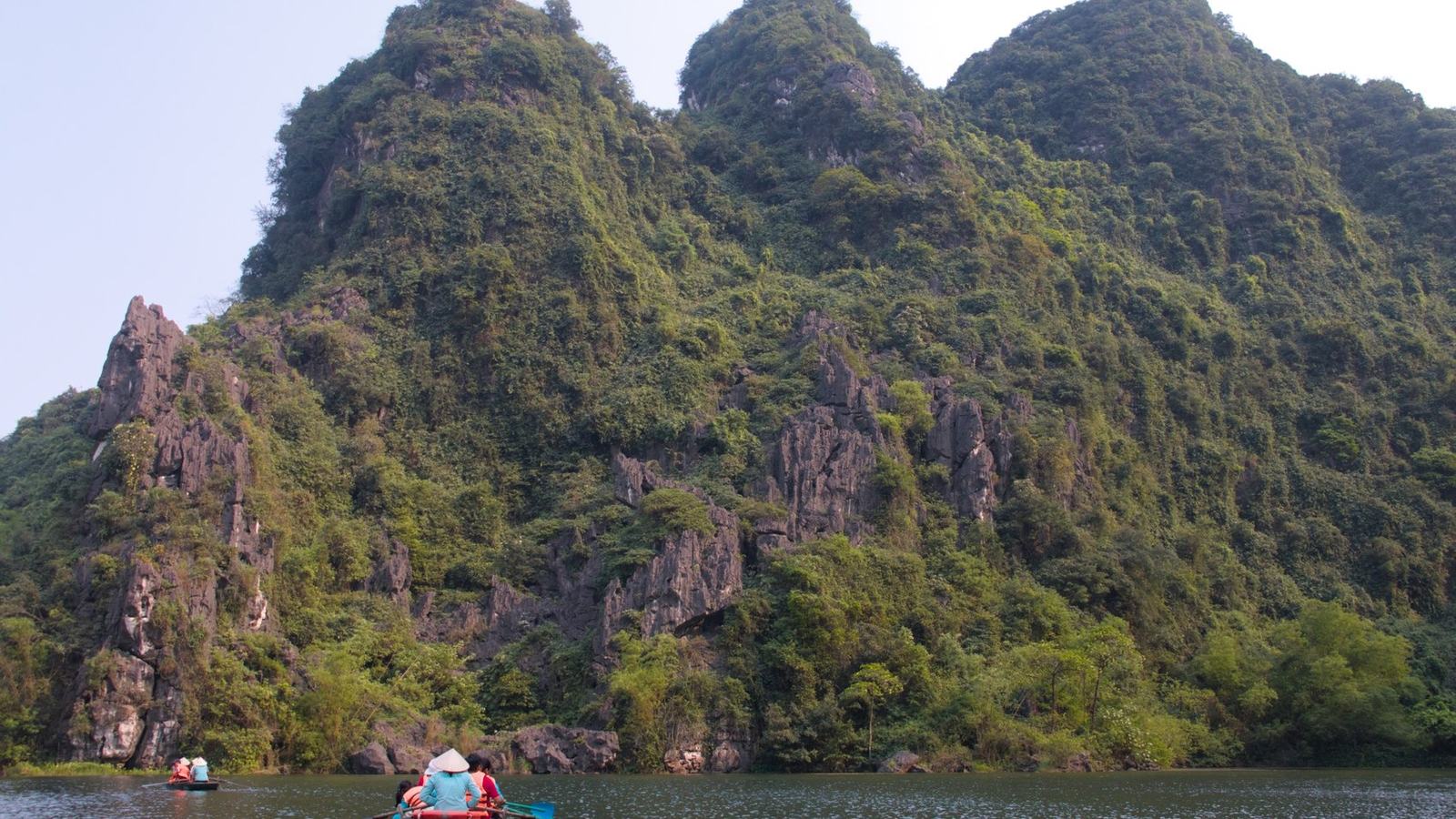
A practical guide to Tràng An’s traditional rowing-boat circuits, cave clearances, historic temples, skilled foot-rowing guides and visitor safety.
In northern Vietnam, the waterways of Tràng An wind between limestone mountains, green valleys and caves in a landscape shaped by water and human history. Rather than being a place where visitors hire a powered boat for independent exploration, the Tràng An experience is organised around traditional rowed sampans operated by local guides. The Vietnam National Authority of Tourism describes the boat tours of Ninh Bình in detail, including the difference between Tràng An and nearby Tam Cốc and the unusual foot-rowing technique used in the region. For the small-boat enthusiast, this is a lesson in how a modest hull and skilled human propulsion can reveal a dramatic landscape without overwhelming it.
A landscape recognised by UNESCO
The Tràng An Landscape Complex gained UNESCO World Heritage status in 2014, reflecting both natural and cultural importance. Vietnam Tourism describes interconnected rivers, lakes, caves and steep limestone karsts extending across a broad protected area. A rowboat is particularly well suited to this scenery because it can pass close to water-level features while travelling slowly enough for passengers to appreciate them. The landscape is not an amusement-park construction. It includes sacred places, ecological habitats and evidence of long human presence. Visitors should understand that the protection of these values is why access follows established routes rather than unrestricted private navigation.
Tràng An is not the same as Tam Cốc
Two names appear repeatedly in visitor advice for Ninh Bình, and it is worth distinguishing them. Tam Cốc offers a shorter, well-established tourist boat experience near the town's visitor area, with rice fields and three celebrated caves. Tràng An lies farther away and is known for longer circuits through protected valleys, caves and historical sites. Vietnam Tourism explains that both have the remarkable local practice of rowing with the feet, but the scenery and itinerary are not identical. Someone planning only one cruise should consider the time available, interest in temples and tolerance for longer periods sitting in a small boat before choosing.
Why a traditional sampan works here
The low wooden or metal visitor boats are moved by local rowers who know the channels and the routes through the caves. Their scale allows passengers to sit close to the surrounding water, with limestone formations rising high above. A larger or faster craft would produce a very different experience and might not suit the constraints of the passages. The boat's design, passenger load and handling are matched to an established tourism route. This is not an invitation to bring a private kayak into any cave visible from the bank. The managed boat system is part of how visitors gain access while staff supervise movement through a sensitive landscape.
Foot rowing is a local skill
Vietnam Tourism highlights a distinctive technique by which local rowers use their feet to move the oars, reducing strain on arms and backs during long days. Watching an expert manage a full boat in this way offers an unexpected lesson in boat handling and adaptation. It is easy for a visitor to regard the technique as a novelty, but it represents considerable coordination and practice. Do not interfere with the rower's rhythm or ask them to perform tricks for a camera. Respect for the guide's work includes keeping weight distributed as instructed and avoiding sudden movements, particularly in a narrow passage where the rower has little room to correct the boat.
Choosing among the three circuits
The official Vietnam Tourism guide describes three principal Tràng An routes with different combinations of caves and cultural stops. One is longer and includes temples such as Trình and Trần, along with several limestone caves. A second route takes visitors to locations including Cao Sơn Temple and the former royal setting of Hành Cung Vũ Lâm. The third combines other caves with cultural sites and a route associated with the filming of a major motion picture. These descriptions are useful planning examples, not a guarantee that every option operates identically on every day. Confirm the actual routes and estimated durations when buying tickets.
Longer is not automatically better
Vietnam Tourism suggests that Tràng An trips can take around two to four hours, depending on route. The most extensive itinerary may appeal to a visitor with strong interest in caves and heritage, but sitting in a small boat for that length of time requires comfortable clothing, sun protection and patience. A family with younger children or a traveller who finds prolonged sitting difficult may prefer a shorter alternative. Do not choose the longest route merely because it appears to include the most attractions. A good boating experience balances scenery and learning against the comfort of the passengers and the practical work performed by the rower.
Low caves require special care
Some of the most memorable passages involve moving through limestone caves where the roof approaches the water. An opening may look spacious from a distance but become much lower inside. Passengers should follow the rower's instructions about posture, hands and luggage, remaining seated throughout. Never reach up to touch rock formations or attempt to stand for a photograph. The operator has experience of the safe line through a passage, while the visitor may not see an overhang until the boat is beneath it. The quiet darkness of a cave is part of the attraction, but it is best enjoyed without interrupting the crew or damaging the geology.
Temples are active cultural places
The Tràng An boat routes connect natural scenery with sacred and historical sites. Vietnam Tourism identifies several temples and pagodas within the circuits, making it clear that the journey is not simply a tour of caves. When passengers disembark at a temple, they should observe local expectations about respectful clothing, footwear and photography. A place of worship is not a prop for a travel photograph. Listen to the guide's explanation and avoid obstructing other visitors who may be there for religious reasons. The most rewarding understanding comes from seeing how the waterways, valleys and sacred sites have influenced one another over time.
The rower sets the working rhythm
Passengers should appreciate that the boat trip is the result of sustained physical work. Rowers may spend hours moving groups along established circuits, managing traffic and landing repeatedly. Be punctual for departures, board only when instructed and do not overload the boat with unnecessary luggage. A request to pause for a photograph should never compromise the route or interfere with other boats in a confined channel. If a visitor wants information about gratuities or local practices, ask the authorised ticketing or guiding team rather than assume an informal payment arrangement. Courtesy towards the person propelling the craft is central to responsible tourism.
Passing other small boats
At popular times, several rowboats may share a channel or wait at a cave entrance. A passenger cannot control the traffic, but can avoid making matters worse by keeping arms and cameras inside the boat and following instructions. Boats may need to pass at close quarters or hold position until a narrow section clears. Sudden shifts in weight can create instability, particularly if everyone leans towards the same photograph. Quiet patience allows the rowers to manage the passage. A short delay can also be a chance to appreciate the view rather than an invitation to complain that the itinerary is running behind schedule.
The weather changes everything
Tropical and subtropical weather can bring bright sun, heavy rain and changing water conditions to Ninh Bình. Even when the route lies inland, a thunderstorm can make a boat excursion unsuitable. Check official local weather information and follow decisions made by the boat operator. Vietnam Tourism advises visitors to wear sunscreen and hats, stay hydrated and follow safety rules, including wearing lifejackets. A waterproof layer may also be useful. Avoid scheduling the cruise so tightly that a weather delay causes a missed onward journey. An honest understanding of conditions improves the experience more than an inflexible demand to complete the route.
Lifejackets are not optional decoration
The official tourism guidance explicitly advises visitors to wear the provided lifejacket. That instruction remains important even when a rowboat is moving slowly across apparently calm water. Ask for a correctly fitting jacket and keep it fastened for the duration recommended by the operator. Children need equipment suited to their size, and adults should avoid placing heavy bags where they block access or interfere with rowing. A passenger who dislikes wearing flotation equipment should not press the rower to ignore the rule. Good safety conduct protects the group and allows the guide to concentrate on navigating the route.
Photography without touching the caves
Tràng An rewards a wide-angle view: a small boat beside towering rock, green water beneath a bridge of stone or light appearing at the far end of a tunnel. Cameras should be secured against splashes, and passengers should remain seated rather than lean over the side. Avoid touching stalactites, plants or cultural objects in the name of creating a picture. A quiet composition can communicate the scale of the setting without an intrusive close-up. Be considerate of other passengers and rowers, especially where boats queue to pass beneath a low ceiling. The best image is not worth damaging a cave or slowing an entire procession.
The value of a slower itinerary
A multi-hour rowboat journey may seem unusually slow to a visitor accustomed to motorised sightseeing. That pace allows the valley to reveal itself gradually. Forested cliffs, small openings in rock and reflections on the water become noticeable because the boat is not travelling at speed. A good visitor uses the time to listen and observe rather than expecting constant commentary or entertainment. The rower has an active responsibility to guide the boat, and continuous requests can be distracting. Allowing the journey to unfold at its intended pace is part of appreciating how the traditional craft fits the protected landscape.
Planning from Hanoi or Ninh Bình
Vietnam Tourism notes that Ninh Bình is roughly 100 kilometres from Hanoi and is popular for weekend excursions. That distance should not encourage an overly rushed itinerary. Travel times depend on the transport chosen, while the boat tour may occupy several hours once check-in and waiting are included. Visitors staying locally have more flexibility to avoid peak periods and adjust for weather. Check the official departure point and route rather than relying on an old map pin that may direct you to Tam Cốc instead. Because the region has several boating experiences, confirming the exact site matters more than simply asking a driver to go to the nearest boat pier.
A distinctive lesson for leisure boaters
Tràng An shows that low-powered boating can be exceptionally rich when the craft, route and operator are all adapted to the landscape. The rower does not compete with the cliffs and temples; the boat permits passengers to see them from a respectful position. With properly fitted lifejackets, realistic scheduling and consideration for sacred sites and local workers, visitors can enjoy a rare connection between water travel and cultural history. The journey is memorable not because it covers a great distance, but because every turn offers a new relationship between rock, water and human ingenuity.
Sources and photograph attribution
Official destination and boating guidance: Vietnam National Authority of Tourism — A Guide to Ninh Bình Boat Tours. Current access, rules, weather and reservations must be checked independently before travel.
Photograph: Benjamin Smith — Trang An - 03.jpg (CC BY-SA 4.0), via Wikimedia Commons. Resized and converted to JPEG for editorial presentation. Source: https://commons.wikimedia.org/wiki/File:Trang_An_-_03.jpg. Licence: https://creativecommons.org/licenses/by-sa/4.0. Original rights remain with the credited creator or as specified by the source and licence.
