
A practical Telemark Canal small-cruiser guide using official lock rules, seasonal opening, passage times, VHF channels, harbours and waste advice.
Norway's Telemark Canal offers something unusual for a small-boat holiday: a navigable route through a sequence of lakes, historic locks and settlements that carries a crew from the coastal region towards the mountainous interior. The official Telemark Canal website publishes a practical guide for leisure boat owners, with information about lock operations, bridge clearance, harbour facilities and navigation. This is not merely a scenic passenger-boat itinerary. Suitable private motorboats can travel the canal under the operator's rules, while kayaks and canoes may also explore sections with appropriate planning. The experience requires patience and real seamanship; passage through multiple locks is as much part of the journey as the scenery.
A route measured in locks and lakes
The canal links Skien with destinations including Dalen and Notodden. According to its official boating information, the route from Skien to Dalen is approximately 105 kilometres, while the route to Notodden is about 80 kilometres. The canal system has eight lock installations comprising eighteen chambers, overcoming a total height difference of roughly 72 metres. Those figures show why it cannot be treated as a quick afternoon cruise. A small cruiser will spend time waiting, moving between locks and enjoying waters that vary considerably in scale. The slow pace is a feature, not an inefficiency to be eliminated by travelling faster.
Vrangfoss as a highlight
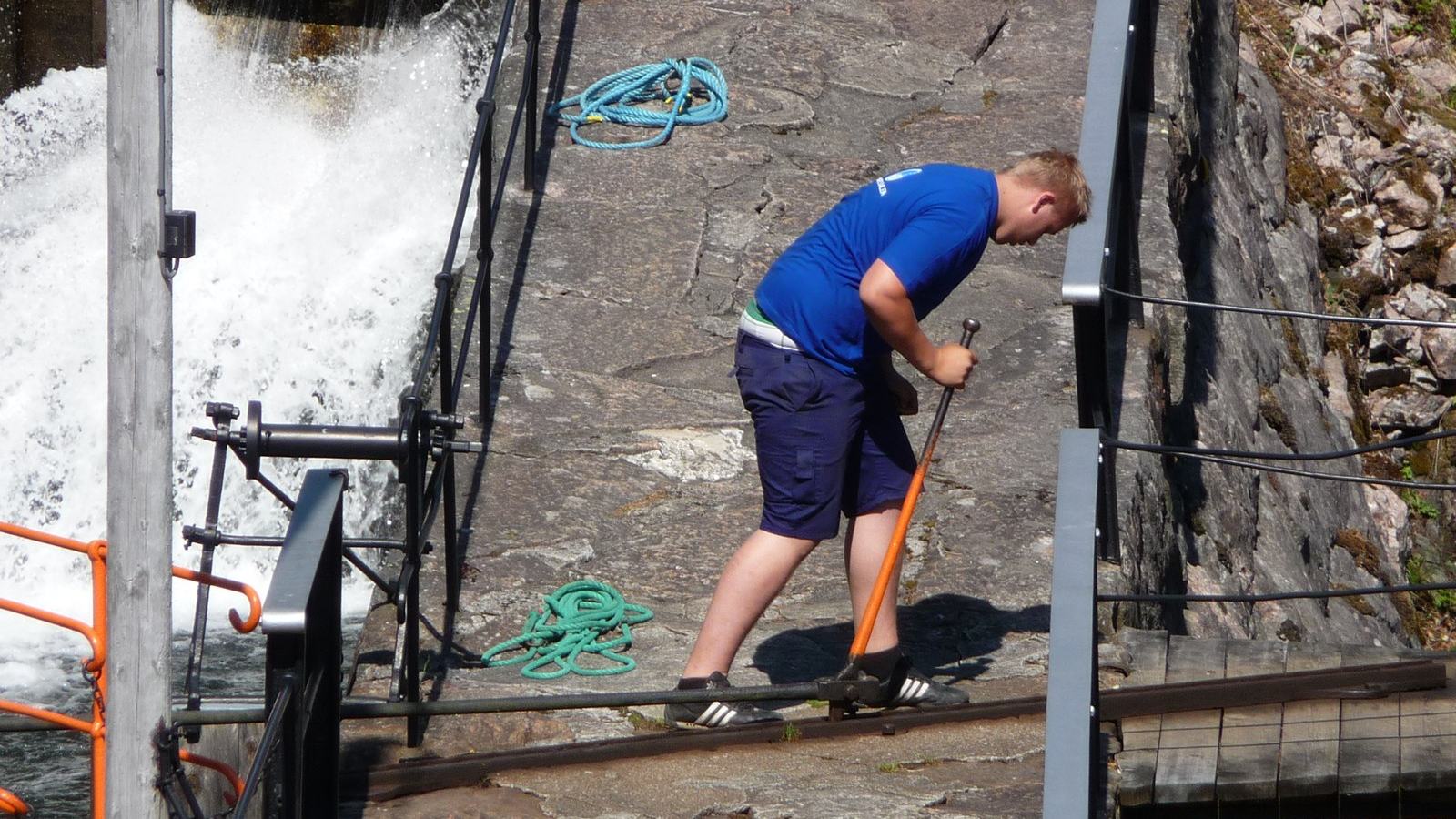
The Vrangfoss lock flight is the largest part of the system, with five chambers that together raise or lower vessels approximately 23 metres. Seeing a small cruiser positioned inside these chambers creates a clear sense of the engineering required to connect the region's lakes. The official canal guidance describes lock work that preserves a substantial element of historic operation, including manually worked gates in the upper canal. For visitors accustomed to modern marina gates, this can be a memorable encounter with industrial heritage. However, it is a working lock rather than a museum demonstration, and every crew must obey the lock keepers' instructions throughout.
The journey is seasonal
The canal authority publishes opening hours that vary by time of year and lock, with the main season centred on summer. A November article must not imply that the full system is operating on an ordinary winter schedule. The published practical guide identifies attended periods in the summer and more restricted arrangements outside that period. Before planning a voyage, consult the current official opening-hours page and confirm exactly which locks are operating. Do not rely on a general tourism description of a summer journey to plan a passage in autumn or early spring. Seasonal weather and daylight are part of the practical assessment as well.
A week is a sensible starting idea
The official guide notes that many people allow at least a week for a return voyage between Skien and Dalen, while a Skien–Notodden return trip typically takes several days. These are examples rather than guarantees: waiting time, weather, harbour stops and the crew's priorities can all change the duration. A family who enjoys walking ashore or visiting towns may prefer a slower itinerary. One of the pleasures of a canal holiday is that the boat does not have to be moved every hour. A plan with free time at locks, guest harbours and small settlements makes the passage less stressful than an aggressive schedule that assumes immediate access everywhere.
Commercial passenger vessels have priority
The canal carries historic passenger boats as well as private craft, and the operator warns that scheduled vessels may receive priority at the locks to maintain their timetables. A private skipper should expect occasional waiting rather than regard the first-come principle as absolute. At busy lock flights, several vessels may need to pass before a small cruiser. Good planning includes food, water, a comfortable waiting arrangement and enough fuel to complete the day without pressure. The skipper should keep a lookout and avoid obstructing approaches while waiting. Congestion is easier to manage when the crew accepts that the canal is shared by different kinds of users.
VHF channel nine at the locks
The official boating guide says that canal locks have VHF communications on channel 9. Before the trip, check that the boat's equipment and operator comply with relevant licensing and communication requirements, and confirm any updated channel instructions with the canal authority. VHF should not be used as a substitute for listening to the lock keeper, nor should a crew make unnecessary transmissions while manoeuvring. If a boat has no suitable radio, contact the operator in advance to establish the permitted alternative procedure. Clear communication is essential where boats are moving through confined chambers, and a misunderstanding can quickly become a safety problem.
Ropes and fenders are essential
Lock passage requires more than an engine capable of moving a boat into position. The authority instructs owners to protect both sides of the hull with suitable fenders and to follow the lock keepers' directions for bow and stern lines. The ropes must be handled so they can move as the water level changes rather than being tied fast in a way that could trap or damage the vessel. The operator also explains that fender boards can be borrowed at certain locks to protect against rough surfaces. A crew unfamiliar with locks should practise clear responsibilities before arrival. One person needs to understand the helm, while others must know how to manage lines safely.
Engines off inside the chamber
The canal's official instructions say that the engine should be switched off once a vessel is in the lock chamber. This is part of a set of rules that also prohibits smoking or open flames there and requires people aboard to wear lifejackets. The combination reflects the confined working environment and the forces involved when water rises or falls. Keep fingers clear of pinch points, do not step ashore without permission and avoid leaning over the rail to adjust a line at an awkward angle. Children should stay well away from working ropes. A lock can be exciting to watch, but safety always takes priority over photographs.
Speed cannot be the objective
Canal water is shared by kayakers, moored boats, residents and passenger vessels. The official guide specifies a maximum speed of five knots in harbour facilities and stresses careful navigation throughout. Even where a vessel could comfortably move faster, excessive wake can disturb smaller craft and damage shorelines. This is a holiday best suited to someone who enjoys travelling slowly. A skipper should learn local limits for each section rather than applying a single assumption to the whole route. Courtesy towards paddlers includes reducing speed in good time and maintaining a safe distance. The pleasure of the landscape is easier to appreciate when the boat is not creating its own problems.
The markers demand attention
The canal publishes specific advice about its route markers and recommends the boating chart for the waterway. The guide warns that individual marker stakes may be displaced and should be interpreted alongside the chart, not followed blindly. Boats should pass through paired markers as directed and keep clear of individual stakes where required. A crew should understand local navigation conventions before entering unfamiliar narrow water. An electronic chart or mobile application may not contain all the detail needed for such a route; the operator notes the importance of its own printed boating chart. Proper preparation is particularly important for owners arriving from open coastal water.
Bridge clearance must be checked
Several bridges impose height limits or have particular opening arrangements. The official canal guidance identifies Frednes and Porsgrunn bridges, among others, and provides instructions about contacting the bridge operator. A small cruiser with a tall canopy, radar mast or aerial needs to know its air draft, not just its overall length. Even a boat that seems compact in a marina can have clearance problems with equipment mounted overhead. Check the current bridge operating procedures and ensure the vessel's actual height is measured accurately. Do not assume a bridge will open whenever requested or that its advertised clearance includes temporary water-level changes.
Fuel planning between harbours
The official guide lists fuel options at locations such as Ulefoss, Norsjø and Dalen, but operators and facilities can change. Fuel availability should be confirmed before departure and built into the route rather than left until the gauge is low. The boat's consumption on slow canal passages may differ from its normal coastal operation, especially after prolonged idling or manoeuvring. Carry sufficient reserve for delays and unexpected changes. Do not store loose fuel containers in unsuitable spaces or refill in a way that creates fire or pollution risk. A successful self-guided cruise depends on ordinary, careful preparation as much as the ability to handle the dramatic locks.
Guest harbours give the journey rhythm
The canal authority identifies guest harbour and waterside service locations along the route, including Ulefoss, Kviteseid, Dalen and other stopping points. Some offer toilets, showers or sewage-disposal facilities, while the exact amenities and opening hours vary. A sensible itinerary uses these stops to rest, explore ashore and manage waste. Do not assume every quay visible on a map accepts overnight visitors. Check current depth, mooring arrangements, fees and local instructions before arrival. A long, narrow craft may need different space from a compact motorboat. Advance research helps ensure that evening brings a pleasant berth rather than a hurried search for a place to tie up.
Protecting drinking water
The canal authority specifically warns that parts of the waterway, including Norsjø, serve as drinking-water sources for local communities. Discharging sewage, rubbish or other waste into the water is prohibited. Skippers should use appropriate holding-tank facilities and shore-based toilets, and arrange rubbish disposal at authorised collection points. These obligations apply regardless of whether a boat is large or small. Even an apparently minor discharge can affect the shared environment when multiplied by the number of visitors. A low-wake cruise should also be a low-impact one. Waste management is an essential part of boating competence, not an optional environmental extra.
The view from a kayak or canoe
The Telemark region also appeals to paddlers who prefer to move at human speed. Visit Norway describes combining paddling with canal-boat transport, making it possible to explore selected stretches without requiring every visitor to row the entire waterway. Such an arrangement needs advance confirmation of vessel transport, schedules and appropriate landing points. Kayaks may have an advantage in shallow places but are especially vulnerable to wakes and changing water flows near locks. Paddlers should never approach a working lock without understanding the authorised procedure. A hybrid holiday involving a passenger boat and short kayak sections may be more appropriate for a novice than an unsupported long-distance expedition.
Historical engineering, present-day recreation
The canal began as a practical transport link for people and goods, connecting communities through difficult inland geography. The contemporary visitor encounters this history in the shape of the locks, the scale of the chambers and the route between lakes. A family holiday can combine a passage through several locks with short walks or cultural visits ashore. The engineering is part of the story, but it should be appreciated from safe positions while the staff work. The site is not a place for visitors to climb machinery or enter restricted areas to obtain a dramatic photograph. Preservation depends on careful operation and considerate behaviour.
Planning a responsible future cruise
A voyage through the Telemark Canal rewards the skipper who checks the current opening season, bridge and lock rules, chart information and harbour facilities before moving the boat. Establish realistic daily distances, carry appropriate fenders and lines, and make sure every passenger understands the safety instructions for a lock chamber. Leave room for the scheduled passenger vessels and do not turn a delay into a race to the next stop. The distinctive attraction of Telemark is the slow connection between coastal water, lakes and Norwegian communities. With patient handling and respect for the canal's historic infrastructure, a modest cruiser can experience a remarkable inland journey without sacrificing safety or care for the waterway.
Sources and photograph attribution
Official destination and boating guidance: Telemark Canal Authority — Practical Information for Leisure Boats. Current access, rules, weather and reservations must be checked independently before travel.
Photograph: JopkeB — Full manual control of Vrangfoss locks in June 2010.jpg (CC BY-SA 4.0), via Wikimedia Commons. Resized and converted to JPEG for editorial presentation. Source: https://commons.wikimedia.org/wiki/File:Full_manual_control_of_Vrangfoss_locks_in_June_2010.jpg. Licence: https://creativecommons.org/licenses/by-sa/4.0. Original rights remain with the credited creator or as specified by the source and licence.
