
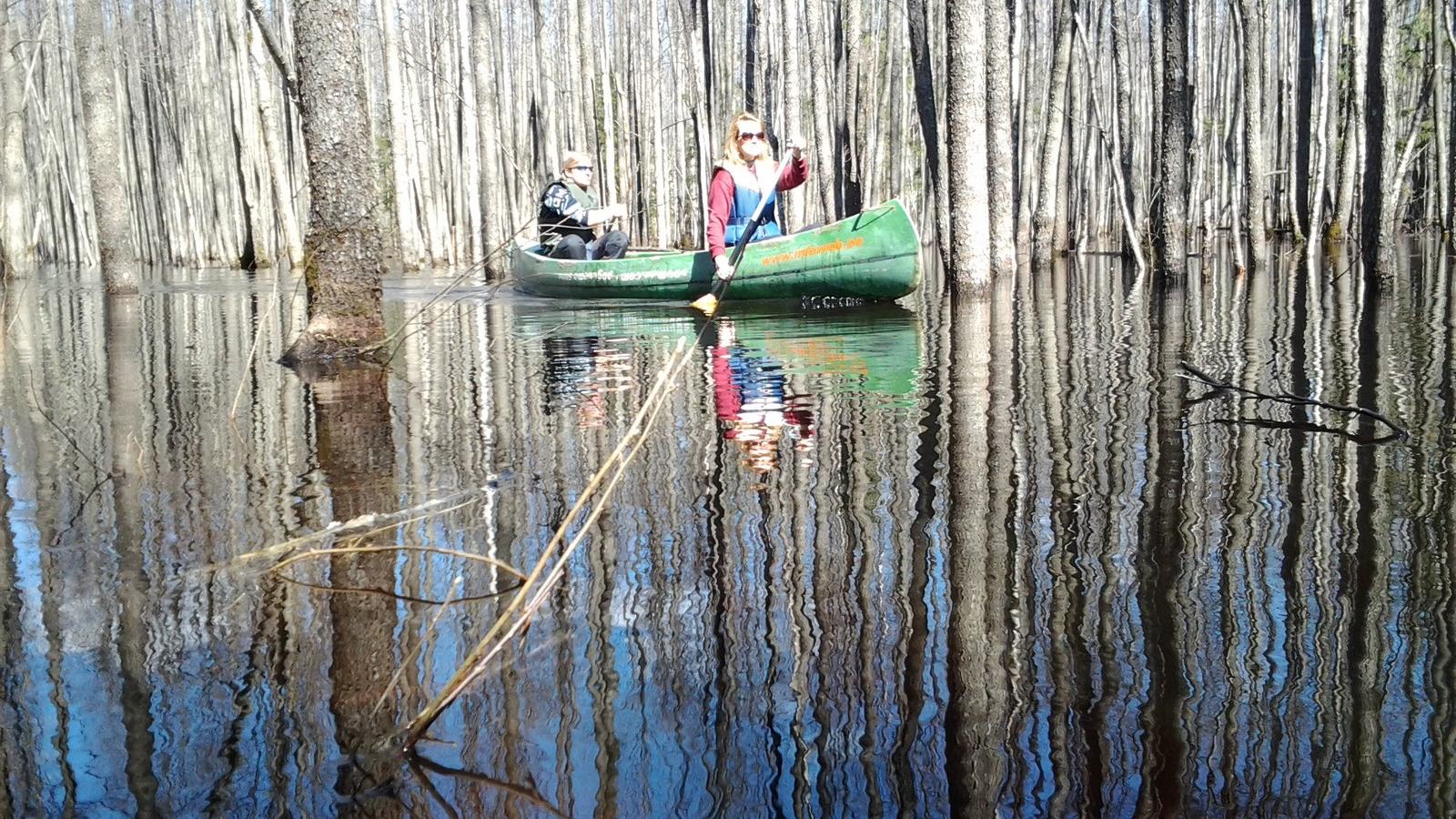
A detailed guide to Soomaa National Park’s fifth-season canoe experiences: flooded forests, traditional dugout boats, safety and future-season planning.
Estonia has four familiar seasons and, in Soomaa National Park, another that depends on water rather than a date on the calendar. During the thaw, rivers spread into forests and meadows, allowing canoes to travel through places that are normally crossed on foot. Visit Estonia calls this spring flood the “fifth season” and describes the experience as one of the country's most unusual paddling journeys. This guide, dated 25 November 2026, is for planning a future spring visit. There is no suggestion that the forests are flooded today, or that a scheduled departure can be booked before the conditions are known. For leisure boaters, the appeal lies in a rare opportunity to observe a wetland at its own pace.
Water changes the map of Soomaa
Soomaa is not one vast permanent lake. The park comprises rivers, bogs, wooded ground and flood meadows whose relationships change with the amount of water flowing through the landscape. Visit Estonia explains that four rivers can overflow their banks during the spring thaw, spreading water across areas which are otherwise dry or only marshy. A canoe therefore experiences an environment whose familiar trails and edges temporarily disappear. It would be misleading to plan a fixed passage through an individual stand of trees simply because an aerial image shows water there. Actual access depends on conditions, conservation rules and the assessment of knowledgeable local operators.
Why locals call it a fifth season
The expression identifies an interlude between winter and spring rather than a permanent fifth entry in the calendar. Visit Estonia places the major spring floods commonly around late March or early April, while warning that the peak cannot be predicted more than a few days ahead. This uncertainty is essential to the experience, not a flaw in the tourism system. A traveller who books long-haul flights to reach an exact “fifth season weekend” months ahead is taking a risk. The sensible approach is to build flexibility into a spring holiday, follow local water reports and treat a guided floodwater paddle as conditional on the actual flood.
The Halliste and its floodplain
The Halliste River and the Tõramaa floodplain appear prominently in Visit Estonia's account of the phenomenon. A guide who knows the river's behaviour may be able to show visiting paddlers how water flows among trees and across open meadows. These are habitats, not a playground filled with obstacles to race around. Tall grasses, submerged branches and changes of depth can make the route technically demanding, even where the water looks nearly still. For anyone bringing a privately owned canoe, a photographed route cannot replace current local knowledge. A conventional river trip outside the flood peak may be the more suitable alternative if conditions are uncertain.
A canoe makes room for observation
Part of the attraction is the very modest speed of a hand-propelled craft. The view is not restricted to a distant bank: paddlers may find themselves looking between tree trunks, hearing birds above the water and noticing how vegetation emerges from shallow flooded ground. The official Visit Estonia story emphasises the stillness and silence of the flooded forest, including the extraordinary experience of moving through an apparently familiar woodland without a path. Silence is not guaranteed, of course; a group still has to communicate and other visitors may share the route. But a thoughtful paddle needs little equipment beyond a suitable boat and a competent, prepared crew.
The traditional haabjas
Soomaa has a distinctive heritage of single-log dugout canoe construction, known in Estonian as the haabjas. Visit Estonia connects this craft with the region's flood culture, and the UNESCO-recognised knowledge of building and using such vessels gives the journey a cultural dimension beyond outdoor recreation. A modern rental canoe is not the same thing as a traditional dugout; their designs, handling and purpose differ. A traveller interested in the tradition should seek a genuine demonstration or interpretation rather than assuming every paddling operator teaches boatbuilding. Respecting local expertise is part of understanding why river travel and flooded landscapes are so intertwined here.
Guided or independent travel
Visit Estonia lists guided canoe and kayak experiences during the fifth season as well as other trips available at different times of year. Guided travel makes particular sense in a landscape where routes change quickly and a small lapse in judgement may leave paddlers uncertain of the return channel. Independent paddlers need more than ordinary proficiency on a placid lake. They should understand the local waterways, obtain current guidance, assess rescue and communications options and avoid protected or hazardous areas. A guide may also know where wildlife is likely to be disturbed, allowing the group to enjoy the surroundings without inadvertently treating sensitive nesting or feeding places as a route.
Cold spring air matters
Visit Estonia's account describes March conditions that can be barely above freezing by day and below freezing overnight. A capsize in cold floodwater can create an urgent safety problem even if the paddler was comfortably warm while standing on shore. Clothing should be chosen for immersion risk rather than an optimistic forecast, and every person needs an appropriate personal flotation device. A spare layer kept dry in a sealed bag can be useful after the outing. Paddlers should also carry a reliable means of contacting help and understand whether mobile reception can be expected in the intended area. Cold conditions demand conservative route choices, especially with inexperienced participants.
Flooding is not permission to go anywhere
When water covers a meadow or forest, a paddler might assume that the entire surface is open to navigation. It is not. National-park restrictions, private property and protected wildlife areas still matter when ordinary paths are underwater. The ethical choice is to use recognised routes with up-to-date local guidance, keep clear of structures and avoid damaging plants with paddles or boat hulls. Flooded meadows can hide fences, debris and irregular ground. A person stepping from a canoe into shallow-looking water may encounter unexpected hazards. Remaining aboard and following the established plan is often safer and less damaging than improvising an attractive landing spot.
Respect for the people who live there
The fifth season is a tourism attraction, but for local residents it is also a real flood affecting access and routine life. Visitors should not block roads, gates or emergency access in pursuit of an interesting photograph. If a route is closed or an operator says it is unsafe, the decision should be accepted without argument. The local knowledge which enables a safe guided journey has developed through years of living with the rivers. Paying attention to that knowledge is more respectful than seeking a dramatic crossing that creates problems for rescue services or landowners. A quiet, well-organised visit supports tourism without increasing the burden of a challenging season.
Photographing a flooded forest
Soomaa's temporary landscape offers unusual compositions: trees standing in water, reflections crossing a meadow and familiar woodland forms seen from the low height of a canoe. These do not require a photographer to steer into branches or stand up in a moving boat. Keep the camera secure, use equipment that tolerates splashes and ask the guide before stopping in a narrow passage. A wide view may better communicate the scale of flooding than an extreme close-up of a single trunk. Photographs should also be captioned accurately so readers can distinguish a spring flood from the park's normal summer appearance.
Keeping the experience small-scale
A successful family outing is not necessarily a long one. A suitable guided group, a clear meeting point and a manageable period on the water can allow children and adults to learn without becoming cold or tired. Parents should check minimum ages, boat configuration and the availability of correctly sized flotation equipment with the operator. Some spring flood routes may not be suitable for beginners, regardless of whether the boats are tandem canoes or kayaks. A group with mixed skill levels should select the option appropriate to its least experienced participant. There is no reason to press on merely to complete a route advertised for stronger paddlers.
A holiday needs alternative plans
The flood's unpredictability means that a trip to Soomaa should not depend on one canoe booking. Visit Estonia highlights the park's walking opportunities, visitor facilities and other activities in the surrounding area, though flooding can temporarily close or change access to those too. A sensible itinerary includes time in the wider region and options that can work with different weather. If the flood peak is missed, the rivers and bog landscapes may still reward a carefully planned visit. The guiding principle is to respond to the place as it is, not expect nature to perform according to an airline ticket.
Wildlife without intrusion
The park's rivers and flood forests are habitat for birds and other animals whose behaviour changes with season and water. A kayak's lack of engine noise does not make it invisible. A group can still disturb wildlife by approaching too closely, calling to attract attention or lingering near an animal's refuge. Keep a respectful distance and follow the guide's advice about sensitive places. Do not feed animals, collect plants or take natural objects away. A short observation made without interference can be more meaningful than an extended encounter created by making an animal uncomfortable. Responsible paddling protects the very characteristics that make Soomaa worth visiting.
Practical details to confirm first
Check the current Visit Estonia material and the operator's own published requirements before travelling. Establish whether the trip is genuinely running, how the route is chosen, whether equipment is provided, what clothing is required and what happens if the flood fails to reach navigable levels. Ask about duration, transport to the launch and language of instruction. Know how to cancel or change a booking, and do not rely on a programme described during a previous spring. Anyone planning to bring a personal canoe should confirm local access and conservation rules rather than assuming a commercial guide's arrangements automatically cover private visits.
The reward is learning to follow the water
Soomaa's fifth season is a reminder that some of the richest leisure-boat experiences cannot be made available on demand. The river sets the conditions, the landscape changes and the best route may be the one that a local guide selects on the morning of departure. A short canoe passage through flooded woodland can offer a sense of place far beyond the distance travelled. By choosing a suitable season, respecting local residents and wildlife, carrying equipment for cold water and keeping plans flexible, visitors can appreciate the temporary world that gives southwest Estonia its unusual fifth season.
Sources and photograph attribution
Official destination and boating guidance: Visit Estonia — The Fifth Season: Paddling Through Time in Soomaa. Current access, rules, weather and reservations must be checked independently before travel.
Photograph: Ruukel — Karuskose lammimets Soomaal.jpg (CC BY-SA 4.0), via Wikimedia Commons. Resized and converted to JPEG for editorial presentation. Source: https://commons.wikimedia.org/wiki/File:Karuskose_lammimets_Soomaal.jpg. Licence: https://creativecommons.org/licenses/by-sa/4.0. Original rights remain with the credited creator or as specified by the source and licence.
