
An unhurried canoe or kayak escape on North Carolina’s Lake Waccamaw, combining quiet water, wetland wildlife and distinctive Carolina bay ecology.
Lake Waccamaw is an unusual place for a small-boat holiday, not because it requires a powerful vessel or an ambitious voyage, but because its landscape has a distinctive natural story. The lake lies in Columbus County, North Carolina, within a state park that protects part of one of the region's remarkable Carolina bays. The North Carolina Division of Parks and Recreation describes a broad natural lake surrounded by woodland, trails and habitat for rare aquatic species. Visitors can paddle, fish, walk and spend time on the shore, with boat access provided through park and other public facilities. A canoe or kayak is a fitting way to experience the setting, as long as the trip is planned around local rules, the weather and the paddler's actual ability. The appeal is an outing with enough space for a feeling of escape and enough natural interest to justify slowing down.
A lake with a story beneath the water
Carolina bays are elliptical landscape features found across parts of the Atlantic coastal plain. Many are wet depressions or vegetated areas rather than broad lakes, but Lake Waccamaw remains an open body of water. The state park explains that the region contains an extraordinary number of these formations and that the lake is among the unusual examples with permanent open water. Its chemistry also matters. The park identifies an underlying limestone bluff that moderates acidity, allowing a distinctive range of aquatic life. Those details give the water an ecological importance extending beyond scenery. For a paddler, the main lesson is that this is not simply another pleasant freshwater lake. It is part of a sensitive natural system, and a good visit should avoid disturbing shorelines or aquatic vegetation.
What a canoe reveals
A canoe travels at a pace that encourages attention. From the water, tree lines, changing reflections and the movement of birds can feel more immediate than they do from a road or a crowded viewpoint. A touring kayak offers a similarly low perspective, while the shape and capacity of a canoe may appeal to someone who prefers a little more space for modest day-trip equipment. Neither type is automatically suitable for every condition. A long, open stretch of water can develop waves that are troublesome for an inexperienced crew. The most satisfying route is often a short journey along an accessible shore with time to stop and observe, rather than an attempt to cross the entire lake because it looks manageable on a map.
Launch planning at the state park
North Carolina State Parks lists paddling and fishing among the principal activities at Lake Waccamaw, and identifies a boat ramp among the park's facilities. It also notes a separate boat ramp managed by the North Carolina Wildlife Resources Commission on the northwest side of the lake. This gives visitors choices, but the existence of two access points should not be taken as a guarantee that both are suitable for a particular trailer or paddling craft on every day. Before travelling, check the official park map, access conditions and any current operating notices. Different launching arrangements may be more convenient for a canoe than for a motorboat. Allow time to unload safely, check the craft and keep the ramp clear for other users.
Understanding the open-water conditions
The lake's broad surface means that wind has room to build waves, even though it is inland and surrounded by forest. A small canoe may be quite comfortable in calm water yet become difficult to handle when wind rises across an exposed reach. Paddlers should assess wind direction, speed and forecast changes before launch and avoid assuming that conditions near a sheltered ramp reflect the rest of the lake. The temperature of the water also matters. A warm afternoon does not guarantee that immersion will be safe, especially outside summer. Properly fitted flotation equipment and suitable clothing are essential. A cautious visitor can enjoy the shore in good weather and choose walking or wildlife observation instead of launching when conditions are less favourable.
The park's lakeside facilities
One attraction of a state-park holiday is the possibility of combining boating with several simple activities. Lake Waccamaw State Park offers walking trails, picnicking, fishing and interpretive facilities alongside its water access. Visitors can enjoy the lake without being aboard a boat for the entire day. That makes it suitable for a mixed group in which some people want to paddle and others would prefer a shoreline walk or time near the visitor centre. As with any managed park, facilities and hours should be checked before travel. The official state-park page provides current information on entrances, amenities and seasonal opening times. A travel feature should not invent a specific rental programme, guided paddle or campsite vacancy if none has been confirmed.
A shoreline walk changes the perspective
Walking after a paddle can reveal details that are less obvious from the water. North Carolina State Parks describes an extensive shoreline landscape, including a pedestrian bridge over Waccamaw Dam that makes an around-the-lake walking connection possible. The exact route a visitor can use depends on current access and trail information, and this should not be interpreted as a promise of a short or fully accessible circuit. A brief shore visit can be as rewarding as a longer hike, especially for travellers interested in vegetation, birdlife or the patterns of light across the lake. Changing activities also offers a sensible break when paddlers have spent time in sun or wind and need to rest before continuing their day.
The importance of protecting rare species
Lake Waccamaw is notable for aquatic organisms associated with its unusual water chemistry and natural setting. That gives visitors a particular responsibility to prevent avoidable harm. Do not drag boats across fragile vegetation, disturb shoreline habitat or release bait, aquarium organisms or other species into the water. Clean and dry equipment appropriately when moving between lakes to reduce the spread of aquatic invasive organisms. The park's current regulations and conservation information provide the authoritative basis for specific restrictions. For a recreational paddler, the broad principle is simple: enjoy being close to the habitat without assuming that the ability to reach it gives permission to interfere with it. A small craft can make observation intimate while leaving the environment intact.
Photographing a quiet freshwater landscape
A lake with open water and wooded margins can be rewarding to photograph, particularly when the surface reflects changing skies. The state park's official gallery includes images of a pier, water, trees and birdlife, illustrating the range of scenery available from public areas. A visitor carrying a camera in a canoe should secure it against water and loss and avoid turning suddenly or leaning dangerously in pursuit of a shot. It is better to take photographs from a stable position or after returning ashore. Respect other visitors who may be fishing or enjoying the water quietly. The best image of a lake often comes from patience, not from trying to approach an animal or a difficult shoreline at any cost.
A low-key family outing
A relaxed day can begin with a walk at the park, followed by a short paddle if conditions and experience allow. Children may enjoy seeing the view from a canoe, but their comfort, supervision and suitable flotation equipment should determine the plan. Avoid promising them a distant destination that makes the return difficult or leaves no flexibility for tiredness. Packing water, sun protection, a change of clothing and a simple picnic can help preserve the pleasure of the trip. The group should also have a clear agreement about when to return and what to do if the weather changes. An outing built around a few manageable experiences can be more satisfying than one overloaded with activities.
Fishing and other water users
The lake attracts people for fishing as well as paddling. Different activities can coexist when everyone respects the space needed by others. A kayak should not pass too close to an angler's line or force another vessel into an awkward manoeuvre simply to take the shortest route. Powered boats should manage speed and wake responsibly where smaller craft are present. Fishing rules, licences and any applicable boating requirements should be checked with North Carolina's responsible authorities. A park listing fishing as an activity does not give blanket permission to fish without regard to seasons, species or limits. Responsible boating includes the courtesy of understanding how other visitors use the water and allowing them to enjoy it safely.
Visiting without owning equipment
A visitor arriving from another part of the country may wonder whether it is necessary to bring a canoe. The state park's public information establishes the availability of water access and paddling as an activity, but it does not guarantee that a kayak, canoe or paddleboard can be rented directly from the park on a given date. Any rental arrangement should be checked separately with an authorised local provider. When considering a hired craft, ask about the operating area, any restrictions, the equipment included and the minimum skill level expected. A small-boat holiday can be accessible without boat ownership, but it should not be based on assuming that every visitor facility includes a rental service.
The timing of a visit
The park publishes daily opening hours that vary with the season, and its day-use information indicates that ordinary entry is generally free, with separate charges potentially applying to camping and certain reservations. A visitor should use the current official schedule and fee information when planning. Late autumn and winter may offer attractive quiet periods, but colder water and shorter daylight require more caution. Summer may bring longer days but also heat, thunderstorms and busier access points. There is no universal best season for everyone. The correct choice depends on the kind of outing desired and the conditions expected. Keeping a flexible date or an alternative activity can make the trip more enjoyable.
Respecting the wider community
Lake Waccamaw is not an isolated recreation set. It is part of a landscape used by local residents, anglers, walkers and people who work to protect its natural environment. Visitors should follow posted directions, park only where permitted and avoid creating unnecessary disturbance at launch points. Carry rubbish away and use designated facilities. Someone travelling with a pet must check and respect the park's leash and building rules. A quiet outing can be a welcome contrast to a busy week, but it should remain quiet for the people who live nearby too. A small boat is well suited to this considerate kind of travel because it allows a visit to be slow and observant rather than driven by speed and spectacle.
Official photography and travel information
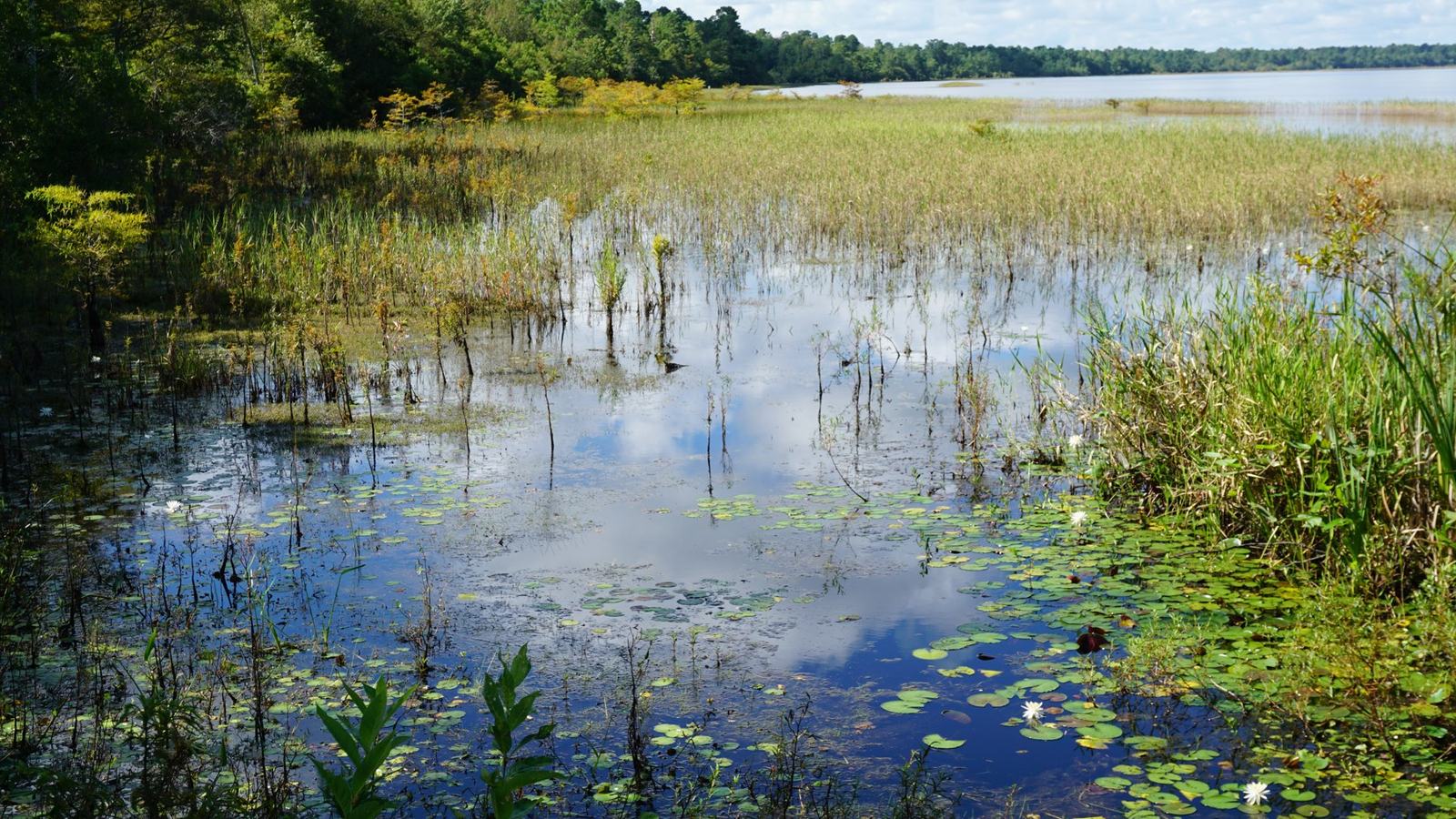
The lead image is an authentic photograph of Lake Waccamaw State Park's fringe wetland made available by ncwetlands.org under the Creative Commons Zero public-domain dedication, with its Wikimedia Commons record retained as rights evidence. It documents the actual location rather than an unrelated lake or a generated illustration. The primary source is the state's current Lake Waccamaw State Park information page, which confirms paddling, fishing, walking, boat access and the distinctive ecological background. Operational arrangements may change, and the park should be consulted directly for the latest notices, opening hours, conditions and regulations. The photo illustrates the landscape in which a paddler would travel; it is not a claim that a particular guided paddle or rental session is being offered today.
A different kind of boating escape
Lake Waccamaw shows how a small-boat holiday can combine natural curiosity with simple recreation. The lake's unusual chemistry and ecological importance provide a reason to learn about the place rather than treat it as interchangeable with any other stretch of freshwater. A short, carefully planned paddle may be enough to see reflections, watch wildlife and enjoy the quiet margins. The surrounding state park adds opportunities for a walk, picnic and further discovery when the canoe is back on land. For visitors who appreciate low-impact travel, the strongest memory may be how little equipment was needed to feel immersed in a distinctive environment. The right craft, good weather and respect for the lake are more important than covering great distances.
Sources and photograph attribution
Official destination and boating guidance: North Carolina State Parks — Lake Waccamaw State Park. Current access, rules, weather and reservations must be checked independently before travel.
Photo: ncwetlands.org, Lake Waccamaw State Park fringe wetland, CC0 1.0 public-domain dedication, via Wikimedia Commons. Source: https://commons.wikimedia.org/wiki/File:Scene_fringe_wetland_Lake_Waccamaw_State_Park_ncwetlands_KG_(3).jpg. Licence: https://creativecommons.org/publicdomain/zero/1.0/. Original rights remain with the credited creator or as specified by the source and licence.
